

Gunmen abduct senior judge, torch court in Pakistan’s Balochistan — police

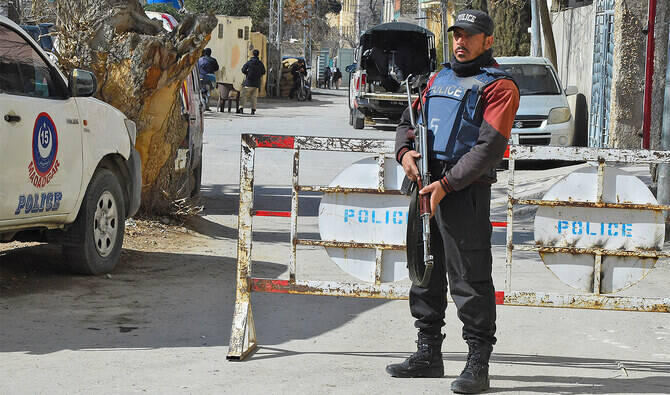
Policeman stands guard in Quetta, Pakistan, on February 5, 2024. (AFP/File)
Short Url
Updated 07 October 2025
Follow

Gunmen abduct senior judge, torch court in Pakistan’s Balochistan — police

  • Armed men attack lower court in Kharan district’s Maskan Kalat area, take judge hostage
  • Balochistan is facing intensifying separatist attacks targeting officials and infrastructure

QUETTA: Gunmen this week kidnapped a senior judge and set fire to a lower court in Pakistan’s southwestern province of Balochistan, police said on Tuesday.

The attack took place in the Maskan Kalat area of Kharan district while court hearings were underway. Armed men stormed the premises, ransacked records, destroyed furniture and briefly held court staff hostage before abducting Judge Qazi Ahmed Jan, according to police.

Balochistan, Pakistan’s largest but least-developed province, has for years faced a separatist insurgency that has intensified recently, with militants increasingly targeting security personnel, government offices, infrastructure and non-local residents.

In the latest attack, unidentified gunmen attacked the court on Monday morning, Deputy Inspector General of Police Abdul Haye Amir Baloch said.

“The gunmen set the court on fire and kidnapped a senior judge Qazi Ahmed Jan while he was inside the court and hearing the proceedings,” Baloch told Arab News.

“Search operation is continuing for the safe recovery of the kidnapped judge,” he added. “Police and other law enforcement agencies are pursuing the kidnappers.”

No group has claimed responsibility for the attack and it is unclear if it was a militant attack.

This is not the first time a judge has been abducted in Pakistan. Last year, suspected militants kidnapped Judge Shakirullah Marwat in northwestern Khyber Pakhtunkhwa province while he was traveling from his hometown to Dera Ismail Khan. Marwat was later released. 

Islamabad has for years accused India of supporting militant groups to foment unrest in Pakistan, an allegation New Delhi denies.

Balochistan, rich in minerals and home to key China-Pakistan Economic Corridor routes and projects, has seen several high-profile attacks this year, including the hijacking of a passenger train in March and a May suicide bombing in Khuzdar that killed several children traveling to school. 


Pakistan, global crypto exchange discuss modernizing digital payments, creating job prospects 

Updated 05 December 2025
Follow

Pakistan, global crypto exchange discuss modernizing digital payments, creating job prospects 

  • Pakistani officials, Binance team discuss coordination between Islamabad, local banks and global exchanges
  • Pakistan has attempted to tap into growing crypto market to curb illicit transactions, improve oversight

ISLAMABAD: Pakistan’s finance officials and the team of a global cryptocurrency exchange on Friday held discussions aimed at modernizing the country’s digital payments system and building local talent pipelines to meet rising demand for blockchain and Web3 skills, the finance ministry said.

The development took place during a high-level meeting between Finance Minister Muhammad Aurangzeb, Pakistan Virtual Assets Regulatory Authority (PVARA) Chairman Bilal bin Saqib, domestic bank presidents and a Binance team led by Global CEO Richard Teng. The meeting was held to advance work on Pakistan’s National Digital Asset Framework, a regulatory setup to govern Pakistan’s digital assets.

Pakistan has been moving to regulate its fast-growing crypto and digital assets market by bringing virtual asset service providers (VASPs) under a formal licensing regime. Officials say the push is aimed at curbing illicit transactions, improving oversight, and encouraging innovation in blockchain-based financial services.

“Participants reviewed opportunities to modernize Pakistan’s digital payments landscape, noting that blockchain-based systems could significantly reduce costs from the country’s $38 billion annual remittance flows,” the finance ministry said in a statement. 

“Discussions also emphasized building local talent pipelines to meet rising global demand for blockchain and Web3 skills, creating high-value employment prospects for Pakistani youth.”

Blockchain is a type of digital database that is shared, transparent and tamper-resistant. Instead of being stored on one computer, the data is kept on a distributed network of computers, making it very hard to alter or hack.

Web3 refers to the next generation of the Internet built using blockchain, focusing on giving users more control over their data, identity and digital assets rather than big tech companies controlling it.

Participants of the meeting also discussed sovereign debt tokenization, which is the process of converting a country’s debt such as government bonds, into digital tokens on a blockchain, the ministry said. 

Aurangzeb called for close coordination between the government, domestic banks and global exchanges to modernize Pakistan’s payment landscape.

Participants of the meeting also discussed considering a “time-bound amnesty” to encourage users to move assets onto regulated platforms, stressing the need for stronger verifications and a risk-mitigation system.

Pakistan has attempted in recent months to tap into the country’s growing crypto market, crack down on money laundering and terror financing, and promote responsible innovation — a move analysts say could bring an estimated $25 billion in virtual assets into the tax net.

In September, Islamabad invited international crypto exchanges and other VASPs to apply for licenses to operate in the country, a step aimed at formalizing and regulating its fast-growing digital market.