

Karachi crowds gather on beaches as first supermoon of 2025 brightens night sky

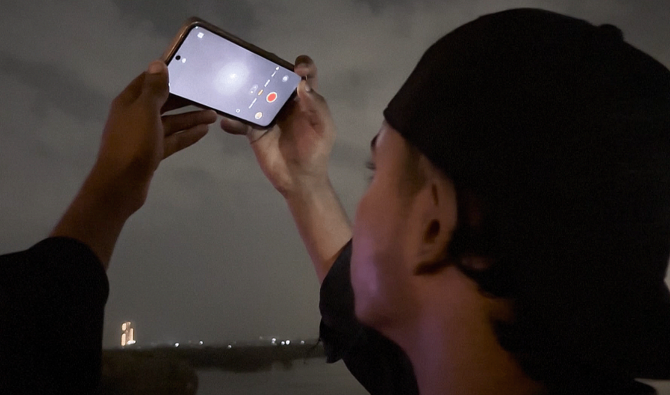
Screengrab taken from a video shared by Reuters on October 7, 2025, showing a man taking a picture of “Harvest Supermoon” in Karachi, Pakistan.
Short Url
Updated 07 October 2025
Follow

Karachi crowds gather on beaches as first supermoon of 2025 brightens night sky

  • Pakistan’s space agency says the October supermoon appeared larger and brighter than usual
  • The brightest supermoon of the year will appear in November as the moon moves closer to Earth

KARACHI: A “Harvest Supermoon,” one of the year’s largest and brightest celestial events, lit up the skies over Pakistan’s port city of Karachi on Monday night, drawing crowds eager to photograph the glowing lunar spectacle from beaches and waterfronts.

The phenomenon occurs when a full moon coincides with the moon’s closest point to Earth in its elliptical orbit — a position known as perigee — making it appear noticeably larger and brighter.

According to Pakistan’s national space agency SUPARCO, the October supermoon was about 6.6 percent larger and 13 percent brighter than an average full moon, reaching its peak at 8:47 p.m. local time (0347 GMT).

Residents flocked to popular viewing spots such as Sea View and Clifton Beach, where the moon rose above the Arabian Sea and cast a golden reflection across the water.

“It’s not every day you get to see this view,” said Umair Aslam, a Karachi resident. “This opportunity only comes once a year, so we came to enjoy the season, see the supermoon, and take some selfies.”

“We had an amazing time,” he added.

Another local, Mohammad Qaisar, said the sight drew nature enthusiasts from across the city.

“For those who love nature and keep their eyes on the sky, the first supermoon of 2025 was a deeply charming event,” he said. “It brought great happiness to everyone who witnessed it over Karachi.”

SUPARCO said this was the first of three supermoons expected in 2025, with the next two forecast for November 5 and December 5.

The brightest supermoon of the year is expected in November, when the moon will come as close as 221,817 miles (357,067 kilometers) to Earth, offering another luminous spectacle for skywatchers worldwide.


Pakistan, Afghanistan border clashes kill 5, officials say

Updated 3 sec ago
Follow

Pakistan, Afghanistan border clashes kill 5, officials say

  • Afghanistan and Pakistan trade blame for “unprovoked firing” along Chaman-Spin Boldak border
  • Exchange takes place nearly a week after a fresh round of peace talks between neighbors failed

KABUL: Pakistan and Afghanistan exchanged heavy fire along their border late on Friday, officials from both countries said, killing at least five people amid heightened tensions following failed peace talks last weekend.

Afghan Taliban spokesman Zabihullah Mujahid said Pakistani forces launched attacks in the Spin Boldak district of Kandahar province.

His deputy Hamdullah Fitra told Reuters that shelling by Pakistan killed five people, including a Taliban member.

A spokesman for Pakistan’s prime minister said Afghan forces carried out “unprovoked firing” along the Chaman border.

“Pakistan remains fully alert and committed to ensuring its territorial integrity and the safety of our citizens,” spokesman Mosharraf Zaidi said in a statement.

The exchange came nearly a week after a new round of peace talks between the South Asian neighbors ended without a breakthrough, although both sides agreed to continue their fragile ceasefire.

The talks in Saudi Arabia last weekend were the latest in a series of meetings hosted by Qatar, Turkiye and Saudi Arabia to cool tensions following deadly border clashes in October.

At the heart of the dispute, Islamabad says Afghan-based militants have carried out recent attacks in Pakistan, including suicide bombings involving Afghan nationals. Kabul denied the charge, saying it could not be held responsible for security inside Pakistan.

Dozens were killed in October’s clashes, the worst violence on the border since the Taliban took power in Afghanistan in 2021.