JERUSALEM: Numbers alone cannot capture the toll the Israel-Hamas war has taken on the Gaza Strip.
But they can help us understand how thoroughly the conflict has upended the lives of 2.1 million Palestinians living in the territory and decimated the territory’s 365 square kilometers (140 square miles).
Out of every 10 people, one has been killed or injured in an Israeli strike. Nine are displaced. At least three have not eaten for days. Out of every 100 children, four have lost either one or both parents. Out of every 10 buildings that stood in Gaza prewar, eight are either damaged or flattened. Out of every 10 homes, nine are wrecked. Out of every 10 acres of cropland, eight are razed (more than three out of every four hectares).
The war began when Hamas militants launched a surprise attack on Israel on Oct. 7, 2023, killing some 1,200 people, mainly civilians, and taking 251 hostages back to Gaza.
In response, Israeli leaders promised a punishing offensive on the strip to annihilate Hamas and free the hostages.
Here’s a closer look at the devastation that followed, by the numbers.
Roughly 11 percent of Gaza’s population has been killed or injured
Cemeteries are overflowing. Mass graves dot the strip. Israeli airstrikes have killed entire families in their homes. More than 2,000 people seeking food have been killed, according to Gaza’s Health Ministry. In some cases Israel has acknowledged firing warning shots at chaotic crowds attempting to obtain desperately needed aid.
Israeli attacks on health care facilities and limitations on the entry of medical supplies have left overwhelmed doctors to treat advanced burn victims with rudimentary equipment. Israel says it strikes hospitals because Hamas operates in them and uses them as command centers, though it has offered limited evidence. Hamas security personnel have been seen in hospitals and have kept some areas inaccessible. Israel has said restrictions on imports are needed to prevent Hamas from obtaining arms.
The war is the deadliest conflict for journalists, health workers and UN aid workers in history, according to the Committee to Protect Journalists and the UN The British Medical Journal says the prevalence of patients with injuries from explosives in Gaza compares to data on injured US combat forces in Iraq and Afghanistan.
In all, Israel’s campaign has killed more than 67,000 Palestinians and wounded nearly 170,000, according to Gaza’s Health Ministry. More than 40,000 of those wounded have life-altering injuries, according to the World Health Organization.
The death toll does not include the thousands of people believed buried under the rubble. The ministry — part of the Hamas-run government and staffed by medical professionals — does not distinguish between civilians and combatants in its count. Its figures are seen as a reliable estimate by the UN and many independent experts.
Israel blames Hamas for the high civilian toll, saying the group’s presence in residential areas has turned the population into human shields. Still, its strikes often hit homes, killing many inside with no word of who the target was.
Nearly the entire population is displaced and thousands are missing
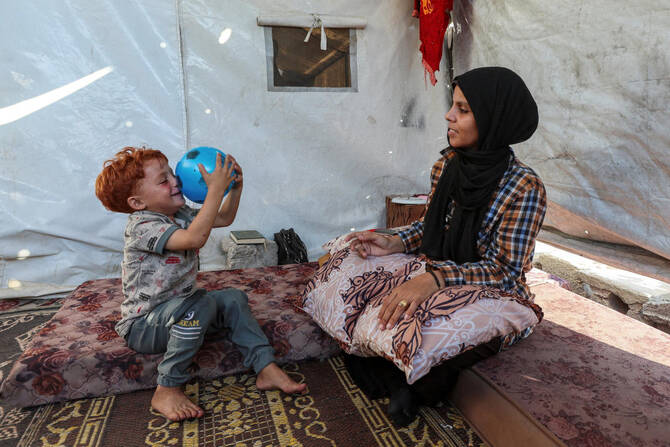
Countless Palestinian families have fled the length of Gaza and back, forced to move every few months to dodge successive Israeli offensives. Many have been displaced multiple times, moving between apartments and makeshift tent camps as they try to survive. Squalid tent cities now sprawl across much of Gaza’s south.
Displacements have separated families. Heavy bombardment has left thousands buried under the rubble. Troops round up and detain men, from dozens to several hundreds at a time, searching for any they suspect of Hamas ties. The result is families split apart.
Israel occupies the vast majority of Gaza
Israel’s military has gained control of the vast majority of Gaza, pushing most of the Palestinian population to a small zone along the southern coast. Under Israeli control, Gaza’s land has been transformed. Forces have flattened or bulldozed entire neighborhoods of Gaza City and small agricultural towns dotting the border, carved new roads across the territory and built up new military posts.
Bombardment has carpeted the Gaza Strip in a blanket of rubble roughly 12 times the size of the Great Pyramid of Giza. Using imagery of Gaza from space, the UN’s Satellite Center says that at least 102,067 buildings have been destroyed. In the wreckage lie the ruins of grade schools and universities, medical clinics and mosques, greenhouses and family homes.
At least 30 percent of people go days without eating
Hundreds of Palestinians crowd charity kitchens jostling for a bowl of lentils. Babies are so emaciated they weigh less than at birth. After months of warnings from aid groups, the world’s leading authority on food crises said in August that Gaza City had fallen into famine. Israel disputes the determination.
Towns have been leveled
Towns scattered across the strip, where Palestinian farmers used to plant strawberries and watermelons, wheat and cereals, are now emptied and flattened. Between May and October 2025, Israeli bombardment and demolitions virtually erased the town of Khuzaa, whose rows of wheat and other cereals made it a breadbasket for the city of Khan Younis.
With the war entering its third year, Israel has launched an offensive to take over Gaza City and kill the Hamas militants it says are hiding there.
Israel says it also aims to free the 48 hostages who remain in Gaza, about 20 of whom the government believes are alive. Since the war began, 465 Israeli soldiers have been killed in Gaza.
A new American peace plan is on the table, even as Israeli tanks and ground troops threaten the heart of Gaza City.


![]()

How 2 years of war devastated Palestinian lives in Gaza
Short Url
https://arab.news/zetdh
How 2 years of war devastated Palestinian lives in Gaza
- Out of every 10 people, one has been killed or injured in an Israeli strike. Nine are displaced


Latest updates


© 2026 SAUDI RESEARCH & PUBLISHING COMPANY, All Rights Reserved And subject to Terms of Use Agreement.