

Disaster agency says Punjab rivers stable after monsoon rains, no immediate flood risk

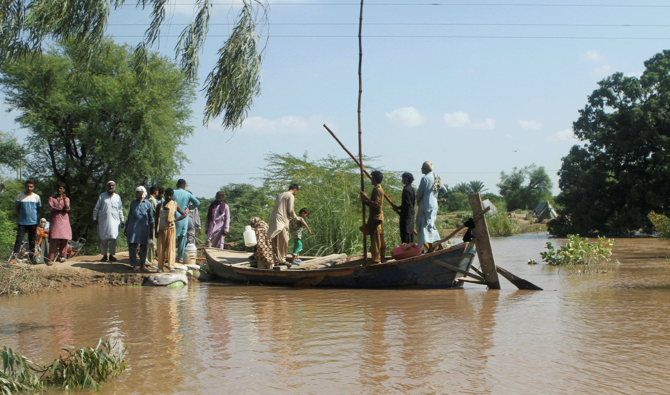
Residents board a boat while other wait for Rescue 1122 boat as they evacuate from the flooded area, following monsoon rains and rising water levels of the Chenab River, in Qasim Bela village on the outskirts of Multan in Punjab province, Pakistan, September 11, 2025. (Reuters/File)
Short Url
Updated 07 October 2025
Follow

Disaster agency says Punjab rivers stable after monsoon rains, no immediate flood risk

  • PDMA says water levels expected to rise in Sutlej, Ravi, Chenab and Jhelum but they remain within safe limits
  • Monsoon season since late July has killed more than 1,000 people in Pakistan, damaged homes and farmland

ISLAMABAD: River flows across Pakistan’s Punjab province remained normal on Tuesday despite rising water levels following a recent spell of monsoon rains, the Provincial Disaster Management Authority (PDMA) said, ruling out any immediate threat of flooding.

The update came as Pakistan continues to recover from weeks of torrential rains and riverine floods that inundated large parts of Punjab and Khyber Pakhtunkhwa, damaging homes, infrastructure and farmland. The monsoon season, which began in late July, has claimed at least 1,037 lives in incidents including roof collapses, landslides and flash floods.

Punjab, the country’s agricultural heartland, experienced one of its worst floods in years after neighboring India released excess water into three major rivers, affecting millions of people across the province.

“River flows in Punjab are currently normal,” said PDMA Punjab Director General Irfan Ali Kathia in a statement. “While rainfall has led to an increase in water levels, there is no risk of flooding at this stage.”

According to the PDMA, the flow in the Ravi River was recorded at 23,000 cusecs at Jassar, 22,000 cusecs at Shahdara, 55,000 cusecs at Balloki and 45,000 cusecs at Sidhnai.

The Sutlej River had flows of 59,000 cusecs at Ganda Singh Wala and 31,000 cusecs at Sulemanki, while the Chenab River recorded 31,000 cusecs at Marala, 17,000 at Khanki, 11,000 at Qadirabad and 11,000 at Trimmu.

At Panjnad, the flow stood at 30,000 cusecs.

The PDMA said water levels were expected to rise further in the next 24 hours in the Sutlej, Ravi, Chenab and Jhelum rivers, though all remained within safe limits.

It also reported that no water flow was observed in hill torrents across the Dera Ghazi Khan division, an area that often experiences flash flooding during heavy monsoon rains.

The statement said the PDMA’s control room continued to monitor the situation round the clock and coordinate with irrigation and district authorities to ensure timely alerts and preventive measures.


EU, Pakistan sign €60 million loan agreement for clean drinking water in Karachi

Updated 17 December 2025
Follow

EU, Pakistan sign €60 million loan agreement for clean drinking water in Karachi

  • Project will finance rehabilitation, construction of water treatment facilities in Karachi city, says European Investment Bank
  • As per a report in 2023, 90 percent of water samples collected from various places in city was deemed unfit for drinking

ISLAMABAD: The European Investment Bank (EIB) and Pakistan’s government on Wednesday signed a €60 million loan agreement, the first between the two sides in a decade, to support the delivery of clean drinking water in Karachi, the EU said in a statement. 

The Karachi Water Infrastructure Framework, approved in August this year by the EIB, will finance the rehabilitation and construction of water treatment facilities in Pakistan’s most populous city of Karachi to increase safe water supply and improve water security. 

The agreement was signed between the two sides at the sidelines of the 15th Pak-EU Joint Commission in Brussels, state broadcaster Radio Pakistan reported. 

“Today, the @EIB signed its first loan agreement with Pakistan in a decade: a €60 million loan supporting the delivery of clean drinking water for #Karachi,” the EU said on social media platform X. 

Radio Pakistan said the agreement reflects Pakistan’s commitment to modernize essential urban services and promote climate-resilient infrastructure.

“The declaration demonstrates the continued momentum in Pakistan-EU cooperation and highlights shared priorities in sustainable development, public service delivery, and climate and environmental resilience,” it said. 

Karachi has a chronic clean drinking water problem. As per a Karachi Water and Sewerage Corporation (KWSC) study conducted in 2023, 90 percent of water from samples collected from various places in the city was deemed unsafe for drinking purposes, contaminated with E. coli, coliform bacteria, and other harmful pathogens. 

The problem has forced most residents of the city to get their water through drilled motor-operated wells (known as ‘bores’), even as groundwater in the coastal city tends to be salty and unfit for human consumption.

Other options for residents include either buying unfiltered water from private water tanker operators, who fill up at a network of legal and illegal water hydrants across the city, or buying it from reverse osmosis plants that they visit to fill up bottles or have delivered to their homes.

The EU provides Pakistan about €100 million annually in grants for development and cooperation. This includes efforts to achieve green inclusive growth, increase education and employment skills, promote good governance, human rights, rule of law and ensure sustainable management of natural resources.