

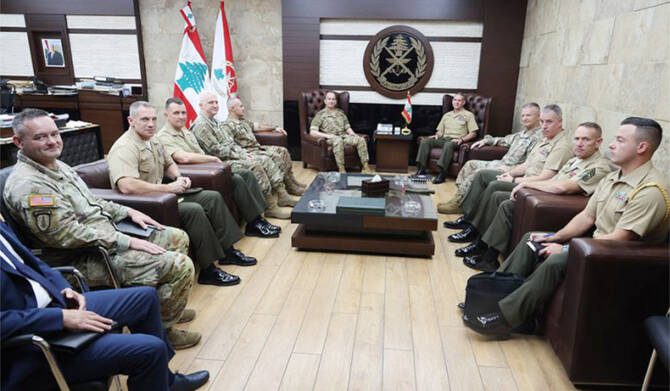

BEIRUT: Army chief Gen. Rodolphe Haykal presented the Army Command report on the newly implemented plan to establish exclusive state control over weapons.
The Lebanese state, under President Joseph Aoun, is attempting to seize weapons belonging to Hezbollah in an attempt to secure a monopoly on arms and greater authority over events in the country.
Hezbollah, the Shiite political party and paramilitary group, has long been viewed as one of the word’s most powerful non-state actors.
Monday’s meeting was chaired by Aoun at the Presidential Palace. It focused on measures undertaken in the South Litani sector and beyond, in areas where illegal weapons and military activity have historically challenged state authority.
Lebanon’s army was tasked in August with drafting and overseeing the plan to disarm Hezbollah.
While the military institution has remained tight-lipped about the details of its plan, Haykal — who had just toured several military units in the South Litani sector to review progress — said in a speech distributed by Army Command that the next phase “will once again prove that the army holds the power of right, and that it is the (sole) protector of the national interests.”
The army’s plan, particularly south of the Litani River, is being implemented in coordination with UNIFIL, the UN peacekeeping force, amid heightened tensions from regular Israeli cross-border strikes and the continued occupation of Lebanese border territory.
A senior military source said that the army’s approach focuses on “containing Hezbollah’s weapons,” specifically restricting any transfer or new introduction of weapons that could allow the organization to reconstitute its armed capacity in the wake of its bruising war with Israel.
During a recent visit to meet officers and soldiers assigned to South Litani Sector Command, Haykal praised their professionalism in “achieving great accomplishments,” adding that they “have proven themselves equal to the immense responsibility placed upon them, earning the confidence of brotherly and friendly nations.
“This compels us to continue exerting efforts and making sacrifices to fulfill our duty.”
Before heading to the Presidential Palace on Monday, Haykal met US Gen. Joseph Clearfield, head of the Hezbollah-Israel ceasefire oversight mechanism. They discussed progress on the ceasefire agreement.
During Monday’s Cabinet session, discussions focused on Hezbollah’s controversial defiance of the Prime Minister’s Office.
In late September, members of the militia illuminated Beirut’s iconic Raouche Rock with images of former Hezbollah leaders Hassan Nasrallah and Hashem Safieddine, despite being prohibited by official orders.
The illumination of Raouche Rock — a prominent tourist landmark — also took place despite warnings from prominent Beirut MPs.
The Cabinet agenda included a proposal to revoke the license of Hezbollah’s cultural association, Ressalat, for violating the terms of its permit by illuminating the site.
This triggered a deep rift between Hezbollah and Prime Minister Nawaf Salam, escalating into a smear campaign against the prime minister led by Hezbollah supporters and officials, including coordinated attacks on social media.
An official source told Arab News that that the Cabinet sought to bridge this rift “by allowing each party to present its viewpoint, without voting on the step of withdrawing the license from the Ressalat Association, and awaiting the results of the administrative investigations into what happened.”
The source added that Lebanon’s interior minister, Ahmad Al-Hajjar, is expected to take appropriate measures, including issuing warnings and imposing fines, to deter the undermining of the state.
The country’s judiciary has investigated several activists who insulted and defamed Salam on social media; some have refused to appear before court.
Commenting on the incident, Deputy Prime Minister Tarek Mitri said that “calling the prime minister a Zionist is contrary to political ethics.”
Meanwhile, Israel’s air force on Monday struck Bekaa Valley training camps belonging to Hezbollah’s elite Radwan Force, media reports said.
The strikes hit locations including Zaghrine, the barren areas around Hrabta and Hermel, as well as heights between Hrabta and Chaat.
Reports suggest that Hezbollah continues to store heavy weapons in the Bekaa region, particularly in the barren areas bordering Syria.


