

Pakistan warns of severe cyclone near Karachi amid forecast of more rains in Punjab

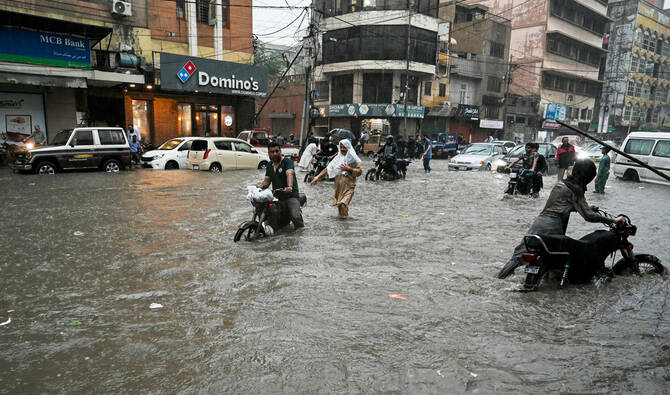
People wade through a flooded street after heavy rainfall in Karachi on August 19, 2025. (AFP/File)
Short Url
Updated 04 October 2025
Follow

Pakistan warns of severe cyclone near Karachi amid forecast of more rains in Punjab

  • Winds and thunderstorms with moderate rain triggered by Cyclone SHAKHTI expected in Sindh, Balochistan
  • Punjab’s top disaster management official Irfan Kathia says rainfall will lash the province again from Oct. 5-7

KARACHI: A cyclonic storm over the Arabian Sea has intensified into a severe system located about 390 kilometers south-southwest of Karachi, the Pakistan Meteorological Department (PMD) said on Saturday, while also forecasting more rain in eastern Punjab from Oct. 5 to 7 as the province continues to grapple with flood damage.

At least 1,037 people have died in Pakistan due to heavy rains, floods and landslides during the annual monsoon season between Jun. 26 and Oct. 1, according to the National Disaster Management Authority (NDMA).

More than 3.6 million people were affected across 3,363 villages, with nearly 1.3 million moved to safer areas and hundreds of relief camps established in inundated districts of Punjab, the country’s agricultural heartland.

The floods largely spared southern Sindh, unlike three years ago when Pakistan lost over 1,700 lives and the province was the worst hit. However, winds and thunderstorms accompanied by light to moderate rain triggered by Cyclone SHAKHTI are expected to affect

Karachi, Badin, Thatta, Sujawal, Jamshoro, Hub, Lasbela, Awaran and Kech districts in Sindh and Balochistan.

“Sea conditions are likely to remain rough to very rough with squally winds of 40-50 gusting 55 km/hour near the Sindh coast,” the PMD said in a statement. “Fishermen are advised not to venture into deep sea till Oct. 5.”

The cyclone is expected to move west-southwest, reaching the northwestern and adjoining central parts of the Arabian Sea by Oct. 5, before changing direction and weakening over the next 24 hours.

The PMD said winds could blow at 90 to 100 kilometers per hour, strengthening to around 110 km/h, with gusts as high as 125 km/h in the following 36 hours.

It said winds would weaken later, but the sea would remain rough to very high over the north-central Arabian Sea.

RAIN IN PUNJAB

Meanwhile, Punjab Provincial Disaster Management Authority (PDMA) Director General Irfan Ali Kathia said rains are expected to return to the province on Oct. 5 and continue in the northern regions of Pakistan until Oct. 7.

He said the intensity of rainfall may increase on Oct. 6-7, with 50 to 70 millimeters expected in several districts of Punjab, adding that heavy rains could raise river flows to between 100,000 and 150,000 cusecs.

Punjab has been reeling from weeks of flooding that inundated farmland, destroyed crops, displaced thousands and disrupted transport and irrigation networks, leaving many rural communities struggling to recover.

Pakistan remains among the countries most vulnerable to climate change, with scientists warning that rising temperatures are making South Asian monsoon rains heavier and more erratic.

Seasonal downpours provide up to 80 percent of the country’s annual rainfall but frequently cause widespread destruction.

The catastrophic 2022 floods submerged one-third of Pakistan, displaced 30 million people and caused economic losses exceeding $35 billion. 


Peace can only prevail if Afghanistan renounces support for ‘terrorism’— Pakistan defense chief

Updated 04 March 2026
Follow

Peace can only prevail if Afghanistan renounces support for ‘terrorism’— Pakistan defense chief

  • Pakistan’s chief of defense forces visits South Waziristan district bordering Afghanistan
  • Pakistan says has killed 481 Afghan Taliban operatives since clashes began last Thursday

ISLAMABAD: Pakistan’s Chief of Defense Forces Field Marshal Syed Asim Munir said on Wednesday that peace with Afghanistan can only prevail if Kabul renounces support for “terrorism” and “terrorist” organizations, the military’s media wing said as the two countries remain locked in conflict. 

Fighting between the two neighbors, the worst in decades, broke out last Thursday night after Afghan forces attacked Pakistan’s military installations along their shared border. Afghanistan said its attacks were in response to earlier airstrikes by Pakistan against alleged militant hideouts in its country. 

Pakistan accuses Afghanistan of sheltering militant outfits such as the Tehreek-e-Taliban Pakistan (TTP) on its soil who have launched attacks against Pakistani civilians and security forces in recent years. Kabul denies the allegations. 

Munir visited Wana town in Pakistan’s South Waziristan district to review the security situation and troops’ operational preparedness at the Afghan border, the Pakistani military’s media wing said in a statement. 

“The Field Marshal reiterated that peace could only prevail between both sides if the Afghan Taliban renounced their support for terrorism and terrorist organizations,” the Inter-Services Public Relations (ISPR) said. 

The military chief said the use of Afghan soil by militant outfits to launch attacks against Pakistan was unacceptable, vowing that “all necessary measures” would be taken to neutralize cross-border threats. 

During the visit, Munir was briefed by military commanders about ongoing intelligence-based operations and measures being taken by the military to manage the border with Afghanistan.

He was also briefed about “Operation Ghazab Lil Haq” or “Wrath for the Truth,” the name Pakistan has given to its military operation against Afghan forces, the ISPR said. 

The Pakistani military chief spoke to troops deployed in the area, praising their vigilance, professional conduct and high morale, the ISPR said. 

Pakistan’s Information Minister Attaullah Tarar said on Wednesday that the military has killed 481 Taliban operatives, injured more than 690 and destroyed 226 Afghan checkposts since clashes began. 

Arab News has been unable to verify claims by both sides about the damages they claim to have inflicted on each other.

Afghanistan has signaled it is open for dialogue but Pakistan rejected the offer, saying it would continue its military operations till its objectives were achieved. 

Since the conflict began, diplomatic efforts have intensified with several countries, including global bodies such as the European Union and United Nations, urging restraint and calling for talks.

Turkish President Recep Tayyip Erdogan told Pakistani Prime Minister Shehbaz Sharif that ⁠Ankara would help ⁠reinstate a ceasefire, the Turkish Presidency said on Tuesday, as other countries that had offered to mediate have since been hit by the conflict in the Gulf.