Germany to raise drone defense issue at Munich meeting

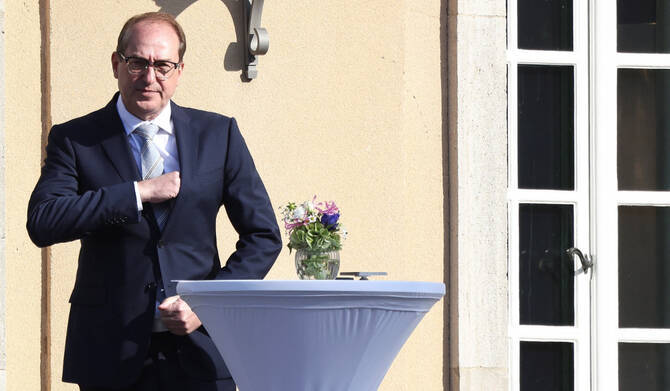
German Interior Minister Alexander Dobrindt stands ahead of a press conference on the second day of a two-day cabinet meeting at Villa Borsig in Berlin, Germany October 1, 2025. (REUTERS)
Short Url
Updated 03 October 2025
Follow

Germany to raise drone defense issue at Munich meeting

  • The Munich airport disruption was the latest in a series of similar incidents that have rattled European aviation, raising concerns about deniable hybrid attacks on Ukraine’s European allies, possibly directed by Russia

BERLIN: Germany’s Interior Minister, Alexander Dobrindt, said he would raise the matter of anti-drone defenses at a meeting of European interior ministers on Saturday, which had initially been billed as a migration summit.
Speaking in Saarbruecken, western Germany, the morning after drone sightings forced the closure of Munich airport for several hours, Dobrindt added that more research was needed on anti-drone defenses.
“At the meeting of European interior ministers this weekend in Munich, we will, in addition to the migration issues, also explicitly address the situation of drones and the threat posed by drones,” he said. Drone sightings at Germany’s Munich airport led to the cancelation and diversion of dozens of flights, leaving nearly 3,000 passengers stranded and leading politicians to promise harsh new measures allowing for drones to be shot down.
The Munich airport disruption was the latest in a series of similar incidents that have rattled European aviation, raising concerns about deniable hybrid attacks on Ukraine’s European allies, possibly directed by Russia. The Kremlin has indeed denied any involvement in the incidents.
The airport said several drone sightings late on Thursday evening had forced air traffic control to suspend operations, leading to the cancelation of 17 flights and disrupting travel for nearly 3,000 passengers, who were provided with camp beds, blankets, and food. Another 15 arriving flights were diverted around the region.
“Our police must get the power to shoot drones down,” said Markus Soeder, premier of Bavaria, of which Munich is the capital, on social media, promising state-level emergency legislation to enable this. “We need sovereignty over our airspace.”
As airport operations resumed on Friday, passengers checking in for a flight to Varna in Bulgaria found that the departure board showed only a few flights had been canceled. A flight from Bangkok was the first of the day to land at around 5:25 a.m. (0325 GMT).
Public broadcaster BR said local and national police were investigating the incident. State and federal police had no immediate comment.
The drones were sighted in the late evening above the airport, a police spokesperson told newspaper Bild. 
But because it was dark, the sizes and types of the drones could not be determined, he added. Police did not immediately respond to Reuters’ requests for comment.
The drone incidents follow airspace intrusions last week that temporarily shut airports in Denmark and Norway, which led EU leaders at a Copenhagen summit to back plans to bolster the bloc’s defences with anti-drone measures.
In Brussels, the Belgian Defense Ministry said it had opened an investigation into several drones flying over the military base at Elsenborn, located on the German border, overnight.
The airport disruption in Munich added to a tense week for the city after its popular Oktoberfest was closed temporarily due to a bomb threat and the separate discovery of explosives in a residential building in the city’s north.


8 in 10 British Muslims face ‘financial faith penalty’ when seeking home finance, survey finds

Updated 5 sec ago
Follow

8 in 10 British Muslims face ‘financial faith penalty’ when seeking home finance, survey finds

  • Restricted choices plague potential buyers

LONDON: Eight in 10 British Muslims say their home finance choices are restricted because of their faith, according to a new national survey that highlighted what researchers describe as a growing “financial faith penalty” in the UK housing market.

The report, published by Islamic home finance fintech firm Offa, found that 80 percent of Muslim respondents believe their religious beliefs limit their access to suitable home finance, while those who do use Islamic products often face slower decisions, heavier paperwork and poorer customer experiences than in the conventional mortgage market.

Based on surveys of 1,000 British Muslims conducted by Muslim Census, and 2,000 non-Muslims carried out by OnePoll, the research calls on providers, brokers and policymakers to modernize Islamic home finance and improve access to Sharia-compliant products.

Among the 24.3 percent of British Muslims who have used Islamic home finance, just 5 percent said they had received a same-day decision.

Some 62 percent waited up to two weeks, while 33 percent waited more than 15 days, including 16 percent who waited over a month.

Long decision times were cited as the biggest challenge by 28 percent of respondents, followed by excessive paperwork (22.6 percent) and poor customer service (18.9 percent).

Islamic home finance differs from conventional mortgages by avoiding interest and steering investment away from sectors considered harmful to society, including gambling, alcohol, tobacco, arms trading and animal testing.

Sagheer Malik, chief commercial officer and managing director of home finance at Offa, said the findings showed British Muslims were being underserved by outdated systems.

Malik said: “Property is the asset class of choice for many of the UK’s 3.87 million Muslims, both as a route to generational wealth and as a long-term financial foundation, yet our insightful research report reveals that British Muslims are being underserved and deterred by slow, outdated and opaque Islamic home finance provision.

“This is not a niche concern. It goes to the heart of financial fairness and inclusion in modern Britain.”

He added that Muslims deserved Sharia-compliant products that matched mainstream standards on “price, speed and simplicity.”

Despite strong demand, uptake remains low.

Only 12.8 percent of British Muslims surveyed said they currently use Islamic home finance, with a further 11.5 percent having done so in the past. More than three quarters (75.7 percent) have never used it.

Faith plays a central role in financial decisions, with 94.2 percent saying it is important that their financial products align with their ethical or religious beliefs. Yet more than half of those using conventional mortgages said they felt unhappy or uneasy about doing so because of their faith.

The study also found that British Muslims share similar home ownership aspirations to the wider population, with 79.1 percent citing the desire to provide a stable home for their family, while 18.6 percent said building generational wealth was their main motivation. Only 2.2 percent said they did not want to own a home.

The report suggests Islamic finance could appeal beyond Muslim communities. While 64 percent of non-Muslim respondents had never heard of Islamic home finance, 63 percent said they favored its ethical principles once explained.

Younger generations were the most receptive, with 43 percent of Generation Z and 37 percent of millennials saying they would consider using Islamic home finance, compared with just 7 percent of baby boomers. More than three quarters of Gen Z and 72 percent of millennials also said it was important that their finance provider avoided investing in ethically harmful sectors.

Offa said the findings pointed to an opportunity to expand ethical finance in the UK, provided the industry can deliver faster, simpler and more transparent services.