PARIS: An Egyptian former minister is the favorite to become head of the UN’s culture agency, but his Congolese rival says bets are still off before a key decision next week.
The vote to replace outgoing French UNESCO director-general Audrey Azoulay after two four-year terms in office is not expected until Nov. 6, during the body’s general assembly in Uzbekistan.
But UNESCO’s executive board is expected to recommend a name, in a move that has in the past led to that person’s election by the assembly.
Just two candidates remain in competition for the top job after a Mexican contender withdrew in August.
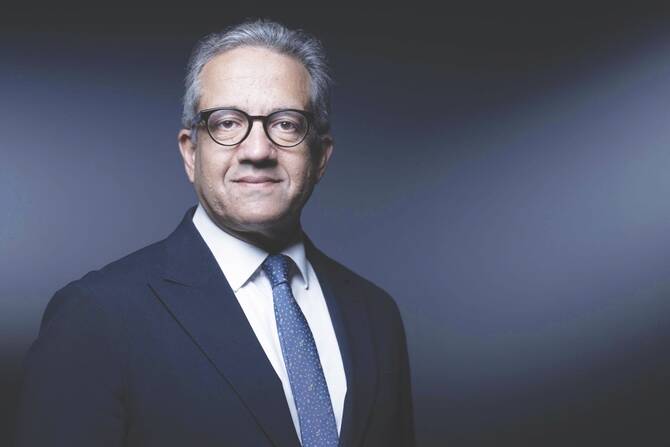
They are former Egyptian Antiquities and Tourism Minister Khaled Al-Enany and the Republic of Congo’s Firmin Edouard Matoko, who served as UNESCO’s de facto foreign minister until March.
Enany, a 54-year-old Egyptologist who announced his intention to run more than two years ago, has emerged as a favorite.
When the board interviewed the candidates in April, the Egyptian was “by far the best” candidate, said a European diplomat.
A source with knowledge of UNESCO workings said Enany’s election was a “done deal.”
However, Matoko, a 69-year-old diplomat who has worked at UNESCO since 1990, has argued that he is a better candidate, with more knowledge of the agency.
The recommendation of the executive board, which comprises 58 out of 194 member states, is expected to be key.
“When they don’t name you, you can go home and rethink your career plans,” said Matoko.
Enany oversaw antiquities and, later, also tourism, from 2016 to 2022 under President Abdel Fattah El-Sisi.
Since announcing his bid in 2023, he claims to have visited 65 countries and met with 400 people over the course of 30 months on the campaign trail. Matoko has dismissed these remarks.
“You don’t need to visit 70 countries to make yourself known,” he said.
“I’ve been visiting countries for 30 years. I’ve visited more than 100 countries to suggest solutions,” during UNESCO postings in Africa, South America, and in Paris, he added.
The Republic of Congo has gone all out in recent weeks at trying to gain traction for its contender.
It has deployed at least three ministers, including the president’s son, International Cooperation Minister Denis Christel Sassou Nguesso, to plead the case for a Congolese UNESCO chief in Asia, South America, the Caribbean, and the Gulf.
“The race is not over, the vote remains completely open,” said Sassou Nguesso, adding they had the backing of many of the 13 sub-Saharan African nations on the executive board.
“It’s a secret ballot. We have confidence in the African group, and backing from some other countries,” he said.
Senegal’s Amadou-Mahtar Mbow was the agency’s only sub-Saharan director-general from 1974 to 1987.
Enany has countered that the African Union, of which Egypt is a member, has three times backed his candidacy.
His team says he also has the backing of the Arab League, as well as individual support from executive board members.
“We don’t think it’ll be a tight race,” a member of his team said, requesting anonymity.
Matoko was recently campaigning in New York when world leaders attended the UN General Assembly last week.
Enany, however, stayed in France to attempt to persuade UNESCO delegates at home that it was time for the Paris-based agency to be headed by an Arabic-speaking country.
His critics point to the risks associated with such a choice, especially in the context of the Gaza war.
“Matoko would be a smoother candidate in terms of geostrategic issues,” Sassou Nguesso, who vowed to campaign until the last minute.
“You have to plow your field until the day of the vote,” he said.


![]()


Egyptian, Congolese contenders vie for UNESCO top job
Short Url
https://arab.news/gzccs
Egyptian, Congolese contenders vie for UNESCO top job


Cuban FM to meet Putin Wednesday amid oil crisis: Kremlin
- Cuban Foreign Minister Bruno Rodriguez will meet Russian President Vladimir Putin in Moscow on Wednesday, the Kremlin said
MOSCOW: Cuban Foreign Minister Bruno Rodriguez will meet Russian President Vladimir Putin in Moscow on Wednesday, the Kremlin said, in a visit to the socialist island’s traditional ally during a crippling US oil embargo.
Moscow has accused the United States of using “suffocating measures” against Havana and has said it was mulling sending aid to Cuba.
US President Donald Trump cut off key supplies of Venezuelan oil to Cuba after ousting Venezuela’s Nicolas Maduro. He has also threatened sanctions on countries that sell oil to Cuba.
The island has long grappled with a severe fuel shortage but the US embargo has deepened the crisis.
“Putin will receive Bruno Rodriguez in the Kremlin,” the Russian leader’s spokesman, Dmitry Peskov, told reporters, including AFP.
“The Russian Federation has consistently opposed the blockade of Cuba,” Peskov said, adding: “we provide assistance to our friends.”
Cuba has been allied to Moscow since its 1960s socialist revolution, relying on the Soviet Union for economic and political support for decades.
The Kremlin maintained close ties to the Caribbean island after the USSR collapsed.
Russia’s foreign ministry spokeswoman Maria Zakharova earlier said Rodriguez was leading a Cuban delegation that is “currently in Moscow.”
Rodriguez will also hold talks with his Russian counterpart Sergei Lavrov, Zakharova said.
Putin, an ex-KGB spy, visited Cuba in 2014, meeting with the island’s revolution leader Fidel Castro, who died two years later.
Moscow has accused the United States of using “suffocating measures” against Havana and has said it was mulling sending aid to Cuba.
US President Donald Trump cut off key supplies of Venezuelan oil to Cuba after ousting Venezuela’s Nicolas Maduro. He has also threatened sanctions on countries that sell oil to Cuba.
The island has long grappled with a severe fuel shortage but the US embargo has deepened the crisis.
“Putin will receive Bruno Rodriguez in the Kremlin,” the Russian leader’s spokesman, Dmitry Peskov, told reporters, including AFP.
“The Russian Federation has consistently opposed the blockade of Cuba,” Peskov said, adding: “we provide assistance to our friends.”
Cuba has been allied to Moscow since its 1960s socialist revolution, relying on the Soviet Union for economic and political support for decades.
The Kremlin maintained close ties to the Caribbean island after the USSR collapsed.
Russia’s foreign ministry spokeswoman Maria Zakharova earlier said Rodriguez was leading a Cuban delegation that is “currently in Moscow.”
Rodriguez will also hold talks with his Russian counterpart Sergei Lavrov, Zakharova said.
Putin, an ex-KGB spy, visited Cuba in 2014, meeting with the island’s revolution leader Fidel Castro, who died two years later.
Latest updates


Recommended


© 2026 SAUDI RESEARCH & PUBLISHING COMPANY, All Rights Reserved And subject to Terms of Use Agreement.