

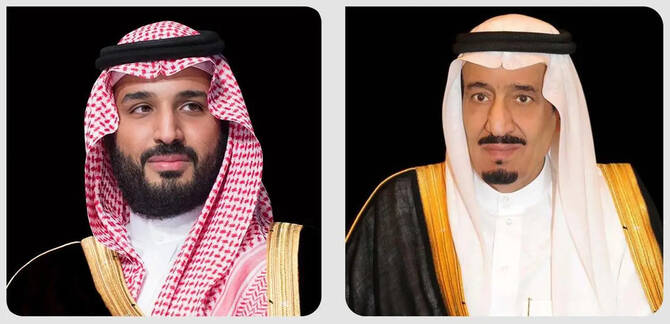

JEDDAH: Saudi Arabia’s King Salman and Crown Prince Mohammed bin Salman on Sunday congratulated the leaders of Liberia and Maldives on their countries’ independence anniversaries.
In separate cables carried by the Saudi Press Agency, the king and crown prince wished Liberia’s President Joseph Nyuma Boakai and his people continued good health and happiness on their 179th anniversary.
The Saudi leaders also sent similar congratulations to Maldives’ President Mohamed Muizzu, marking the 61st anniversary of his country’s independence.

Prince Mansour bin Mutaib bin Abdulaziz, minister of state, cabinet member and royal adviser, attended Maldives’ Independence Day celebrations in Malé and conveyed the messages of King Salman and Crown Prince Mohammed bin Salman to President Muizzu. (SPA photo)
Liberia, on West Africa’s Atlantic coast, is the continent’s oldest continuously independent nation, having declared independence on July 26, 1847.
Its roots trace to the 1820s, when the American Colonization Society began relocating free-born and formerly enslaved Black Americans, along with some Afro-Caribbeans, to the West African coast.
Over the following decades, more than 18,000 settlers arrived before the effort wound down around the start of the US Civil War in 1861.
These settlers and their descendants, who became known as Americo-Liberians, went on to lead the country to independence.
Washington did not formally recognize Liberia’s sovereignty until 1862.
The Maldives, an Indian Ocean archipelago, ranks as Asia’s smallest nation by land area at just 298 sq. km and its second least populous, with roughly 515,000 residents as of 2022.
The islands have been inhabited for over 2,500 years, with outside contact dating back to around 947 A.D., when Arab traders began arriving. Islam took hold by the 12th century, spread largely through Arab and Persian merchants active in Indian Ocean trade.
The islands later formed a sultanate with wide-reaching commercial and cultural links across Asia and Africa, before coming under growing European influence from the 1500s onward. Britain established a protectorate there in 1887.
The Maldives broke from British rule in 1965 and became a presidential republic three years later, with power vested in an elected People’s Majlis.


