TALLINN: Scores of political prisoners pardoned by the authoritarian leader of Belarus sat on a bus waiting to cross the border with Lithuania last month, minutes from freedom. Suddenly, one of them stood up, forced the door open and got off, defiantly refusing to leave his homeland in what he called as a forced deportation.
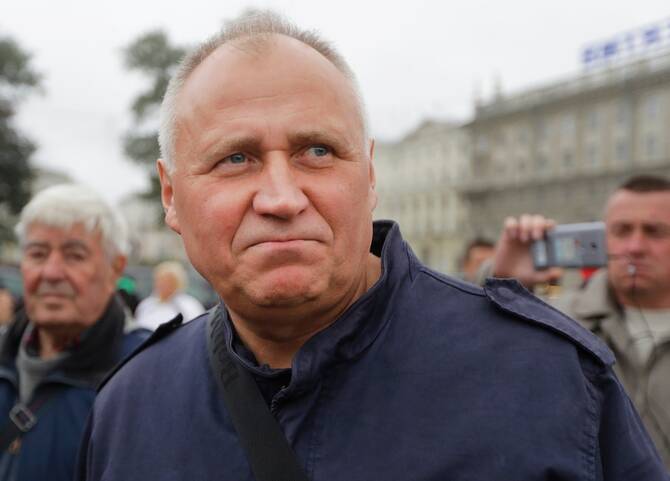
Since that incident on Sept. 11, Mikalai Statkevich hasn’t been seen. Human rights activists are demanding that Belarusian authorities reveal what has happened to the 69-year-old opposition politician and former presidential candidate.
Statkevich was one of 52 political prisoners pardoned by President Alexander Lukashenko as part of a deal brokered by the United States.
Fellow political prisoner Maksim Viniarski, who was traveling with him on the bus, told The Associated Press that “Statkevich looked determined — ready to fight not only for himself, but for the freedom of all Belarusians.”
When the emaciated Statkevich bolted from the bus, he left behind his critically needed heart medication on the bus, which continued on to Lithuania.
“Statkevich disrupted Lukashenko’s script and proved that even sick ... you can still resist dictatorship and lawlessness,” Viniarski said. “He clearly understood the price of his choice. He told me: ‘I won’t allow myself to be sold or for someone to decide where I live — or where I die.’”
Security forces seen taking him away
For several hours, Statkevich remained in the no-man’s-land at the Kamenny Loh border crossing until surveillance cameras recorded six masked security forces escorting him back into Belarus.
Lukashenko later said Statkevich was back in Belarus — “He’s our citizen after all” — but wouldn’t elaborate.
Statkevich’s actions echoed those of Maria Kolesnikova, a leader of mass demonstrations after a disputed 2020 election that kept Lukashenko in power. She became a symbol of resistance by tearing up up her passport at the border and walking back into Belarus when authorities tried to deport her that year. In 2021, she was convicted of charges including “conspiracy to seize power” and sentenced to 11 years in prison.
After Statkevich’s disappearance, his wife Maryna Adamovich returned to Belarus from a trip abroad and visited the prison colony in Hlybokaye, where he previously had been held, but officials refused to confirm if he was there. She’s received no response from authorities about his condition and location.
“The abuse continues. Trying to deport Mikalai, given his character, was a pointless undertaking,” she said, adding that he had told her: “They’re deporting patriots. I won’t go. What will happen to the country?”
Adamovich fears for his health, noting Statkevich had a heart attack in prison, but “neither illness nor years of solitary confinement had broken his will.”
Protests over his attempted deportation
Pavel Sapelka of the Viasna human rights group said it’s unclear whether authorities have filed new charges against Statkevich to keep him in custody even though he was pardoned by Lukashenko.
United Nations experts protested what they described as Statkevich’s attempted deportation and demanded information about his whereabouts.
“There are solid reasons to believe that Statkevich is a victim of enforced disappearance and arbitrary detention,” the experts said, according to the UN human rights office. “We call on Belarus to provide information about his fate and whereabouts, as well as on his state of health.”
Lukashenko’s decision to pardon the 52 prisoners followed a phone call in August with US President Donald Trump that sparked speculation of a possible thaw in relations. The release was part of a US-brokered deal that eased sanctions on the national carrier Belavia, including the resumption of parts supplies and aircraft servicing.
Trading political prisoners ‘like commodities’
“Lukashenko is trading political prisoners like commodities, releasing some and imprisoning other activists in their place,” opposition leader Sviatlana Tsikhanouskaya told AP. “I respect Statkevich’s principled decision and choice to remain in the country, but this highlights the problem — Belarusian political prisoners are not being released but forcibly deported to other countries against their will.”
Lukashenko, nicknamed “Europe’s last dictator,” has ruled Belarus for over three decades, maintaining his grip on power through elections dismissed by the West as neither free nor fair and violent crackdowns on dissent. Following the 2020 protests that saw hundreds of thousands take to the streets, more than 65,000 people were arrested, thousands were beaten, and hundreds of independent media outlets and nongovernmental organizations were closed and outlawed.
According to Viasna, about 1,200 political prisoners, including its founder, Nobel Peace Prize laureate Ales Bialiatski, remain in custody. Activists say they are kept in harsh conditions and often denied medical care, legal representation and family contact.
Belarus has been repeatedly sanctioned by Western countries for human rights violations and for allowing Russia to use its territory to invade Ukraine in 2022.
Statkevich was arrested before the 2020 election, convicted on charges of organizing mass unrest, and sentenced to 14 years in prison. In 2022, authorities labeled him an “extremist” — a term used against government critics. Since Feb. 9, 2023, he’s been held in complete isolation with no contact with the outside world.
In his decades of political activism, Statkevich has been imprisoned three times and spent more than 12 years behind bars. Amnesty International has recognized him as a prisoner of conscience three times.
Statkevich is the country’s longest-serving opposition politician and the founder of the Belarusian Social Democratic People’s Hramada party, which is affiliated with the Socialist International.
Earlier in his life, Statkevich pursued a military career and was involved with forming the Belarusian army after the 1991 collapse of the Soviet Union. In 1999, he helped organize the mass “March of Freedom” opposing Belarus’s proposed union with Russia. For organizing another opposition rally protesting the outcome of the 2004 parliamentary elections and referendum allowing Lukashenko to seek another term Statkevich was sentenced to three years of restricted freedom.
In the 2010 presidential election, he ran against Lukashenko and spent nearly five years in prison afterward. He was among Belarusian opposition leaders awarded the European Parliament’s Sakharov Prize for Freedom of Thought.
“Statkevich exemplifies the resilience and courage of a politician forced to work under a dictatorship,” Viniarski said. “Statkevich has reiterated that our values are worth exactly what we are willing to pay for them.”


![]()

Belarus opposition leader vanishes after refusing deportation in a US-brokered prisoner release
Short Url
https://arab.news/wr6nv
Belarus opposition leader vanishes after refusing deportation in a US-brokered prisoner release
- When the emaciated Statkevich bolted from the bus, he left behind his critically needed heart medication on the bus, which continued on to Lithuania
- Statkevich was one of 52 political prisoners pardoned by President Alexander Lukashenko as part of a deal brokered by the United States


Latest updates


© 2026 SAUDI RESEARCH & PUBLISHING COMPANY, All Rights Reserved And subject to Terms of Use Agreement.