China court sentences 11 members of Myanmar-based crime syndicate to death

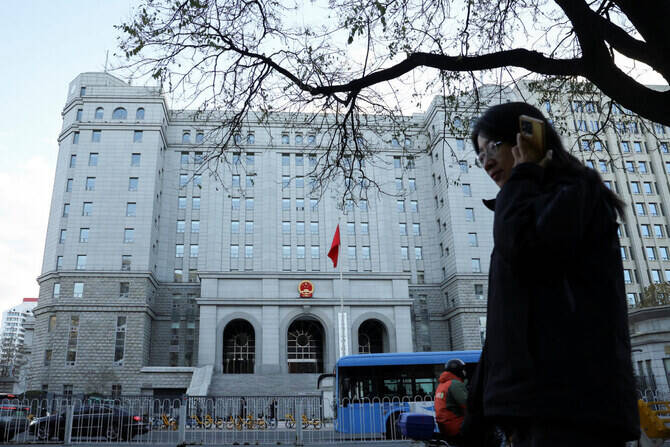
A court in China sentenced 11 people to death on Monday for their roles in a family-run crime syndicate accused of running illegal gambling and scam operations worth more than $1.4 billion and for the deaths of disobedient workers. (Reuters/File)
Short Url
Updated 30 September 2025
Follow

China court sentences 11 members of Myanmar-based crime syndicate to death

  • The sentences came shortly after China on Sunday separately sentenced former Minister of Agriculture and Rural Affairs Tang Renjian to death
  • China issued arrest warrants for members of the Ming family in November 2023 on suspicion of fraud, murder and illegal detention

BANGKOK: A court in China sentenced 11 people to death on Monday for their roles in a family-run crime syndicate accused of running illegal gambling and scam operations worth more than $1.4 billion and for the deaths of disobedient workers.
The Wenzhou Intermediate People’s Court sentenced Ming Guoping, Ming Zhenzhen, Zhou Weichang — all members of a powerful family in Kokkang, Myanmar — to death along with eight others, according to a court statement.
The court also handed death sentences suspended for two years to five others, while a further 12 defendants received jail sentences of between five and 24 years. Two-year suspended death sentences are often converted to life in prison.
The sentences came shortly after China on Sunday separately sentenced former Minister of Agriculture and Rural Affairs Tang Renjian to death with reprieve for taking bribes. Tang took bribes of more than 268 million yuan ($38 million) in cash and property between 2007 and 2024, according to a statement by the Intermediate People’s Court of Changchun in the northeastern Jilin province.
China issued arrest warrants for members of the Ming family in November 2023 on suspicion of fraud, murder and illegal detention as part of a crackdown on illegal scam operations near the border with Myanmar.
The syndicate’s crimes resulted in the deaths of 10 workers and injuries to two others who tried to escape the scam centers it ran, the court statement said.
The centers, in which criminals run sophisticated online scams targeting people all over the world, have proliferated in countries in Southeast Asia, including Myanmar, Laos and Cambodia. They often use trafficked workers who are forced to conduct romance-based investment scams as part of a globalized industry that the United Nations Office on Drugs and Crime estimates is worth $40 billion annually.
China is cracking down on scam centers in the region through joint operations or coordinating with local police forces. In February, China, Myanmar and Thailand exerted pressure on scam centers located along the Thai-Myanmar border, resulting in the release of more than 7,000 workers, most of whom were Chinese citizens.


India signs free trade deal with Oman, expands footprint in Gulf region

Updated 9 sec ago
Follow

India signs free trade deal with Oman, expands footprint in Gulf region

  • Agreement is India’s second CEPA with a GCC state and Oman’s first such deal in two decades
  • Deal opens tariff-free access for most Indian exports and simplifies visa regime for professionals

NEW DELHI: India signed a free trade agreement with Oman on Thursday, marking its second such deal with a Gulf Cooperation Council country and expanding its economic presence in the region.

The Comprehensive Economic Partnership Agreement was signed by Commerce Minister Piyush Goyal and Qais bin Mohammed Al-Yousef, ‘s minister of commerce, during Prime Minister Narendra Modi’s state visit to Muscat.

The new deal allows India to export most of its goods without paying tariffs, covering 98 percent of the total value of India’s exports to Oman.

Beyond tariff cuts and goods, the agreement covers services, investment and mobility facilitation, and cooperation in sectors such as textiles, vehicles, agro-chemicals, and renewables.

“The CEPA will act as an enabler of a more ambitious future by offering duty-free access, addressing trade barriers, and simplifying rules. It will allow our exports to be more competitively priced in each other’s economies,” Goyal said.

“The comprehensive economic partnership would facilitate greater market access for our professionals and firms supporting Oman’s Vision 2040 ... The CEPA allows fair and predictable visa regime and labor mobility for our skilled workforce while fully respecting Oman’s sovereign employment policies.”

Indian professionals working in Oman on short-term assignments will be allowed to stay for up to two years, up from the previous 90 days, with the option to extend for another two years.

Oman is one of Delhi’s smaller GCC trading partners — trailing behind the UAE and Saudi Arabia, with bilateral trade of about $10 billion, according to India’s trade ministry. But it is strategically important to India due to its location near the Strait of Hormuz, a key passage for Asia’s crude oil.

Hosting 700,000 Indian citizens, it is also home to the fifth-largest population of Indians working overseas.

Free trade negotiations between India and Oman began in November 2023, with the first round in New Delhi and the second in Muscat. When the talks concluded in March 2024, Oman sought revisions on market-access terms and the final signature was postponed.

The Shoura Council, Oman’s consultative and legislative body, approved the CEPA draft last week.

The pact is the second such trade agreement with a GCC country after a 2022 CEPA with the UAE. For Oman, it is the second such bilateral deal after the Oman-US free trade agreement signed in 2006.

“The agreement is a strategic instrument to boost investments, enhance supply chains, and promote joint growth not only in trade but also in production, innovation, and regional integration,” Al-Yousef told Indian business leaders, as quoted by the Oman News Agency before the deal was signed.

“The historic trade routes that once connected our ports remain vital today, linking India to the Gulf, East Africa, and global markets through Oman’s advanced logistics corridors, ports, and industrial hubs.”