

Pakistan’s average inflation to rise to 6% in FY26 due to flood impacts, gas tariffs

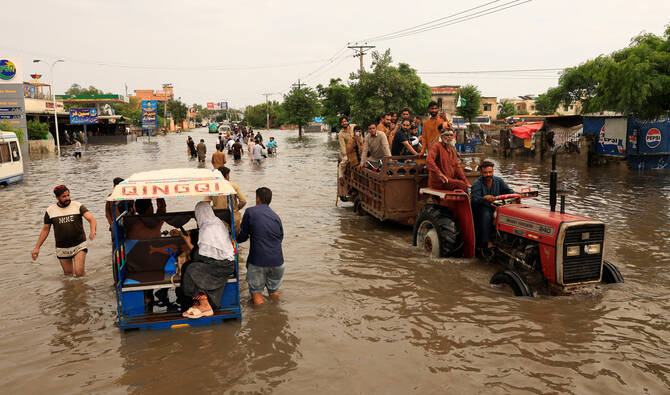
Residents sit on a tractor trolley as they cross a flooded road following monsoon rains and rising water levels in Sialkot, Punjab province, Pakistan on August 27, 2025. (REUTERS/File)
Short Url
Updated 30 September 2025
Follow

Pakistan’s average inflation to rise to 6% in FY26 due to flood impacts, gas tariffs

  • ADB says supply chain disruptions due to recent floods, increase in gas tariffs to hike inflation in FY26
  • Says policy consistency, climate resilience remain vital for Pakistan to maintain growth momentum

ISLAMABAD: The Asian Development Bank (ADB) said in its latest report on Tuesday that Pakistan’s average inflation is expected to rise to 6 percent during fiscal year 2026, reflecting the impact of flood-related supply chain disruptions and recent increase in gas tariffs on prices.

Heavy monsoon rains and excess water released from dams in India triggered floods in Pakistan’s eastern Punjab province, also known as its breadbasket province, since late August. Over 2.5 million people were evacuated to safer locations as thousands of acres of farmland were inundated with floodwaters. Experts warned of looming food shortages and price hikes due to the deluges.

In July, Pakistan’s government revised gas prices for the fiscal year 2025-26 and okayed a 50 percent increase in fixed charges for domestic consumers. The move was in line with Pakistan’s structural benchmarks agreed with the International Monetary Fund (IMF), including rationalization of captive power tariffs and a shift from subsidies to direct, targeted support for low-income consumers.

“Average inflation is projected to increase to 6.0 percent in FY2026, reflecting the impact of flood-related supply chain disruptions on food prices and the increase in gas tariffs,” the ABD said in a report. “In response, the central bank is expected to adopt a cautious approach to easing monetary policy to stabilize inflation within its medium-term target range of 5 percent–7 percent.”

The bank said Pakistan’s economic activity is expected to strengthen in FY2026, supported by improved external buffers and renewed business confidence following the US-Pakistan trade agreement.

“However, the damage caused to infrastructure and farmland by the recent floods may weigh on growth,” it warned. “Recovery and rehabilitation efforts, bolstered by fiscal incentives for the construction sector announced in the FY2026 budget, are expected to partially offset the adverse impact.”

Citing the ‘Asian Development Outlook for September 2025,’ the ADB’s annual flagship economic publication, the bank said Pakistan’s growth is projected to continue in the medium term, with real gross domestic product (GDP) growth forecast at 3.0 percent in FY2026, as macroeconomic stability deepens through sustained reforms addressing structural vulnerabilities.

It noted that Pakistan’s economic reform has progressed “considerably” under the IMF’s $7 billion Extended Fund Facility arrangement which began in October last year.

“Policy consistency and climate resilience remain vital to maintaining the growth momentum. Downside risks to the outlook remain high,” the ADB stressed.


Pakistan to launch last 2025 anti-polio nationwide drive targeting 45 million children next week

Updated 3 sec ago
Follow

Pakistan to launch last 2025 anti-polio nationwide drive targeting 45 million children next week

  • Over 400,000 frontline health workers will participate in Dec. 15-21 nationwide polio vaccination campaign, say authorities
  • Pakistan is one of only two countries in the world, the other being Afghanistan, where wild poliovirus remains endemic

KARACHI: Pakistan will kick off the last nationwide anti-polio vaccination campaign of 2025 targeting 45 million children next week, the National Emergencies Operation Center (NEOC) said on Monday, urging parents to coordinate with health workers during the drive. 

The campaign takes place days after Pakistan launched a nationwide vaccination drive from Nov. 17-29 against measles, rubella and polio. Pakistan said it had targeted 22.9 million children across 89 high-risk districts in the country with oral polio vaccination drops during the drive. 

Over 400,000 health workers will perform their duties during the upcoming Dec. 15-21 nationwide polio vaccination campaign, the NEOC said in a statement. 

“Parents are urged to cooperate with polio workers and ensure their children are vaccinated,” the NEOC said. “Complete the routine immunization schedule for all children up to 15 months of age on time.”

Health authorities aim to vaccinate 23 million children in Punjab, 10.6 million in Sindh, over 7.2 million in Khyber Pakhtunkhwa, over 2.6 million in Balochistan, more than 460,000 in Islamabad, over 228,000 in Gilgit-Baltistan and more than 760,000 children in Pakistan-administered Kashmir during the seven-day campaign, it added. 

Pakistan is one of only two countries in the world where wild poliovirus remains endemic.

Polio is a highly infectious and incurable disease that can cause lifelong paralysis. The only effective protection is through repeated doses of the Oral Polio Vaccine for every child under five during each campaign, alongside timely completion of all routine immunizations.

Islamabad’s efforts to eliminate poliovirus have been hampered by parental refusals, widespread misinformation and repeated attacks on anti-polio workers by militant groups. In remote and volatile areas, vaccination teams often operate under police protection, though security personnel themselves have also been targeted and killed in attacks.