

Trump gives Hamas ultimatum on Gaza deal

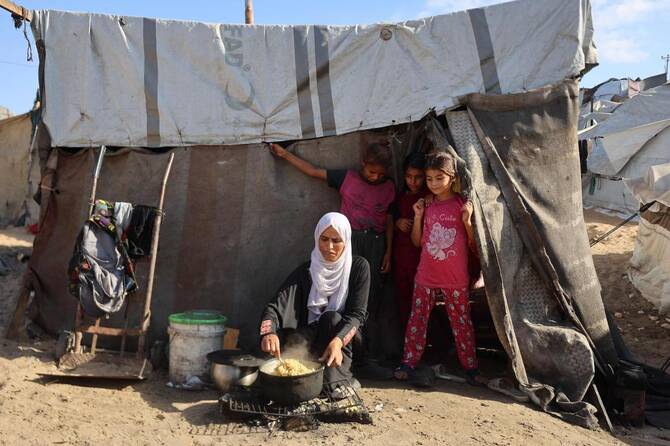
Prime Minister Benjamin Netanyahu said the Israeli military would stay in most of the territory after he gave the US president his backing. (AFP)
Short Url
Updated 30 September 2025
Follow

Trump gives Hamas ultimatum on Gaza deal

  • “We’re going to do about three or four days,” Trump told reporters when asked about any timeframe
  • Netanyahu said the military would stay in most of Gaza, and also that he did not agree to a Palestinian state during his talks in Washington

JERUSALEM: US President Donald Trump gave Hamas an ultimatum of “three or four days” on Tuesday to respond to his plan for Gaza, as the militant group reviewed the proposal backed by Israel.
The plan calls for a ceasefire, release of hostages by Hamas within 72 hours, disarmament of Hamas and gradual Israeli withdrawal from Gaza, followed by a post-war transitional authority headed by Trump himself.
World powers, including Arab and Muslim nations, welcomed the proposal, but Hamas had yet to issue its response.
“We’re going to do about three or four days,” Trump told reporters when asked about any timeframe.
“We’re just waiting for Hamas, and Hamas is either going to be doing it or not. And if it’s not, it’s going to be a very sad end.”
Trump announced the deal at the White House on Monday after meeting Israeli Prime Minister Benjamin Netanyahu.
On Tuesday, a Palestinian source said on condition of anonymity that Hamas had begun consultations on the plan “within its political and military leaderships, both inside Palestine and abroad.”
“The discussions could take several days due to the complexities,” the source said.
Qatar, which hosts Hamas’s exiled leadership, said the group had promised to study the proposal “responsibly,” and also said it would hold a meeting with Hamas and Turkiye later on Tuesday.
“It is still too early to speak about responses, but we are truly optimistic that this plan, as we said, is a comprehensive one,” foreign ministry spokesman Majed Al-Ansari said.
The deal demands that Hamas militants fully disarm and be excluded from future roles in the government, but those who agreed to “peaceful co-existence” would be given amnesty.
It would also see a phased Israeli withdrawal from Gaza, after nearly two years of war sparked by Hamas’s unprecedented attack on Israel on October 7, 2023.
But in a video statement posted after the joint press conference with Trump, Netanyahu said the military would stay in most of Gaza, and also that he did not agree to a Palestinian state during his talks in Washington.
“We will recover all our hostages, alive and well, while the (Israeli military) will remain in most of the Gaza Strip,” he said.
Still, Israel’s far-right Finance Minister Bezalel Smotrich, a member of Netanyahu’s coalition government, blasted the plan as a “resounding diplomatic failure.”
“In my estimation, it will also end in tears. Our children will be forced to fight in Gaza again,” he said.

“Full backing”

Trump’s plan includes deployment of a “temporary international stabilization force” — and the creation of a transitional authority headed by Trump himself and including former British premier Tony Blair.
During his press conference with Trump, Netanyahu cast doubt on whether the Palestinian Authority, which nominally runs Palestinian population centers in the occupied West Bank, would be allowed a role in Gaza’s governance.
Trump noted that during their meeting Netanyahu had strongly opposed any Palestinian statehood — something that the US plan leaves room for.
“I support your plan to end the war in Gaza which achieves our war aims,” Netanyahu said.
“If Hamas rejects your plan, Mr.President, or if they supposedly accept it and then basically do everything to counter it, then Israel will finish the job by itself.”
Trump said that Israel would have his “full backing” to do so if Hamas did not accept the deal.
Reaction was global, and swift. Key Arab and Muslim nations, including mediators Egypt and Qatar, hailed the agreement’s “sincere efforts” in the wake of their own talks with Trump last week.
Washington’s European allies promptly voiced support, with the leaders of Britain, France, Germany and Italy sharing strong expressions of support for the plan, while China and Russia also declared their backing.

“Unrealistic”

But in Gaza, people were skeptical.
“It’s clear that this plan is unrealistic,” 39-year-old Ibrahim Joudeh told AFP from his shelter in the so-called humanitarian zone of Al-Mawasi in southern Gaza.
“It’s drafted with conditions that the US and Israel know Hamas will never accept. For us, that means the war and the suffering will continue,” said the computer programmer, originally from the southern city of Rafah, devastated by a military offensive that began in May.
Israeli air strikes and shelling continued across Gaza on Tuesday, according to the territory’s civil defense agency and witnesses.
The Israeli military said its forces were carrying out operations across the territory, particularly in Gaza City, where they have mounted a major offensive in recent weeks.
The Palestinian Authority welcomed Trump’s “sincere and determined efforts.”
Hamas ally Islamic Jihad, on the other hand, said the plan would fuel further aggression against Palestinians.
“Through this, Israel is attempting — via the United States — to impose what it could not achieve through war,” the group said in a statement.
The Gaza war was triggered by Hamas’s October 7, 2023, attack on Israel that killed 1,219 people, mostly civilians, according to an AFP tally of Israeli official figures.
Israel’s offensive has reduced much of Gaza to rubble and killed 66,055 Palestinians, also mostly civilians, according to health ministry figures in the Hamas-run territory that the United Nations considers reliable.


How Israel’s multi-ton truck bombs ripped through Gaza City

Updated 9 sec ago
Follow

How Israel’s multi-ton truck bombs ripped through Gaza City

GAZA CITY: In the weeks before the Gaza ceasefire on October 10, Israel widely deployed a new weapon: M113 Armored Personnel Carriers repurposed to carry between 1 and 3 tons of explosives, Reuters found.
As Israeli troops pushed toward the center of Gaza City, these powerful bombs, along with airstrikes and armor-plated bulldozers, leveled swathes of buildings, drone footage and satellite images show.
In most cases, but not all, the inhabitants fled ahead of demolitions after Israeli warnings, residents, Israeli security sources and Gaza authorities said.
Hesham Mohammad Badawi’s five-story home on Dawla Street in the affluent Tel-al-Hawa suburb, damaged by an airstrike earlier in the war, was completely destroyed by an APC explosion on September 14, he and a relative said, leaving him and 41 family members homeless.
Badawi, who was a few hundred meters away, said he heard at least five APCs detonate in roughly five-minute intervals. He said he received no evacuation ​warning before the demolition and family members escaped “by a miracle” amid explosions and heavy gunfire.
Several buildings in the same block were demolished around that time, satellite images show.
The family is now staying with relatives in different parts of the city, Badawi said, while he lives in a tent by his former home. Israel’s military did not respond to Reuters questions about the incident. Reuters could not establish what Israel targeted in the attack or independently verify all the details of Badawi’s account of the events.
When Reuters visited in November, remains of at least one of the vehicles were strewn among large piles of rubble.
“We could not believe this was our neighborhood, this was our street,” Badawi said.
To compile a detailed account of the role of APC-based bombs by the Israeli military in Tel-al-Hawa and the neighboring Sabra district in the six weeks before the ceasefire, Reuters spoke to three Israeli security sources, a retired Israeli military brigadier, an Israeli reservist, Gazan authorities and three military experts.
Seven Gaza City residents said their homes or those of neighbors were levelled or severely damaged by the explosions, which several likened to an earthquake. Analysis of Reuters footage by two of the military experts confirmed wreckage of at least two exploded APCs among the rubble at sites in Gaza City.
Israel packed 1 to 3 tons of ordnance in APCs, three military experts estimated, based on cabin space and wreckage of vehicle armor. Some of the ordnance was likely non–military ammonium nitrate or emulsion, though without chemical testing that conclusion is not certain, they said.
Such a multi-ton explosion could approach an equivalent power to Israel’s largest airborne bombs, the 2,000-pound US-made Mark 84, said two experts, who examined Reuters footage of the blast area and vehicle remains.
It could scatter vehicle fragments hundreds of meters, and break close-by exterior walls and building columns. The blast wave would be strong enough to potentially collapse a multi-story building, they said.

HIGHLY UNUSUAL
APCs generally transport troops and equipment on the battlefield. The three military experts ‌consulted by Reuters said use of ‌the vehicles as bombs was highly unusual and risked excessive damage to civilian dwellings.
In response to detailed Reuters questions for this story, Israel’s military said it was committed to the rules of war. Regarding allegations ‌of destruction ⁠of civilian ​infrastructure, it said it used ‌what it called engineering equipment only for “essential operational purposes,” without disclosing further details.
Decisions are guided by military necessity, distinction, and proportionality, it said.
In an interview with Reuters in Gaza for this story, Hamas spokesman Hazem Qassem said Israel’s demolitions with armored vehicles were aimed at the large-scale displacement of the city’s residents, which Israel has denied.
The reporting provides new evidence of the power of these low-tech weapons and how they came to be widely used.
Retired reservist Brig.-General Amir Avivi, founder of the Israel Defense and Security Forum (IDSF), a think tank, called the weapon an “innovation of the Gaza War.” One of the security sources said its increasing use partly responded to US restrictions on transfers of heavy Mark-84 airborne bombs and Caterpillar bulldozers.
Israel’s military and Prime Minister’s Office also did not respond to questions about the reasons for the shift in tactics. The US State Department, White House and Department of War did not respond to Reuters questions for this story.
Before the war, Tel-al-Hawa and Sabra, a historic area of modest houses in south-central Gaza City, bustled with bakeries, shopping malls, mosques, banks and universities.
Now, large parts lie in ruins.
Satellite imagery analysis by Reuters showed that about 650 buildings in Sabra, Tel-al-Hawa and surrounding areas were destroyed in the six weeks between September 1 and October 11.

MILITARY NECESSITY?
Two international law scholars, the UN human rights office and two of the military experts who reviewed Reuters findings said use of such large explosives in dense residential urban areas may have failed one or more principles of humanitarian law that prohibit attacking civilian infrastructure and using disproportionate force.
“The basis that some of it may be booby-trapped” or once used by Hamas snipers is not enough to justify mass destruction, Ajith Sunghay, head of the UN Human Rights Office ⁠in the Occupied Palestinian Territory, told Reuters, referring to Israel’s allegation that Hamas placed improvised explosive devices in houses, which Hamas denies.
In some circumstances, buildings could lose legal protection and become targets if Israel had evidence Hamas used them for military advantage, said Afonso Seixas Nunes, Associate Professor in the School of Law at Saint Louis University.
Israel’s military did not respond to Reuters requests to provide such evidence.
If not the result of military necessity, ‌the demolition of civilian infrastructure could amount to wanton destruction of property, which is a war crime, Sunghay said.
The level of ruin reflects a broader trend: 81 percent of Gaza’s buildings suffered damage or ‍destruction during the war, according to the UN Satellite Center. The area including Gaza City experienced most damage since July, with approximately 5,600 newly affected structures, it ‍said in October.
In August, Israeli Prime Minister Benjamin Netanyahu told reporters Israel was packing tons of explosives into APCs because Hamas had placed explosive devices in “just about every single building” in evacuated areas.
“We detonate them, and they set off all the booby traps. That’s why you see the destruction,” Netanyahu said.
In ‍response to questions for this story, Qassem, the Hamas spokesman, denied booby trapping buildings, and said Hamas did not have the capacity to set devices at the scale Israel claimed.

FORCES ENTER GAZA CITY
Later in August, Israeli forces entered Gaza City with the declared aim of eliminating Hamas and freeing hostages held by militants since the October 7, 2023 attack on Israel that triggered the war.
Israel ordered a full evacuation of the city in September.
As troops advanced, backed by tanks and airstrikes, they extensively damaged eastern suburbs before approaching central areas of the city, where most displaced people were sheltering.
Hundreds of thousands fled south. The UN estimated 600,000-700,000 people remained in the city.
Israel’s defense minister has said soldiers demolished 25 towers that Israel said had Hamas tunnels underneath or were used as lookout points. The UN human rights office says Israel has provided no evidence the buildings were military targets.
Among the destruction visible in Sabra, Tel-al-Hawa and South Rimal between September 1 and October 11, Reuters identified Al-Roya tower, which housed the Palestinian Center for Human Rights, a prominent human rights office that worked with ​charity Christian Aid, and Al-Roya 2, a mixture of business and flats, brought down by airstrikes on September 7 and 8.
Two wings of the Islamic University of Gaza and a mosque on the campus were destroyed. In one six-block corner of Tel-al-Hawa almost every building was demolished — more than 60 in total.
Beyond the two cases of APC explosions analyzed in detail for this story, and airstrikes on towers caught on video, Reuters could not establish what weapons Israel deployed to demolish buildings, or the total number of ⁠APCs detonated from August until the ceasefire.
Gaza’s Civil Defense spokesperson Mahmoud Basal said the army detonated hundreds of APCs in that period, as many as 20 daily. Israel’s military did not reply to a question on numbers.

BADAWI’S HOUSE
Among the buildings destroyed was Badawi’s family home of four decades, along with more than 20 neighboring buildings in the same period.
“We didn’t recognize this as our house,” he said.
Two military experts said Reuters footage of the area showed remains of at least one detonated APC.
The explosion had torn one APC caterpillar track from its running gear and “physically thrown it onto the roof” of a multi-story building, a retired senior British military bomb disposal officer said, noting that M113 tracks each weigh hundreds of kilograms.
A thick, ripped piece of metal and a wheel torn in half, both scattered at the property, were consistent with a detonation from within the APC, said Gareth Collett, a retired British Brig. Gen. and leading authority on explosives and bomb disposal. He said the large size of the fragments was indicative of a commercial low energy explosive.

THE RETURN OF THE M113
Bought from the US after the Yom Kippur War in the 1970s, thousands of M113s were deemed to insufficiently protect soldiers and were mothballed, military historian Yagil Henkin said.
FMC Corp, originally the M113’s primary manufacturer, did not respond to Reuters’ requests for comment about its use as a weapon and potential associated human rights concerns.
BAE Systems, which currently provides maintenance for the vehicle globally, did not reply to Reuters questions about Israel’s new use of the M113 other than to say it currently had no direct military sales to the country. It said equipment it sold to the US government could reach other countries indirectly.
In May, Israel posted a public tender seeking to sell an unspecified number of M113s internationally, public documents show.
The tender was later canceled, according to an undated posting on the Ministry of Defense website. The cancelation allowed Israel to scale up repurposing M113s, one of the security sources told Reuters. The military did not respond to Reuters’ questions about the tender.
The first media reports of an APC detonating in Gaza date to mid-2024.
Use accelerated this year when Israel rationed stocks after the US paused deliveries of Mark-84 bombs over concerns about the bombs use in residential areas, the source said.

CATERPILLAR D9
The increased role of APC-based bombs also coincided with shortages in Israel of US company Caterpillar’s giant D9 bulldozer, long used by Israel’s military for demolition, one of the security sources said.
Hamas heavily targeted D9s earlier in the war, killing or injuring soldiers and damaging the vehicles, the source said. Alarmed by their use to demolish homes, the US paused D9 sales to Israel in November 2024, adding to the shortage. Under President Donald Trump, D9 transfers resumed.
Caterpillar did not respond to questions from ‌Reuters about the military use of its machines in Gaza demolitions and has not publicly commented on the matter.
Amid the shortages, the military began using other methods of demolition, including APCs, another of the security sources said.
Danny Orbach, an Israeli military historian, told Reuters demolitions were normal in war, made necessary in Gaza due to tunnels and booby traps. He said Israel’s military was underprepared for the complex fighting, leading to the conclusion there was “no other way to fight such a war except destroying all buildings above ground.”
Israel’s military told Reuters targets were reviewed prior to attack and the munition selected “to achieve the military objective while minimizing collateral damage” to civilians and civilian infrastructure.