BENGALURU/HYDERABAD: Donald Trump’s H-1B visa crackdown will hasten US firms’ shift of critical work to India, turbocharging the growth of global capability centers (GCCs) that handle operations from finance to research and development, economists and industry insiders say.
The world’s fifth-largest economy is home to 1,700 GCCs, or more than half the global tally, having outgrown its tech support origins to become a hub of high-value innovation in areas from design of luxury car dashboards to drug discovery.
Trends such as growing adoption of artificial intelligence and increasing curbs on visas are pushing US firms to redraw labor strategies, with GCCs in India emerging as resilient hubs blending global skills with strong domestic leadership.
“GCCs are uniquely positioned for this moment. They serve as a ready in-house engine,” said Rohan Lobo, partner and GCC industry leader at Deloitte India, who said he knew of several US firms reassessing their workforce needs.
“Plans are already underway” for such a shift, he added, pointing to greater activity in areas such as financial services and tech, and particularly among firms with exposure to US federal contracts.
Lobo said he expected GCCs to “take on more strategic, innovation-led mandates” in time.
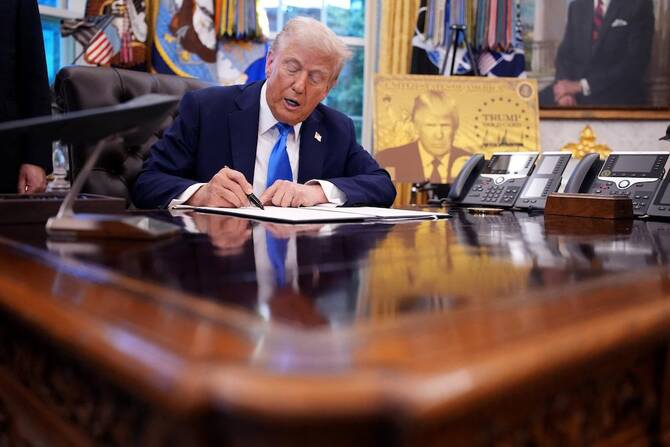
US President Trump raised the cost of new H-1B visa applications this month to $100,000, from an existing range of $2,000 to $5,000, adding pressure on US firms that relied on skilled foreign workers to bridge critical talent gaps.
On Monday, US senators reintroduced a bill to tighten rules on the H-1B and L-1 worker visa programs, targeting what they called loopholes and abuse by major employers.
If Trump’s visa curbs go unchallenged, industry experts expect US firms to shift high-end work tied to AI, product development, cybersecurity, and analytics to their India GCCs, choosing to keep strategic functions in-house over outsourcing.
Growing uncertainty fueled by the recent changes has given fresh impetus to discussions about shifting high-value work to GCCs that many firms were already engaged in.
“There is a sense of urgency,” said Lalit Ahuja, founder and CEO of ANSR, which helped FedEx, Bristol-Myers Squibb, Target and Lowe’s set up their GCCs.
Reassessing India strategies
Such a rush could lead to “extreme offshoring” in some cases, said Ramkumar Ramamoorthy, a former managing director of Cognizant India, adding that the COVID-19 pandemic had shown key tech tasks could be done from anywhere.
Big Tech, including Amazon, Microsoft, Apple and Google parent Alphabet, along with Wall Street bank JPMorgan Chase and retailer Walmart, were among the top sponsors of H-1B visas, US government data showed.
All have major operations in India but did not want to comment as the issue is a politically sensitive one.
“Either more roles will move to India, or corporations will near-shore them to Mexico or Colombia. Canada could also take advantage,” said the India head of a retail GCC.
Even before Trump’s hefty fee on new H1-B visa applications and plan for a new selection process to favor the better-paid, India was projected to host the GCCs of more than 2,200 companies by 2030, with a market size nearing $100 billion.
“This whole ‘gold rush’ will only get accelerated,” Ahuja said.
Implications for India
Others were more skeptical, preferring a “wait and watch” approach, especially as US firms could face a 25 percent tax for outsourcing work overseas if the proposed HIRE Act is passed, bringing significant disruption in India’s exports of services.
“For now, we are observing and studying, and being ready for outcomes,” said the India head of a US drugmaker’s GCC.
India-US trade tension has spilled into services from goods, with visa curbs and the proposed HIRE Act threatening to reduce India’s lower-cost edge and choke cross-border flows of services.
While the $283-billion IT industry that contributes nearly 8 percent of India’s GDP may feel the strain, surging demand for GCC services could cushion such a blow, however.
“Lost revenues from H-1B visa reliant businesses could be somewhat supplanted by higher services exports through GCCs, as US-based firms look to bypass immigration restrictions to outsource talent,” Nomura analysts said in a research note last week.

Trump visa curbs push US firms to consider shifting more work to India
https://arab.news/zntb7
Trump visa curbs push US firms to consider shifting more work to India
- Visa curbs force US firms to rethink labor strategies
- Work tied to AI, cybersecurity could shift to India
Putin says there are points he can’t agree to in the US proposal to end Russia’s war in Ukraine
- He emphasized that Russia will fulfill the goals it set and take all of the eastern Donetsk region
- “All this boils down to one thing: Either we take back these territories by force, or eventually Ukrainian troops withdraw,” he said
Russian President Vladimir Putin says some proposals in a US plan to end the war in Ukraine are unacceptable to the Kremlin, indicating in comments published Thursday that any deal is still some ways off.
US President Donald Trump has set in motion the most intense diplomatic push to stop the fighting since Russia launched the full-scale invasion of its neighbor nearly four years ago. But the effort has once again run into demands that are hard to reconcile, especially over whether Ukraine must give up land to Russia and how it can be kept safe from any future aggression by Moscow.
Trump’s special envoy, Steve Witkoff, and son-in-law Jared Kushner planned to meet later Thursday with the Ukrainian delegation led by Rustem Umerov following the Americans’ discussions with Putin at the Kremlin, but there was no immediate confirmation whether that meeting took place.
The meeting at the Shell Bay Club, a golf property developed by Witkoff in Hallandale Beach, was tentatively set to begin at 5 p.m. EST, according to an official familiar with the logistics. The official was not authorized to discuss the matter publicly because the meeting has not yet been formally announced and spoke on condition of anonymity.
Putin said his five-hour talks Tuesday with Witkoff and Kushner were “necessary” and “useful,” but also “difficult work,” and some proposals were unacceptable.
Speaking to the India Today television channel before he landed Thursday in New Delhi for a state visit, Putin said the American proposals discussed at the Kremlin meeting were based on earlier discussions between Russia and the US, including his meeting with Trump in Alaska in August, but also included new elements.
“We had to go through practically every point, which is why it took so much time,” he said. “It was a meaningful, highly specific and substantive conversation. Sometimes we said, ‘Yes, we can discuss this, but with that one we cannot agree.’“
Trump said Wednesday that Witkoff and Kushner came away from the marathon session confident that Putin wants to find an end to the war. “Their impression was very strongly that he’d like to make a deal,” he added.
Putin said the initial US 28-point peace proposal was trimmed to 27 points and split into four packages. He refused to elaborate on what Russia could accept or reject, and none of the other officials involved offered details of the talks.
The Russian leader praised Trump’s peace efforts, noting that “achieving consensus among conflicting parties is no easy task.”
“To say now what exactly doesn’t suit us or where we could possibly agree seems premature, since it might disrupt the very mode of operation that President Trump is trying to establish,” Putin said.
He emphasized that Russia will fulfill the goals it set and take all of the eastern Donetsk region. “All this boils down to one thing: Either we take back these territories by force, or eventually Ukrainian troops withdraw,” he said.
European leaders, left on the sidelines by Washington as US officials engage directly with Moscow and Kyiv, have accused Putin of feigning interest in Trump’s peace drive.
French President Emmanuel Macron met in Beijing with Chinese leader Xi Jinping, seeking to involve him in pressuring Russia toward a ceasefire. Xi, whose country has provided strong diplomatic support for Putin, did not say respond to France’s call, but said that “China supports all efforts that work toward peace.”
Russian barrages of civilian areas of Ukraine continued overnight into Thursday. A missile struck Kryvyi Rih on Wednesday night, wounding six people, including a 3-year-old girl, according to city administration head Oleksandr Vilkul.
The attack on Ukrainian President Volodymyr Zelensky’s hometown damaged more than 40 residential buildings, a school and domestic gas pipes, Vilkul said.
A 6-year-old girl died in the southern city of Kherson after Russian artillery shelling wounded her the previous day, regional military administration chief Oleksandr Prokudin wrote on Telegram.
The Kherson Thermal Power Plant, which provides heat for over 40,000 residents, shut down Thursday after Russia pounded it with drones and artillery for several days, he said.
Authorities planned emergency meetings to find alternate sources of heating, he said. Until then, tents were erected across the city where residents could warm up and charge electronic devices.
Russia also struck Odesa with drones, wounding six people, while civilian and energy infrastructure was damaged, said Oleh Kiper, head of the regional military administration.
Overall, Russia fired two ballistic missiles and 138 drones at Ukraine overnight, officials said.
Meanwhile, in the Russia-occupied part of the Kherson region, two men were killed by a Ukrainian drone strike on their vehicle Thursday, Moscow-installed regional leader Vladimir Saldo said. A 68-year-old woman was also wounded in the attack, he said.


