

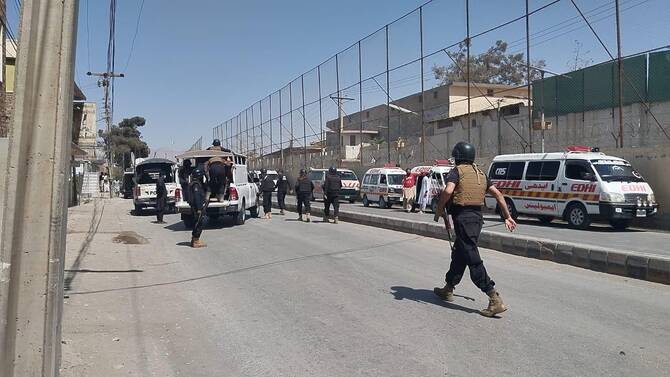
Attack on paramilitary force headquarters in Quetta leaves 10 people and four militants dead

Security officials cordon off the site after an explosion near the Frontier Corps Headquarters in Quetta on September 30, 2025. (AN Photo)
Short Url
Updated 30 September 2025
Follow

Attack on paramilitary force headquarters in Quetta leaves 10 people and four militants dead

  • Provincial health minister says many of the 32 injured are critical and being treated at Quetta’s Trauma Center
  • Balochistan chief minister says security forces responded promptly and repelled the ‘cowardly’ militant attack

QUETTA: A powerful suicide blast targeting the Frontier Corps (FC) headquarters in Quetta, the capital of Pakistan’s restive Balochistan province, killed at least 10 people and triggered a shootout in which four militants were slain, according to top provincial ministers on Tuesday.

Balochistan, which borders Afghanistan and Iran, is strategically significant for its vast mineral wealth and as a transit hub for the multibillion-dollar China-Pakistan Economic Corridor (CPEC). Yet, the province has long been gripped by separatist violence, with groups such as the Baloch Liberation Army (BLA) intensifying attacks in recent years.

So far, no militant outfit has claimed responsibility for Tuesday’s bombing.

“Ten people, including two members of Frontier Corps Balochistan and eight civilians, were killed in the suicide attack on the FC headquarters today,” provincial health minister Bakht Muhammad Kakar told journalists at the Civil Hospital after the blast. “Thirty-one injured were brought to the trauma center, with five in critical condition.”

Witnesses said a plume of smoke rose from the site on Quetta’s Haali Road, followed by gunfire that lasted more than 10 minutes.

Balochistan Chief Minister Mir Sarfraz Bugti said in televised remarks a suicide bomber drove a pickup truck into the compound to carry out the blast.

He added that several gunmen then stormed the headquarters, sparking a firefight in which paramilitary forces promptly killed four militants.

He condemned the bombing as a “cowardly act” and reaffirmed his government’s commitment to making the province peaceful and secure.

Bugti also expressed solidarity with the victims’ families and prayed for the swift recovery of the injured.

Separatist militant groups in Balochistan accuse Pakistan of depriving locals of a fair share in the province’s natural resources, allegations Islamabad denies.

However, the province has witnessed a string of high-profile attacks since the beginning of the year. In March, the BLA hijacked a passenger train, and in May, a suicide bombing in Khuzdar killed several children after targeting their school bus.

Security forces, civilians and non-local workers are frequently targeted by separatist groups in the region, though authorities have mainly relied on intelligence-based operations rather than launching a full-scale military campaign.


Pakistan offers Kyrgyzstan Arabian Sea access as two states sign 15 cooperation accords

Updated 05 December 2025
Follow

Pakistan offers Kyrgyzstan Arabian Sea access as two states sign 15 cooperation accords

  • Pakistan and Kyrgyzstan sign MOUs spanning trade, energy, agriculture, ports, education, security cooperation
  • Kyrgyz president is on first visit to Pakistan in 20 years as both sides push connectivity and CASA-1000 power links

ISLAMABAD: Pakistan on Thursday offered Kyrgyzstan the shortest and most economical route to the Arabian Sea as the two countries signed 15 agreements and memoranda of understanding aimed at boosting cooperation across trade, energy, agriculture, education, customs data-sharing and port logistics.

The accords were signed during a visit to Islamabad by President Sadyr Zhaparov, the first by a Kyrgyz head of state to Pakistan in two decades, and part of Islamabad’s renewed push to link South Asia with landlocked Central Asian economies through ports, power corridors and transport routes.

For Pakistan, Kyrgyzstan offers access to hydropower through CASA-1000, a $1.2 billion regional electricity transmission project designed to carry surplus summer electricity from Kyrgyzstan and Tajikistan through Afghanistan into Pakistan. For Bishkek, Pakistan provides overland access to warm-water ports on the Arabian Sea, creating a shorter commercial route to global markets.

“President Asif Ali Zardari has reiterated Pakistan’s readiness to offer Kyrgyzstan the shortest and most economical route to the Arabian Sea,” Radio Pakistan reported after Zhaparov met the Pakistani president. 

The two leaders also discussed expanding direct flights to deepen business, tourism and people-to-people ties.

Zardari welcomed Kyrgyzstan’s completion of its segment of the CASA-1000 project and “reaffirmed Pakistan’s commitment to completing its part of the project, which is now at an advanced stage,” the state broadcaster said. 

Zhaparov thanked Islamabad for supporting Bishkek’s candidacy for a non-permanent UN Security Council seat and invited Zardari to visit Kyrgyzstan at a time of his convenience. Both sides expressed satisfaction with progress under the Quadrilateral Traffic in Transit Agreement, designed to facilitate road movement between Pakistan, Kyrgyzstan, Kazakhstan and China.

Earlier, both governments exchanged 15 sectoral cooperation documents covering commerce, mining, geosciences, power, agriculture, youth programs, the exchange of convicted persons, customs electronic data systems and a sister-city linkage between Islamabad and Bishkek.

According to APP, the MOUs were signed by ministers representing foreign affairs, commerce, economy, energy, power, railways, interior, culture, health and tourism. Agreements also covered cooperation between Pakistan’s Foreign Service Academy and the Diplomatic Academy of Kyrgyzstan, as well as collaboration between universities, youth ministries and cultural institutions.

“Our present mutual trade, comprising of about $15–16 million will be enhanced to $200 million in the next two years,” Prime Minister Shehbaz Sharif said after the agreements were signed, calling them “a framework for structured, result-oriented engagement and closer institutional linkages.”

Sharif said Pakistan was ready to serve as a maritime outlet for the landlocked Central Asian republic, offering access to Karachi, Port Qasim and Gwadar to help Kyrgyz goods reach regional and global markets.