

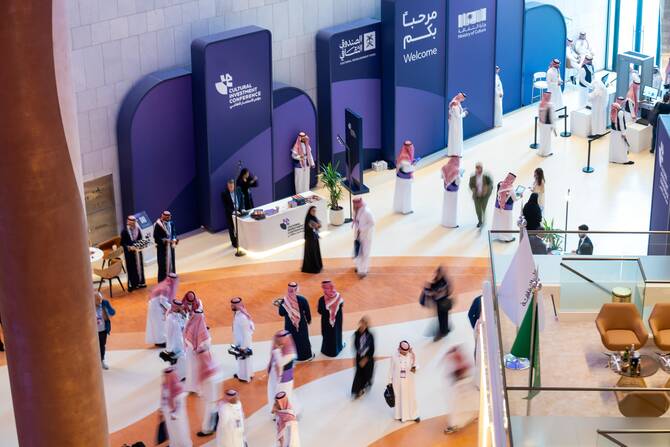
Inaugural Cultural Investment Conference opens in Riyadh

1 / 2
The inaugural Cultural Investment Conference opens in Riyadh. (Abdulrahman Fahad Bin Shulhub/AN)
2 / 2
The inaugural Cultural Investment Conference opens in Riyadh. Screenshot
Short Url
Updated 29 September 2025
Follow

Inaugural Cultural Investment Conference opens in Riyadh

  • Around 235,000 people are currently employed in the Kingdom’s cultural sector

RIYADH: The inaugural Cultural Investment Conference opens in Riyadh, with multisectoral representatives from arts practitioners, government officials, investors to diplomats gathering for high-level discussions on culture as a strategic investment.

The two-day event, held under the patronage of Crown Prince Mohammed bin Salman, “explores bold financing models, strategic partnerships, and the evolving role of cultural capital in driving economic growth, national identity, and global influence,” according to the conference website.

Among the key themes to be discussed include new investment opportunities, emerging markets and untapped sectors in the cultural economy, the RoI of culture, financing the future of culture, artificial intelligence and culture, boosting investor confidence and creative entrepreneurship.

Saudi Minister of Culture Prince Badr bin Farhan gives his opening speech. (Abdulrahman Fahad Bin Shulhub/AN)
The inaugural Cultural Investment Conference opens in Riyadh. (Abdulrahman Fahad Bin Shulhub/AN)
Saudi Investment Minister Khalid bin Abdulaziz Al-Falih, center, and Faisal Ali F. Ibrahim, Saudi Minister of Economy and Planning, right, in a high-level discussion with Arab News Editor-in-Chief Faisal J. Abbas. (Abdulrahman Fahad Bin Shulhub/AN)
Hamed bin Mohammed Fayez, Saudi Arabia’s Vice Minister of Culture, gives his remarks during a high-level session at the inaugural Cultural Investment Conference opens in Riyadh. (Abdulrahman Fahad Bin Shulhub/AN)
From left: Faisal J. Abbas, Arab News Editor-in-Chief, Hamed bin Mohammed Fayez, Saudi Arabia’s Vice Minister of Culture, Shaikha Mai bin Mohammed Al-Khalifa, Founder and Chairperson, Board of Trustees, Shaikh Ebrahim Center for Culture and Research and Dr. Andreas Gorgen, Ambassador for Multilateral Cooperation during a session at the inaugural Cultural Investment Conference in Riyadh. (Abdulrahman Fahad Bin Shulhub/AN)

Saudi Investment Minister Khalid bin Abdulaziz Al-Falih, during the opening high-level session, said that the Kingdom today hosts over 50,000 investors, both local and international.

Around 1,700 international investors are engaged in the Kingdom’s culture sector, including creative industries, arts, events, and entertainment, he said.

Opinion

This section contains relevant reference points, placed in (Opinion field)

Foreign investments in culture have surged from virtually nothing six or seven years ago to over $500 million (SR1.8 billion) as of last year, growing at double-digit rates, the investment minister added.

Faisal Ali F. Ibrahim, the Saudi Minister of Economy and Planning, meanwhile said that around 235,000 people are currently employed in the Kingdom’s cultural sector.


He added that the target is to triple the culture sector’s contribution to GDP by 2030.

Meanwhile Hamed bin Mohammed Fayez, Saudi Arabia’s Vice Minister of Culture, in a separate session, said that cultural tourism alone accounts for 40 percent of global tourism revenue and has proven to be one of the most resilient sectors after COVID-19.


Over 3k flights cancelled across the Middle East after attack on Iran by the US, Israel

Updated 01 March 2026
Follow

Over 3k flights cancelled across the Middle East after attack on Iran by the US, Israel

RIYADH: US and Israeli strikes on Iran led to widespread airspace shutdowns in the Middle East, canceling and rerouting thousands of flights and paralyzing key international travel corridors.

Flight cancellations affected seven airports across the Middle East, including Dubai and Abu Dhabi in the UAE, Doha in Qatar, and Manama in Bahrain.

Emirates Airlines said in a statement: “Due to multiple regional airspace closures, Emirates has temporarily suspended all operations to and from Dubai, up until 1500 hrs UAE time on Monday, 2 March.”

A flydubai spokesperson said the situation is evolving, and the airline is closely monitoring developments while coordinating with authorities to adjust its flight schedule.

“Our teams are working diligently to implement comprehensive welfare for all affected customers. The safety of our passengers and crew remains our highest priority,” the spokesperson said.

He added: “We are currently experiencing a high volume of calls and appreciate our customers’ patience while our teams work to assist everyone as quickly as possible.”

Qatar Airways announced that the airport will remain closed until at least the morning of March 2.

“Qatar Airways flights to, and from, Doha have been temporarily suspended due to the closure of Qatari airspace,” the airline said.

It added: “Qatar Airways will resume operations once the Qatar Civil Aviation Authority announces the safe reopening of Qatari airspace.”

Saudia also said in an official statement that it had canceled a number of flights due to developments in the region and the closure of airspace.

The organization said the decision was taken in line with aviation safety and security standards, noting that its Emergency Coordination Center is closely monitoring developments with relevant authorities.

Saudia urged passengers to verify the status of their flights before heading to the airport and said guests would be notified of updates through the contact details associated with their bookings.

The carrier added that further information would be announced in a subsequent statement if available.

Air Arabia also said its flights were experiencing cancellations, delays, or rerouting as a result of the evolving situation and airspace closures.

Airlines cited airspace closures and safety concerns as the main reasons for flight disruptions, urging passengers to check official channels for updates as the situation develops.

Israeli airspace also remained closed on March 1st. Israeli airline El Al said it was preparing a recovery effort to bring home Israelis stranded abroad once the airspace reopened.

Travelers were either stranded or diverted to other airports on Feb. 28 after Israel, Qatar, Syria, and Iran as well as Iraq, Kuwait and Bahrain, closed their airspace.

After the UAE announced a temporary partial airspace closure, FlightRadar24 recorded no flights over the country.

The closures affected key hub airports in Dubai, Abu Dhabi, and Doha. Emirates, Qatar Airways, and Etihad, airlines that operate from these hubs, normally handle around 90,000 passengers daily, with even more traveling to other Middle Eastern destinations, according to aviation analytics firm Cirium.

Airports hit by attacks

Two airports in the UAE reported incidents as the government there condemned what it called a “blatant attack involving Iranian ballistic missiles” on Feb.28.

Dubai International Airport, the UAE’s largest and one of the world’s busiest, reported four injuries, while Abu Dhabi’s Zayed International Airport said a drone attack killed one person and injured seven others. Strikes were also reported at Kuwait International Airport.

Though Iran did not publicly claim responsibility, the scope of retaliatory strikes that Gulf nations attributed to Iran extended beyond the US bases that it previously said it would target.

Flight delays, cancellations are likely to continue

“For travelers, there’s no way to sugarcoat this,” said Henry Harteveldt, an airline industry analyst and president of Atmosphere Research Group.

“You should prepare for delays or cancellations for the next few days as these attacks evolve and hopefully end,” he added.

To avoid conflict zones, airlines are rerouting Middle East flights over Saudi Arabia, adding hours and fuel costs, which could push ticket prices higher if the tensions persist.

The extra flights will strain air traffic controllers in the Kingdom, who may need to slow traffic for safety. Meanwhile, countries that closed their airspace will lose out on overflight fees from passing airlines.

Mike McCormick, former head of air traffic control at the FAA and now a professor at Embry-Riddle Aeronautical University, said some countries may reopen parts of their airspace in the coming days once US and Israeli officials provide airlines with details on military flight zones and Iran’s missile capabilities.

“Those countries then will be able to go through and say, ok, we can reopen this portion of our space but we’ll keep this portion of our airspace closed,” McCormick said.

“So, I think what we’ll see in the next 24 to 36 hours is how the use of airspace evolves as the kinetic activity gets more well-defined and as the capability of Iran to actually shoot missiles and create additional risk is diminished due to the attacks,” he added.

But it is unclear how long the disruption to flight operations could last. For comparison, the Israeli and US attack on Iran in June 2025 lasted 12 days.