

Return of sanctions must not be end of diplomacy with Iran: EU’s top diplomat

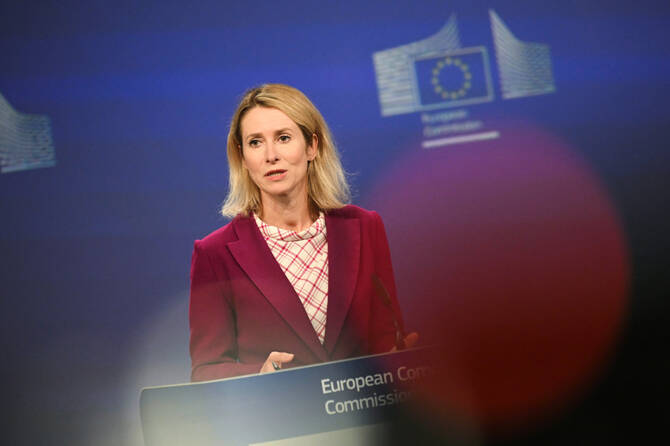
EU High Representative and Vice President for Foreign Affairs and Security Policy Kaja Kallas says a sustainable solution to the Iranian nuclear issue can only be achieved through negotiations. (AFP)
Short Url
Updated 29 September 2025
Follow

Return of sanctions must not be end of diplomacy with Iran: EU’s top diplomat

  • Sustainable solution to nuclear issue can only be achieved through talks: Kallas

BRUSSELS/TEHRAN: The return of widespread sanctions against Iran’s nuclear program “must not be the end of diplomacy” with the country, the EU’s top diplomat said on Sunday.

While the bloc will follow the UN in reimposing sanctions, “a sustainable solution to the Iranian nuclear issue can only be achieved through negotiations,” Kaja Kallas said.

The British, French and German foreign ministers said in a joint statement they would continue to seek “a new diplomatic solution to ensure Iran never gets a nuclear weapon.”

Iran condemned as “unjustifiable” the reinstatement of sanctions. 

“The reactivation of annulled resolutions is legally baseless and unjustifiable ... all countries must refrain from recognizing this illegal situation,” the Iranian Foreign Ministry said.

Iran “will firmly defend its national rights and interests, and any action aimed at undermining the rights and interests of its people will face a firm and appropriate response,” it added.

US Secretary of State Marco Rubio urged Iran to “accept direct talks, held in good faith.”

He also called on UN member states to “immediately” implement sanctions to “pressure Iran’s leaders to do what is right for their nation, and best for the safety of the world.”

Iranian President Masoud Pezeshkian rejected any nuclear negotiations that would cause “new problems.”


Macron vows stronger cooperation with Nigeria after mass kidnappings

Updated 2 sec ago
Follow

Macron vows stronger cooperation with Nigeria after mass kidnappings

PARIS: French President Emmanuel Macron said Sunday that France will step up cooperation with Nigeria after speaking with his counterpart, as the West African country faces a surge in abductions.
Nigeria has been wracked by a wave of kidnappings in recent weeks, including the capture of over 300 school children two weeks ago that shook Africa’s most populous country, already weary from chronic violence.
Macron wrote on X that the move came at Nigerian President Bola Tinubu’s request, saying France “will strengthen our partnership with the authorities and our support for the affected populations,” while urging other countries to “step up their engagement.”
“No one can remain a spectator” to what is happening in Nigeria, the French president said.
Nigeria has drawn heightened attention from Washington in recent weeks, after US President Donald Trump said in November that the United States was prepared to take military action there to counter the killing of Christians.
US officials, while not contradicting Trump, have since instead emphasized other US actions on Nigeria including security cooperation with the government and the prospect of targeted sanctions.
Kidnappings for ransom by armed groups have plagued Nigeria since the 2014 abduction of 276 school girls in the town of Chibok by Boko Haram jihadists.
The religiously diverse country is the scene of a number of long-brewing conflicts that have killed both Christians and Muslims, often indiscriminately.
Many scholars say the reality is more nuanced, with conflicts rooted in struggles for scarce resources rather than directly related to religion.