Pakistan says bilateral trade with Central Asia, Afghanistan rose to $2.4 billion in FY25

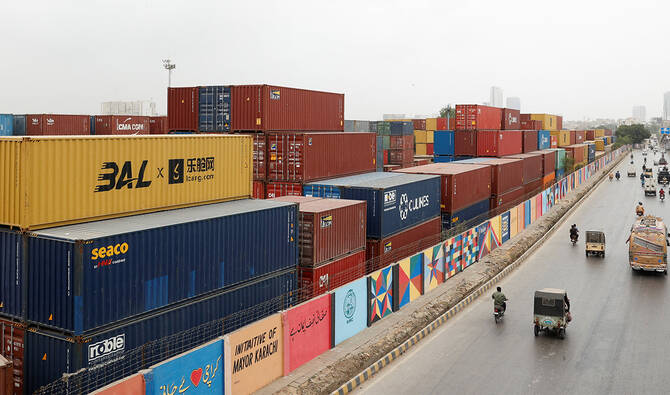
Vehicles move past a warehouse yard with shipping containers near port area in Karachi, Pakistan, on July 31, 2025. (REUTERS/File)
Short Url
Updated 28 September 2025
Follow

Pakistan says bilateral trade with Central Asia, Afghanistan rose to $2.4 billion in FY25

  • Pakistan’s bilateral trade with Central Asian states, Afghanistan was recorded at $1.92 in FY24, says state media 
  • Afghanistan remains Pakistan’s largest trading partner in region, with exports rising to $1.39 billion last fiscal year

ISLAMABAD: Pakistan’s bilateral trade with Central Asian states and Afghanistan increased to $2.41 billion during the last fiscal year, state-run Associated Press of Pakistan (APP) reported this week, citing the need for Islamabad to enhance regional connectivity for greater economic stability. 

Pakistan has undertaken steps in recent months to boost regional connectivity and trade links with Central Asian states and Afghanistan. Prime Minister Shehbaz Sharif visited Azerbaijan and Tajikistan this year as Islamabad attempts to build trade corridors to ensure sustainable economic growth. 

Islamabad has also called for peace and stability in Afghanistan, stressing that law and order in the neighboring country will help regional trade flourish.

“Pakistan’s bilateral trade with Central Asian states, along with Afghanistan and Azerbaijan, surged to $2.41 billion in FY25, showing a sharp increase from $1.92 billion in the previous fiscal year,” the APP reported on Saturday. 

It said Pakistan’s exports to these countries surged to $1.77 billion while imports were recorded at $641 million. The state media said these numbers reflect a “clear recovery” from FY24, when exports were recorded at $1.34 billion and imports reached $581 million. 

“Afghanistan continues to dominate as Pakistan’s largest trading partner in the region, with exports rising to $1.39 billion and imports reaching $612.5 million,” the report said. 

It said Kazakhstan has also emerged as “a significant partner,” with exports from Pakistan increasing to $250.8 million. Uzbekistan followed with $91.4 million in exports and $20.3 million in imports in FY25.

Other countries such as Kyrgyzstan, Tajikistan, Turkmenistan and Azerbaijan maintained “smaller yet consistent shares” in bilateral trade, the state media said. 

“The regional trade context highlights enormous untapped potential. Central Asian countries managed a massive $318.01 billion in global trade during FY24, yet Pakistan’s share in this remains under $0.5 billion,” the report said. 

It said the Pakistan-Central Asia transit trade stood at $410 million in fiscal year 2025, signaling growing reliance on Pakistan’s corridors for regional connectivity.

“Experts underline that while the current trade growth is encouraging, Pakistan’s real opportunity lies in establishing direct connectivity and strategic trade routes with the Central Asian bloc,” the report concluded. 

Ever since it almost defaulted on its loans in June 2023, Pakistan has sought to establish closer economic ties with regional countries. Sharif established the Special Investment Facilitation Council (SIFC) in 2023 to fast-track decisions related to investment in priority sectors such as IT, minerals, agriculture, livestock and tourism, among others. 


Pakistan plans broader privatization push, eyes power utilities this year

Updated 5 sec ago
Follow

Pakistan plans broader privatization push, eyes power utilities this year

  • Considerably high losses, inefficiencies and mounting subsidies in power sector have dented Pakistan’s public finances
  • Finance Minister Muhammad Aurangzeb says 26 state-owned entities have been handed over to Privatization Commission

ISLAMABAD: Pakistan is widening a sweeping privatization program following the sale of its national airline last year, with power distributors next in line and more state companies to be handed to the Privatization Commission, the finance minister said on Monday.

Pakistan’s government successfully divested a 75 percent stake in the Pakistan International Airlines (PIA) in December last year. The move was part of Islamabad’s broader privatization program, which aims to reduce fiscal losses inflicted by loss-making state-owned enterprises (SOEs) by either privatizing or restructuring them.

Pakistani officials have said the Privatization Commission plans to divest the country’s electricity distribution companies in two batches. The first phase will include the Islamabad Electric Supply Company, Gujranwala Electric Power Company and Faisalabad Electric Supply Company, followed by Hyderabad Electric Supply Company and Sukkur Electric Power Company in the second batch. Considerably high losses, inefficiencies and mounting subsidies in the power sector have dented Pakistan’s public finances over the years, making it a central focus of Islamabad’s reform agenda.

Speaking at a news conference about Pakistan’s privatization program, Finance Minister Muhammad Aurangzeb said there are five power distribution companies to be privatized this year, out of which the sell-side advisers for three are Alvarez & Marsel. He said the Turkish Investment Bank has been entrusted with the task of being the sell-side advisers for the other two companies. 

“Overall, 26 SOEs have been handed over to the Privatization Commission,” Aurangzeb told reporters. “This decision is first made in the Cabinet Committee on SOEs, it then goes to the Cabinet Committee on Privatization, and then its overall approval is given by the prime minister and the cabinet.”

Aurangzeb vowed the government will take the privatization process forward with the same level of transparency as it had exhibited during the PIA sale last year. 

“And this will be taken forward with a lot of speed because we will not stop at 26 SOEs,” the finance minister said. “We will also gradually hand over other state institutions to the Privatization Commission,” he added. 

Speaking further about SOEs and their performances over the years, the minister said losses from the state entities decreased by about Rs74 billion [$264.6 million] over the last three years.

He said SOEs had reported losses of Rs905 billion [$3.24 billion] in 2023, Rs851 billion [$3.04 billion] in 2024 and Rs832 billion [$2.98 billion] in 2025.

Pakistan’s privatization push comes at the back of its efforts to ensure sustainable economic progress after a prolonged macroeconomic crisis that drained its foreign exchange reserves and triggered a balance of payments crisis.