Pakistan accuses India of ‘sponsoring terrorism beyond its borders’ durinng UN spat

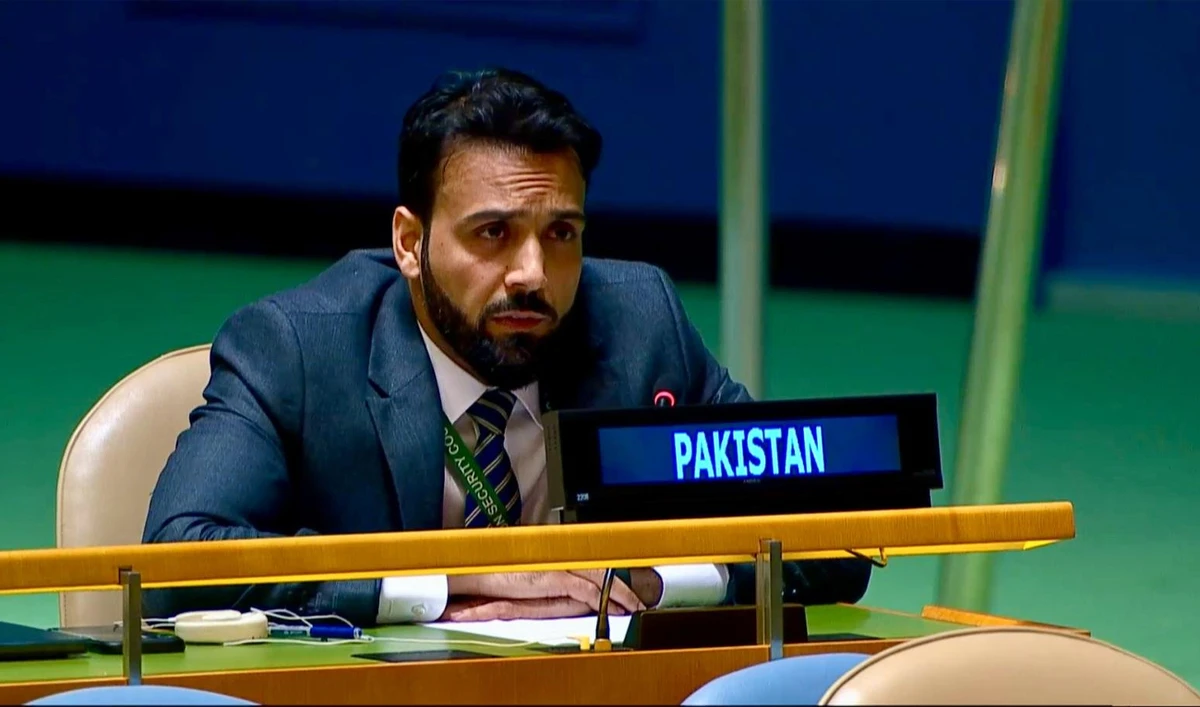
Muhammad Rashid, Second Secretary at the Pakistan Mission to the United Nations, speaks at the 80th Session of the UN General Assembly on September 27, 2025. (X/@PakistanUN_NY)
Short Url
Updated 28 September 2025
Follow

Pakistan accuses India of ‘sponsoring terrorism beyond its borders’ durinng UN spat

  • Islamabad responds to Indian FM describing Pakistan as “epicenter of global terrorism” during UNGA speech
  • Militaries of India, Pakistan engaged in four-day military conflict in May, killing over 70 people on both sides 

ISLAMABAD: A senior Pakistani diplomat at the United Nations this week responded to India’s allegations that its neighboring country was a “terrorist epicenter,” accusing Delhi of sponsoring cross-border “terrorism” as the war of words between the two nations at the global platform worsened. 

India’s External Affairs Minister Subrahmanyam Jaishankar, during his UN General Assembly speech on Saturday, said his country had a neighbor that was the “epicenter of global terrorism,” without naming Pakistan. 

His statement came after Prime Minister Shehbaz Sharif’s UNGA speech on Friday, in which he offered talks to India. However, the Pakistani prime minister blamed India for seeking to “extract political gains” from a militant attack in Indian-administered Kashmir’s Pahalgam, which killed 26 tourists in April. 

India had blamed Pakistan for the attack, a charge denied by Islamabad. The incident triggered a four-day military conflict between the neighbors that saw over 70 killed on both sides of the border before they agreed to a ceasefire on May 10. 

“India itself has been implicated in supporting and sponsoring terrorism beyond its borders,” Muhammad Rashid, the second secretary at the Pakistan Mission at the UN, said in a statement on Saturday. 

“There are credible reports pointing to networks run by Indian intelligence agencies to destabilize its neighboring countries.”

Pakistan and India routinely accuse each other of supporting militant groups waging attacks against the other. Pakistan alleges India arms and funds militants in its western provinces bordering Afghanistan through its Research and Analysis Wing (RAW) intelligence agency, charges New Delhi denies. 

Pakistan has also cited accusations by former Canadian PM Justin Trudeau, who had accused the Indian government last year of being involved in the 2023 killing of Sikh separatist Hardeep Singh Nijjar in British Columbia. India denied the allegations, triggering a diplomatic row between the two nations. 

India, on the other hand, accuses Pakistan of supporting militants in Indian-administered Kashmir, which Islamabad denies. The two countries have fought three wars since 1947, two of which were over the disputed territory of Kashmir. 

In his statement, Rashid said undermining regional stability and violating international law had become a “habit for India.”

“Therefore, such actions expose the duplicity of its counterterrorism claims and raise serious concerns about its role in fueling rather than combating terrorism,” the statement said. 

While the fragile ceasefire between India and Pakistan continues to hold, tensions remain high as Delhi vows to hold in abeyance the Indus Waters Treaty of 1960 that governs the sharing of the Indus River system between the two countries. 

Pakistan has warned that any attempt to restrict or divert the flow of its waters by India would be taken as an “act of war” and would be firmly responded to.
Imran Khan not a ‘national security threat,’ ex-PM’s party responds to Pakistan military

Updated 4 sec ago
Follow

Imran Khan not a ‘national security threat,’ ex-PM’s party responds to Pakistan military

  • Pakistan’s military spokesperson on Friday described Khan’s anti-army narrative as a “national security threat”
  • PTI Chairman Gohar Ali Khan says words used by military spokesperson for Khan were “not appropriate”

ISLAMABAD: Former prime minister Imran Khan’s Pakistan Tehreek-e-Insaf (PTI) party on Saturday responded to allegations by Pakistan military spokesperson Lt. Gen. Ahmed Sharif Chaudhry from a day earlier, saying that he was not a “national security threat.”

Chaudhry, who heads the military’s media wing as director general of the Inter-Services Public Relations (ISPR), spoke to journalists on Friday, in which he referred to Khan as a “mentally ill” person several times during the press interaction. Chaudhry described Khan’s anti-army narrative as a “national security threat.”

The military spokesperson was responding to Khan’s social media post this week in which he accused Chief of Defense Forces Field Marshal Asim Munir of being responsible for “the complete collapse of the constitution and rule of law in Pakistan.” 

“The people of Pakistan stand with Imran Khan, they stand with PTI,” the party’s secretary-general, Salman Akram Raja, told reporters during a news conference. 

“Imran Khan is not a national security threat. Imran Khan has kept the people of this country united.”

Raja said there were several narratives in the country, including those that created tensions along ethnic and sectarian lines, but Khan had rejected all of them and stood with one that the people of Pakistan supported. 

PTI Chairman Gohar Ali Khan, flanked by Raja, criticized the military spokesperson as well, saying his press talk on Thursday had “severely disappointed” him. 

“The words that were used [by the military spokesperson] were not appropriate,” Gohar said. “Those words were wrong.”

NATURAL OUTCOME’

Speaking to reporters earlier on Saturday, Pakistan’s Defense Minister Khawaja Asif defended the military spokesperson’s remarks against Khan.

“When this kind of language is used for individuals as well as for institutions, then a reaction is a natural outcome,” he said. 

“The same thing is happening on the Twitter accounts being run in his [Khan’s] name. If the DG ISPR has given any reaction to it, then I believe it was a very measured reaction.”

Khan, who was ousted after a parliamentary vote of confidence in April 2022, blames the country’s powerful military for removing him from power by colluding with his political opponents. Both deny the allegations. 

The former prime minister, who has been in prison since August 2023 on a slew of charges he says are politically motivated, also alleges his party was denied victory by the army and his political rivals in the 2024 general election through rigging. 

The army and the government both deny his allegations.