18 dead, dozens missing in Nigeria mine collapse: local sources

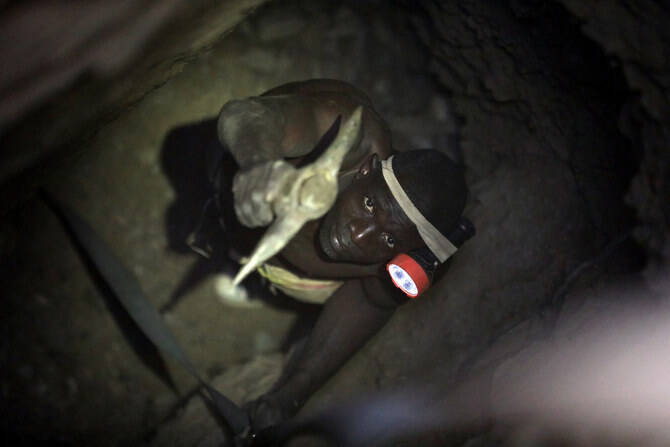
Rescuers in Nigeria are searching for dozens of people missing after a boulder crashed onto an illegal mine during heavy rains, killing at least 18 people, local sources told AFP on Saturday. (AFP/File)
Short Url
Updated 27 September 2025
Follow

18 dead, dozens missing in Nigeria mine collapse: local sources

  • “We have managed to pull out 18 dead bodies from the pit,” Lawwali said
  • A dozen other miners were still trapped inside

GUSAU, Nigeria: Rescuers in Nigeria are searching for dozens of people missing after a boulder crashed onto an illegal mine during heavy rains, killing at least 18 people, local sources told AFP on Saturday.
The rock came crashing down on Thursday on the mine in the northern Zamfara state outside the Kadauri village in the Maru district, they said.
“We have managed to pull out 18 dead bodies from the pit and five other survivors who sustained various degrees of injuries,” Sani Lawwali, a miner who works in unauthorized pits, said from Kadauri.
A dozen other miners were still trapped inside and their fate remained unknown, said Lawwali, who took part in the rescue effort.
“The process is slow and laborious as we use our bare hands to chisel the end of the boulder to make holes for limited access into the pit,” he said.
Rescuers have asked for a bulldozer being used at a nearby road construction site to be brought in to help, but had not yet received a response from the company using it, Lawwali added.
Abubakar Nabube, a local community leader, confirmed the death toll of 18. He said that 15 of those killed came from the nearby Maikwanugga and Damaga villages.
“If no help comes from emergency agencies soon, none of those trapped would come out alive,” he said.
Zayyanu Ibrahim, a resident of Kadauri village said the collapse occurred at one of several newly dug sites in the recently established mining site.
“Dozens of miners were working in the pit while it heavily rained outside. A huge boulder at the mouth of the pit collapsed and buried miners inside,” said Ibrahim, who also confirmed the toll.
Sani Abdullahi, a councillor in the area, said it was difficult to say how many people there were in the pit at the time of the accident.
Officials from the Nigerian emergency agency NEMA did not respond to an AFP enquiry about the accident.
Zamfara, a poor agrarian state, is rich in gold deposits where illegal artisanal mining thrives in the countryside, despite several attempts by authorities to stop the practice.
The authorities have blamed illegal mining for the worsening of bandit violence, with criminal gangs getting money from protection fees they extort from miners.


UN’s top court opens Myanmar Rohingya genocide case

Updated 12 January 2026
Follow

UN’s top court opens Myanmar Rohingya genocide case

  • The Gambia filed a case against Myanmar at the UN’s top court in 2019
  • Verdict expected to impact Israel’s genocide case over war on Gaza

DHAKA: The International Court of Justice on Monday opened a landmark case accusing Myanmar of genocide against its mostly Muslim Rohingya minority.

The Gambia filed a case against Myanmar at the UN’s top court in 2019, two years after a military offensive forced hundreds of thousands of Rohingya from their homes into neighboring Bangladesh.

The hearings will last three weeks and conclude on Jan. 29.

“The ICJ must secure justice for the persecuted Rohingya. This process should not take much longer, as we all know that justice delayed is justice denied,” said Asma Begum, who has been living in the Kutupalong refugee camp in Bangladesh’s Cox’s Bazar district since 2017.

A mostly Muslim ethnic minority, the Rohingya have lived for centuries in Myanmar’s western Rakhine state but were stripped of their citizenship in the 1980s and have faced systemic persecution ever since.

In 2017 alone, some 750,000 of them fled military atrocities and crossed to Bangladesh, in what the UN has called a textbook case of ethnic cleansing by Myanmar.

Today, about 1.3 million Rohingya shelter in 33 camps in Cox’s Bazar, turning the coastal district into the world’s largest refugee settlement.

“We experienced horrific acts such as arson, killings and rape in 2017, and fled to Bangladesh,” Begum told Arab News.

“I believe the ICJ verdict will pave the way for our repatriation to our homeland. The world should not forget us.”

A UN fact-finding mission has concluded that the Myanmar 2017 offensive included “genocidal acts” — an accusation rejected by Myanmar, which said it was a “clearance operation” against militants.

Now, there is hope for justice and a new future for those who have been displaced for years.

“We also have the right to live with dignity. I want to return to my homeland and live the rest of my life in my ancestral land. My children will reconnect with their roots and be able to build their own future,” said Syed Ahmed, who fled Myanmar in 2017 and has since been raising his four children in the Kutupalong camp.

“Despite the delay, I am optimistic that the perpetrators will be held accountable through the ICJ verdict. It will set a strong precedent for the world.”

The Myanmar trial is the first genocide case in more than a decade to be taken up by the ICJ. The outcome will also impact the genocide case that Israel is facing over its war on Gaza.

“The momentum of this case at the ICJ will send a strong message to all those (places) around the world where crimes against humanity have been committed,” Nur Khan, a Bangladeshi lawyer and human rights activist, told Arab News.

“The ICJ will play a significant role in ensuring justice regarding accusations of genocide in other parts of the world, such as the genocide and crimes against humanity committed by Israel against the people of Gaza.”