11 killed, 26 injured in two road accidents in Pakistan’s southwestern Balochistan

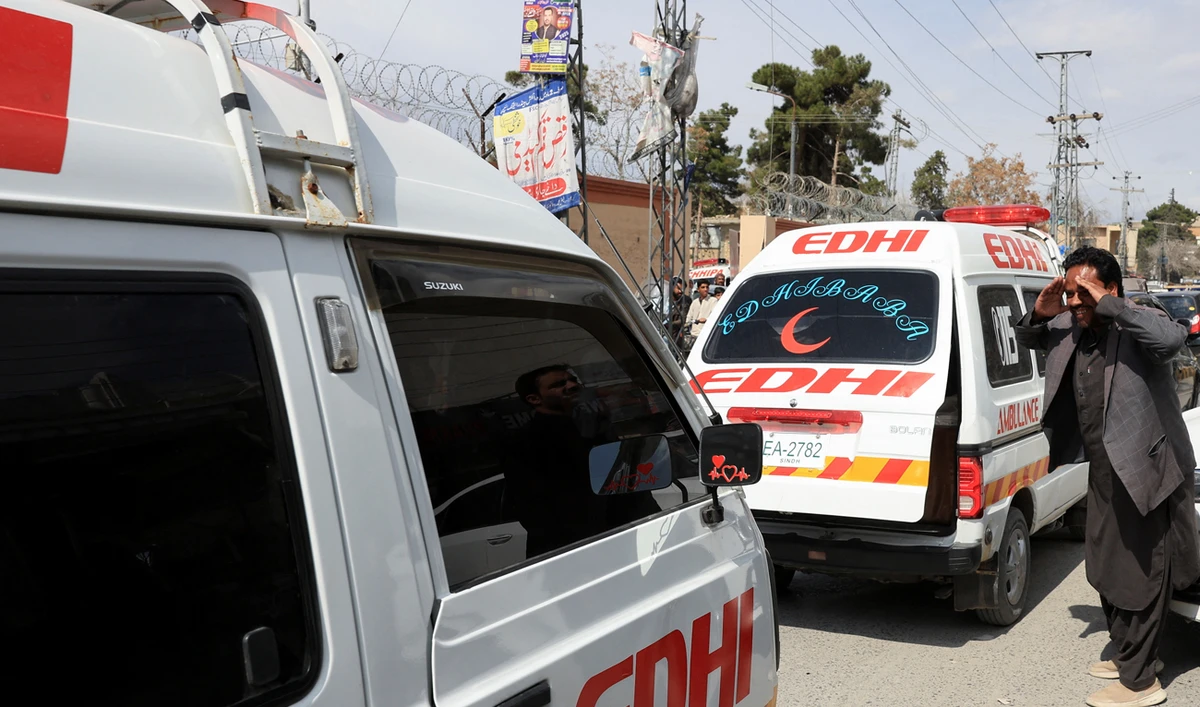
A man reacts next to ambulances carrying the bodies of victims, who were killed in Jaffar Express train hijacking, in Quetta, Pakistan on March 13, 2025. (REUTERS/File)
Short Url
Updated 27 September 2025
Follow

11 killed, 26 injured in two road accidents in Pakistan’s southwestern Balochistan

  • Passenger bus in Panjgur collided with a diesel-laden vehicle, sparking a fire that gutted the coach
  • In Khanozai, a bus going to Islamabad overturned after a head-on crash, injuring several people

QUETTA: At least 11 people were killed and 26 others injured on Saturday in two separate road accidents in Pakistan’s southwestern Balochistan province, government officials said.

The first crash occurred on the N-85 highway near Panjgur when a Khuzdar-Panjgur bound passenger bus collided with an Iranian Zamyad vehicle carrying smuggled diesel. The vehicle burst into flames on impact, setting the bus ablaze.

“Eight people were killed in the accident and three injured,” said Panjgur Deputy Commissioner Kabeer Zarkoon, adding that one critically injured passenger had been referred to Karachi for treatment.

Footage seen by Arab News showed the bus completely gutted by fire.

The second incident took place in Khanozai, about 35 kilometers from Pishin, when a Quetta-Islamabad bound bus overturned after colliding with another vehicle on the N-50 highway.

“The bus crashed into a vehicle coming from the opposite direction and overturned, killing three passengers and injuring 23,” said Amir Hamza, Assistant Commissioner Karezat.

He said eight critically injured passengers were shifted to the Trauma Center Quetta, while others with minor injuries were treated on the spot.

Fatal road accidents are frequent in Pakistan, where poor road conditions, aging vehicles and disregard for traffic rules often cause casualties.

Much of Balochistan lacks dual carriageways, making head-on collisions a persistent danger. The traffic police regularly warn drivers on social media against speeding and reckless driving.

Smuggled Iranian fuel has also played a role in major damage caused by accidents in the province.

Balochistan’s porous border with Iran makes it possible for people to bring diesel and petrol illegally, which are then sold across the province and parts of Sindh, despite the risks of transporting them in unsafe vehicles.
Islamabad puts drivers on notice as smog crisis worsens

Updated 12 sec ago
Follow

Islamabad puts drivers on notice as smog crisis worsens

  • Police checkpoints have issued over 300 fines and impounded 80 vehicles as Islamabad rolls out roadside emissions checks
  • Transport accounts for over half of the capital’s toxic PM2.5, with air quality this month repeatedly breaching WHO safety limits

ISLAMABAD: Truck driver Muhammad Afzal was not expecting to be stopped by police, let alone fined, as he drove into Islamabad this week because of the thick diesel fumes emanating from his exhaust pipe.

“This is unfair,” he said after being told to pay 1,000 rupees ($3.60), with the threat of having his truck impounded if he did not “fix” the problem.

“I was coming from Lahore after getting my vehicle repaired. They pressed the accelerator to make it release smoke. It’s an injustice,” he told AFP.

This picture taken on December 10, 2025, shows residents examining their cars at an emission testing point in Islamabad. (AFP)

Checkpoints set up this month are part of a crackdown by authorities to combat the city’s soaring smog levels, with winter months the worst due to atmospheric inversions that trap pollutants at ground level.

“We have already warned the owners of stern action, and we will stop their entry into the city if they don’t comply with the orders,” said Dr. Zaigham Abbas of Pakistan’s Environmental Protection Agency (EPA), as he surveyed the checkpoint at the southeast edge of the capital.

For Waleed Ahmed, a technician inspecting the vehicles at the site, “just like a human being, a vehicle has a life cycle. Those that cross it release smoke that is dangerous to human health.”

This picture taken on December 10, 2025, shows technician Waleed Ahmed examining a vehicle to test its emissions on road, on the outskirts of Islamabad. (AFP)

‘SELF-INFLICTED CRISIS’

While not yet at the extreme winter levels of Lahore or the megacity Karachi, where heavy industry and brick kilns spew tons of pollutants each year, Islamabad is steadily closing the gap.

So far in December it has already registered seven “very unhealthy” days for PM2.5 particulates of more than 150 micrograms per cubic meter, according to the Swiss-based monitoring firm IQAir.

Intraday PM2.5 levels in Islamabad often exceed those in Karachi and Lahore, and in 2024 the city’s average PM2.5 reading for the year was 52.3 micrograms — surpassing the 46.2 for Lahore.

Those annual readings are far beyond the safe level of five micrograms recommended by the World Health Organization.

An aerial picture shows dense smog in Islamabad on December 12, 2025. (AFP)

Built from scratch as Pakistan’s capital in the 1960s, the city was envisioned as an urban model for the rapidly growing nation, with wide avenues and ample green spaces abutting the Himalayan foothills.

But the expansive layout discourages walking and public transport remains limited, meaning cars — mostly older models — are essential for residents to get around.

“The capital region is choked overwhelmingly by its transport sector,” which produces 53 percent of its toxic PM2.5 particles, the Pakistan Air Quality Initiative, a research group, said in a recent report.

“The haze over Islamabad... is not the smoke of industry, but the exhaust of a million private journeys — a self-inflicted crisis,” it said.

‘HER BASIC RIGHT’

Announcing the crackdown on December 7, EPA chief Nazia Zaib Ali said over 300 fines were issued at checkpoints in the first week, with 80 vehicles impounded.

“We cannot allow non-compliant vehicles at any cost to poison the city’s air and endanger public health,” she said in a statement.

This picture taken on December 10, 2025, shows a technician pasting a certified sticker on a car after it cleared an emission test in Islamabad. (AFP)

The city has also begun setting up stations where drivers can have their emissions inspected, with those passing receiving a green sticker on their windshield.

“We were worried for Lahore, but now it’s Islamabad. And that’s all because of vehicles emitting pollution,” said Iftikhar Sarwar, 51, as he had his car checked on a busy road near an Islamabad park.

“I never needed medicine before but now I get allergies if I don’t take a tablet in the morning. The same is happening with my family,” he added.

Other residents say they worry the government’s measures will not be enough to counter the worsening winter smog.

“This is not the Islamabad I came to 20 years ago,” said Sulaman Ijaz, an anthropologist.

“I feel uneasy when I think about what I will say if my daughter asks for clean air — that is her basic right.”