

Rights groups, activists urge Microsoft to cut all military ties with Israel after partial service suspension

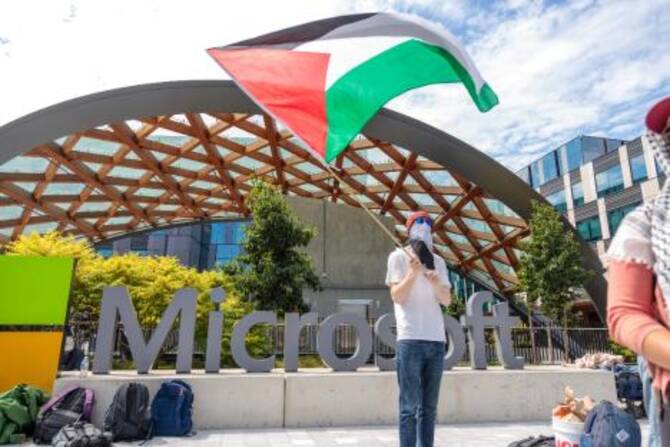
Microsoft workers occupy HQ in protest against company’s ties to Israeli military. (File/No Azure for Apartheid group)
Short Url
Updated 27 September 2025
Follow

Rights groups, activists urge Microsoft to cut all military ties with Israel after partial service suspension

  • Tech giant halts Israeli access to some technologies linked to mass surveillance of Palestinians
  • Campaign group steps up protests against Microsoft, demanding a ‘digital arms embargo’

LONDON: Human rights groups and activists welcomed Microsoft’s suspension of Israeli military access to some technologies linked to mass surveillance of Palestinians, urging the company to go further and end all contracts with Israel.

The decision, announced by Microsoft President Brad Smith on Thursday, followed an investigation by The Guardian, +972 Magazine, and Local Call, which revealed that Unit 8200, Israel’s spy agency, used Microsoft’s Azure cloud platform to store and process vast amounts of Palestinian phone calls in Gaza and the West Bank as part of a mass surveillance program.

Microsoft said it acted after reviewing the reports and had blocked the unit’s access to some cloud storage and AI services.

Agnes Callamard, secretary-general of Amnesty International, urged the tech giant to investigate all its other dealings with the Israeli military to ensure they do not contribute to Israel’s “human rights violations against Palestinians.”

She urged other tech companies to suspend similar technology and military sales and called for accountability as Israel’s campaign in Gaza continues to cause mass civilian casualties, displacement and famine.

“There must be an end to the impunity that Israel has enjoyed and flouted,” said Callamard, urging states to “live up to their legal obligations toward bringing Israel’s genocide.”

The worker-led “No Azure for Apartheid” campaign group, which has lately escalated protests against Microsoft for its ties with Israel, welcomed the partial suspension but said it was “insufficient.”

The group reiterated its call for a complete suspension of Microsoft’s ties with the Israeli military and vowed to continue protests until that demand is met.

“We know that this is not enough,” Hossam Nasr, one of the group’s organizers, told Arab News.

“Microsoft has only disabled a small subset of services to only one unit in the Israeli military. The vast majority of Microsoft’s contract with the Israeli military remains intact.”

He said continuing ties with the military while it carries out its relentless campaign in Gaza is “unconscionable and morally indefensible for Microsoft.”

Nasr, a former Microsoft employee who was fired last year for holding an “unauthorized” vigil for Palestinian victims of Gaza, was one of seven protesters arrested after staging a a sit-in at the office of the Microsoft president in Washington. He said Microsoft’s suspension of some cloud services to Unit 8200, one month after the sit-in and repeated protests, demonstrated that the company had yielded to pressure.

Nasr said that although Microsoft’s response was “inadequate,” it marked the first instance of a US technology company halting the sale of certain services to the Israeli military “since the start of Gaza genocide.”

The campaign group, which gathered over 2,000 signatures from Microsoft employees and held demonstrations outside the company’s Washington headquarters last month, described its demand as part of a broader push for a “digital arms embargo” in parallel with weapons embargoes being imposed by governments worldwide.

In his official statement on Thursday, Smith said investigations were continuing.

Despite the suspension, he said that the company will continue to provide cybersecurity support to Israel and regional partners under existing agreements.


Israel arrests 2 Turkish CNN journalists over live broadcast outside IDF HQ

Updated 03 March 2026
Follow

Israel arrests 2 Turkish CNN journalists over live broadcast outside IDF HQ

  • Police said reporter Emrah Cakmak and cameraman Halil Kahraman were detained on suspicion of filming a sensitive security facility
  • Since the Gaza war began, restrictions have expanded significantly, including tighter limits on filming soldiers on duty and sensitive or strategic sites

LONDON: Israeli police have arrested two Turkish CNN journalists who were broadcasting live outside the Israel Defense Forces’ headquarters in Tel Aviv.

Police said the pair were detained on suspicion of filming a sensitive security facility, according to the Israel Police Spokesperson’s Unit.

Reporter Emrah Cakmak and cameraman Halil Kahraman, from the network’s Turkish-language channel, had been reporting near the IDF’s Kirya military headquarters on Tuesday after Iran launched another missile barrage at Tel Aviv and other parts of central Israel.

During the live broadcast, two men believed to be soldiers approached the crew and seized the reporter’s phone, according to initial reports and a video circulating online that could not be independently verified.

Police said officers were dispatched after receiving reports of two people carrying cameras and allegedly broadcasting in real time for a foreign outlet.

Israel’s long-standing military censorship system, overseen by the IDF Military Censor, has long barred journalists and civilians from publishing material deemed harmful to national security.

Since the Gaza war began, restrictions have expanded significantly, including tighter limits on filming soldiers on duty and sensitive or strategic sites.

After a series of similar incidents involving foreign media — most of them Palestinian citizens of Israel working for Arab-language and international media, along with foreign journalists — during the 12-Day War, Israeli police halted live international broadcasts from missile impact sites, citing concerns that exact locations were being revealed.

The Government Press Office later imposed a blanket ban on live coverage from crash and impact areas.

Communications Minister Shlomo Karhi and National Security Minister Itamar Ben-Gvir subsequently ordered that all foreign journalists obtain prior written approval from the military censor before broadcasting — live or recorded — from combat zones or missile strike locations.

Police said that when officers asked the CNN Turk crew to identify themselves, they presented expired press cards and were taken in for questioning.

Burhanettin Duran, head of Turkiye’s Directorate of Communications, condemned the arrests as an attack on the press and said Ankara is working to secure the journalists’ release.