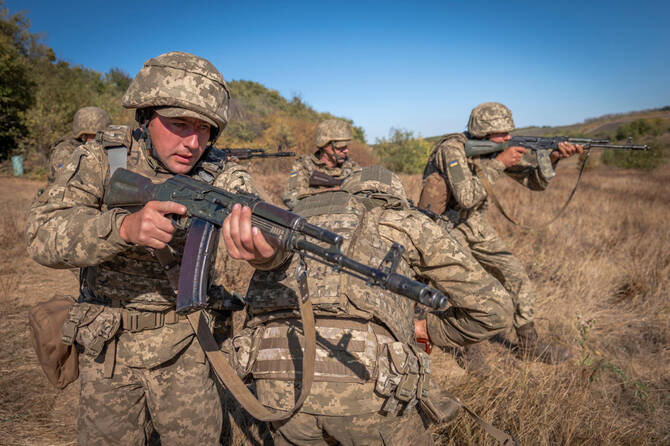
MOSCOW: Russia on Saturday claimed to have captured three villages in eastern Ukraine, as its forces slowly grind through Ukrainian defenses in costly battles.
Russian forces are slowly but steadily gaining ground in fierce meter-for-meter skirmishes for largely devastated areas in eastern Ukraine, with few inhabitants or intact buildings left.
Moscow has captured about 0.8 percent of Ukraine’s total land area since the beginning of the year, according to Russia’s Ministry of Defense.
The villages of Derylove and Maiske were seized in the Donetsk region, Moscow’s army said in a statement, while the settlement of Stepove was taken in the Dnipropetrovsk region.
Ukraine said an overnight Russian barrage killed one person and wounded 12 in the southeastern Kherson region, and damaged railways in the neighboring Odesa region.
Russia said an oil pumping station in the Chuvashia republic suspended operation after a Ukrainian drone strike deep behind the front line.
Kyiv has been targeting Russian refineries for months, calling the attacks fair retribution for Moscow’s own barrages and an attempt to cut off energy revenues that fund Russia’s army.
Diplomatic efforts to stop the war, now nearing its fourth year, have faltered, with US President Donald Trump recently floating the idea that Ukraine may be able to take back all of its lost land from Russia, which vowed to press on the offensive.


Russia says seized three villages in east Ukraine
https://arab.news/9swaf
Russia says seized three villages in east Ukraine

- Russia on Saturday claimed to have captured three villages in eastern Ukraine, as its forces slowly grind through Ukrainian defenses in costly battles


Spain to ban social media for children under 16, prime minister tells WGS
- Pedro Sanchez: Our children are exposed to a space they were never meant to navigate alone
- Sanchez: A space of addiction, abuse, pornography, manipulation, violence. We will no longer accept that, and we will protect them from the digital Wild West
DUBAI: Spanish Prime Minister Pedro Sanchez announced on Tuesday that his country will seek to ban children aged under 16 from using social media platforms.
Speaking at the World Government Summit in Dubai, Sanchez outlined a six-point plan he said would help restore the “promised land” it once was.
“Our children are exposed to a space they were never meant to navigate alone,” he said.
“A space of addiction, abuse, pornography, manipulation, violence. We will no longer accept that, and we will protect them from the digital Wild West.”
The announcement follows a similar ban by Australia last year. French lawmakers also passed a bill last week that would ban those aged under 15 from accessing social platforms. The UK has also announced it is considering new controls.
To enforce the ban, the Spanish government will reportedly seek to order platforms to put in place stringent age verification methods. It also plans to introduce a new bill next week to hold social media executives accountable for illegal and hateful content.
Sanchez added that Spain had joined five other European countries that he labelled the “Coalition of the Digitally Willing” to coordinate and enforce cross-border regulation.


