

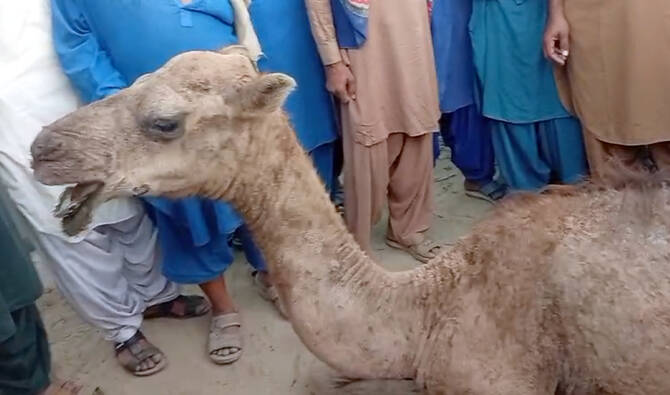
Camel attacked for entering fields in Pakistan’s Sindh undergoes surgery on jaw, leg

The screengrab taken from a video shows the camel whose leg was cut off by unidentified individuals in the Sukkur district of Sindh province, Pakistan, on September 19, 2025. (Screengrab/CM House Sindh/File)
Short Url
Updated 27 September 2025
Follow

Camel attacked for entering fields in Pakistan’s Sindh undergoes surgery on jaw, leg

  • Police last week arrested two of the three suspects who crushed the camel’s leg for trespassing on their land
  • Shelter treating the animal plans to send X-ray results, photos to a US firm in hopes of a prosthetic solution

KARACHI: A female camel that came under a violent attack in Pakistan’s southern Sindh province has undergone surgical procedures on its jaw and hind right leg, the Sindh chief minister’s office said on Saturday, with veterinarians now focusing on restoring her health.

The owner of the camel, nicknamed ‘Chandni,’ had nominated Rasool Baksh Sheikh, Qurban Brohi and Malik Umar as suspects in his complaint to police last week, according to officials.

The three individuals crushed the hind right leg of the animal on Sept. 18 for trespassing on their fields in Sindh’s Sukkur district. Police later arrested Brohi and Sheikh, while the third accused remains on the run.

The animal has undergone surgical procedures to fix its jaw and amputate the injured leg, according to Sindh Livestock Secretary Kazim Jatoi. Experts completed the three-hour-long operation without bleeding.

“Camel Chandni is now out of danger and conscious,” Jatoi said in a report sent to Sindh CM Murad Ali Shah. “She will be able to take food in two days and eat fully in three to five weeks.”

After being crushed by the suspects, the camel’s leg had become infected with no hopes of fixing, according to Sarah Jahangir, Director of the Comprehensive Disaster Response Services (CDRS) Benji Project shelter where the animal is currently being treated.

The panel of vets decided that her leg had to be amputated before it turned septic.

The attack on Chandni came a little more than a year after a similar incident in which a local landlord in Sindh’s Sanghar district allegedly chopped off a camel’s leg as punishment for daring to venture into his field, according to officials.

Caregivers at CDRS Benji Project worked extensively to rehabilitate the camel, called ‘Cammie,’ who was later able to walk for the first time on a prosthetic leg arranged from a US-based firm in July.

“Chandni had her jaw surgery and leg amputation yesterday,” Jahangir told Arab News.

“Everything went smoothly but she still has a long road to recovery. We will take it day by day to ensure she gets the best of care and we just need everyone to pray for her. We are also sending her updated X-rays and photos to Bionic Pets USA in the hopes of a solution for her leg.”

Dr. Javed Khoso, Dr. Zulfiqar Otho and Dr. Ali Gopang, who performed surgery on Chandni, are now focusing on restoring the camel’s health, according to the Sindh chief minister’s office.

CM Shah has directed officials to continue best possible treatment of Chandni.

“After the camel’s wounds heal, the help of experts should be sought to implant an artificial leg,” the chief minister was quoted as saying.


Pakistan bulk cargo terminal signs deal to ship copper-gold output from Reko Diq

Updated 6 sec ago
Follow

Pakistan bulk cargo terminal signs deal to ship copper-gold output from Reko Diq

  • Pakistan International Bulk Terminal says the deal positions it as the primary logistics gateway for Reko Diq’s mineral output
  • A top Barrick Mining official says the agreement marks a ‘step forward,’ with exports from the project expected to begin in 2028

ISLAMABAD: A bulk cargo terminal operating at Pakistan’s Port Qasim has signed an agreement to handle and export copper-gold commodities from Reko Diq, including minerals, metals and other natural earth resources, in a move expected to support multibillion-dollar mineral exports from the country, the company said on Monday.

The terminal operator, Pakistan International Bulk Terminal Limited (PIBT), said the agreement positions it as the primary export gateway for Reko Diq’s mineral output and strengthens Pakistan’s ambitions to expand its footprint in global commodity markets.

The deal covers logistics, storage and exports for output from the Reko Diq copper-gold project in southwestern Balochistan province, one of the world’s largest undeveloped mineral deposits, with shipments expected to begin from 2028.

“This agreement is a historic milestone for PIBT and Pakistan, enabling exports from one of the world’s most significant mining projects and serving as a cornerstone for national economic growth,” Sharique Azim Siddiqui, CEO of PIBT, said in a statement.

He expressed appreciation to the government, the Special Investment Facilitation Council, the Ministry of Maritime Affairs and the Port Qasim Authority for their “pivotal role.”

Barrick Mining Corporation, which is developing Reko Diq, also welcomed the agreement.

“We’re delighted to have signed this important agreement with PIBT which marks another step forward in ensuring that Reko Diq delivers lasting value to all our stakeholders but particularly the people of Balochistan and Pakistan,” Mark Hill, the company’s top official, said.

PIBT is a fully mechanized multipurpose bulk terminal located at Port Qasim and was developed with a $305 million investment in partnership with the International Finance Corporation.

The terminal currently has an annual handling capacity of 12 million tons of imports and 4 million tons of exports, with further investment planned to upgrade its export systems, the company said.