

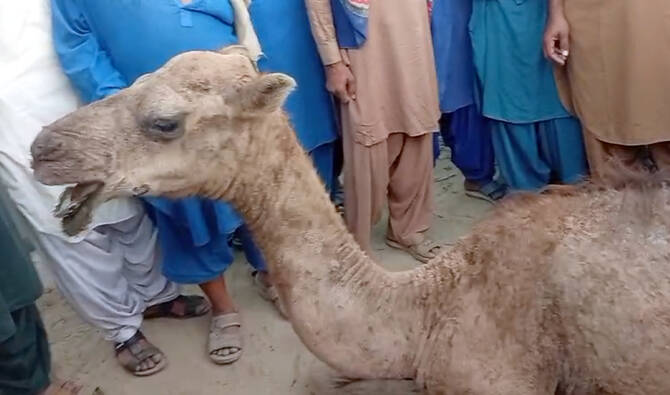
Camel attacked for entering fields in Pakistan’s Sindh undergoes surgery on jaw, leg

The screengrab taken from a video shows the camel whose leg was cut off by unidentified individuals in the Sukkur district of Sindh province, Pakistan, on September 19, 2025. (Screengrab/CM House Sindh/File)
Short Url
Updated 27 September 2025
Follow

Camel attacked for entering fields in Pakistan’s Sindh undergoes surgery on jaw, leg

  • Police last week arrested two of the three suspects who crushed the camel’s leg for trespassing on their land
  • Shelter treating the animal plans to send X-ray results, photos to a US firm in hopes of a prosthetic solution

KARACHI: A female camel that came under a violent attack in Pakistan’s southern Sindh province has undergone surgical procedures on its jaw and hind right leg, the Sindh chief minister’s office said on Saturday, with veterinarians now focusing on restoring her health.

The owner of the camel, nicknamed ‘Chandni,’ had nominated Rasool Baksh Sheikh, Qurban Brohi and Malik Umar as suspects in his complaint to police last week, according to officials.

The three individuals crushed the hind right leg of the animal on Sept. 18 for trespassing on their fields in Sindh’s Sukkur district. Police later arrested Brohi and Sheikh, while the third accused remains on the run.

The animal has undergone surgical procedures to fix its jaw and amputate the injured leg, according to Sindh Livestock Secretary Kazim Jatoi. Experts completed the three-hour-long operation without bleeding.

“Camel Chandni is now out of danger and conscious,” Jatoi said in a report sent to Sindh CM Murad Ali Shah. “She will be able to take food in two days and eat fully in three to five weeks.”

After being crushed by the suspects, the camel’s leg had become infected with no hopes of fixing, according to Sarah Jahangir, Director of the Comprehensive Disaster Response Services (CDRS) Benji Project shelter where the animal is currently being treated.

The panel of vets decided that her leg had to be amputated before it turned septic.

The attack on Chandni came a little more than a year after a similar incident in which a local landlord in Sindh’s Sanghar district allegedly chopped off a camel’s leg as punishment for daring to venture into his field, according to officials.

Caregivers at CDRS Benji Project worked extensively to rehabilitate the camel, called ‘Cammie,’ who was later able to walk for the first time on a prosthetic leg arranged from a US-based firm in July.

“Chandni had her jaw surgery and leg amputation yesterday,” Jahangir told Arab News.

“Everything went smoothly but she still has a long road to recovery. We will take it day by day to ensure she gets the best of care and we just need everyone to pray for her. We are also sending her updated X-rays and photos to Bionic Pets USA in the hopes of a solution for her leg.”

Dr. Javed Khoso, Dr. Zulfiqar Otho and Dr. Ali Gopang, who performed surgery on Chandni, are now focusing on restoring the camel’s health, according to the Sindh chief minister’s office.

CM Shah has directed officials to continue best possible treatment of Chandni.

“After the camel’s wounds heal, the help of experts should be sought to implant an artificial leg,” the chief minister was quoted as saying.


Fear, shock grip southwestern Pakistan day after deadly separatist attacks

Updated 5 sec ago
Follow

Fear, shock grip southwestern Pakistan day after deadly separatist attacks

  • Separatist militants carrying assault rifles stormed banks, jails, police stations and military installations, killing 31 civilians and 17 security personnel
  • Mobile Internet, train services remained suspended across Pakistan’s Balochistan on Sunday, with major roads and businesses deserted after attacks

QUETTA: Residents in the southwestern Pakistani city of Quetta were in shock and feared more violence, they said on Sunday, following deadly separatist attacks that killed nearly 200 people, including militants, security personnel and civilians, in the Balochistan province.

Authorities in Balochistan are battling one of the deadliest flare-ups in years as ethnic Baloch separatists step up assaults on security forces, civilians and infrastructure in the resource-rich province bordering Iran and Afghanistan.

Separatist militants carrying assault rifles stormed banks, jails, police stations and military installations in a string of coordinated attacks in several cities of Balochistan, including the provincial capital of Quetta, early Saturday.

Officials said the attacks killed 31 civilians and 17 security personnel, while 145 militants were killed in skirmishes and follow-up operations. The assaults were claimed by the Baloch Liberation Army (BLA) separatist group.

“The fear and anger are palpable in the city’s atmosphere following yesterday’s attacks at various locations in Quetta and other cities of Balochistan,” Zain Ali, a resident of Quetta’s Brewery Road, told Arab News on Sunday.

“We used to think that there is insurgency in Balochistan but Quetta is safe but that perception has been shattered.”

Balochistan has long been the site of a separatist insurgency that has intensified in recent years, with the BLA emerging as the most influential of separatist groups operating in the region.

The separatists, who frequently target security forces, foreigners, government officials and non-local Pakistanis, accuse the central government of stealing the region’s resources to fund development elsewhere in the country. The Pakistani government denies the allegations and says it is working for the uplift of local communities in Balochistan.

Saturday’s pre-dawn attacks by BLA targeted high-security government installations in Balochistan’s Quetta, Gwadar, Dalbandin, Pasni, Nushki, Kalat, Turbat and Mastung cities. 

Ali, who teaches at a private school and stepped out of home to buy groceries on Sunday, said he experiences an “unexplainable fear” of a sudden ambush by armed men on his way to downtown Quetta.

“If the capital is not safe, how would you expect security in rural areas of Balochistan,” Zain said. “The government has to take decisive action against these elements.”

On Sunday, mobile Internet and train services remained suspended across the province, with major roads and businesses deserted after the attacks.

Hafiz Ameer Muhammad, a security guard at a government’s run bank in Quetta’s Hazar Ganji area, recounted the horror when the militants stormed the city’s busiest business market, attacking several bank branches and torching goods and equipment.

“They came here at 10am and fired upon the gate but we didn’t let them in,” he told Arab News. “They broke the window and got inside and threatened us to hand over the weapons or face death.”

Dr. Mansoor Tareen, a dentist at Quetta’s Liaquat Bazar, said he feared more such attacks.

“Unfortunately, the government is limited to media and newspapers,” he said.

Pakistan’s military said the attacks were launched by “Indian-sponsored Fitna al Hindustan,” a reference it uses for Baloch separatist groups. India has denied any involvement.

In a statement on Saturday, the BLA said it had launched “Operation Herof 2.0,” claiming responsibility for attacks at multiple locations across Balochistan. Saturday’s assaults were similar to coordinated attacks carried out by the group in Aug. 2024, which killed dozens of people in various districts of Balochistan.

Balochistan Chief Minister Sarfraz Bugti has vowed his government would not surrender and would fight the militants until they are eliminated.

“We will fight this war for 1,000 years,” he said on Sunday. “This country is ours. This is our motherland. We will fight for it.”