French militant who claimed Nice attack to be tried in Iraq: source close to probe

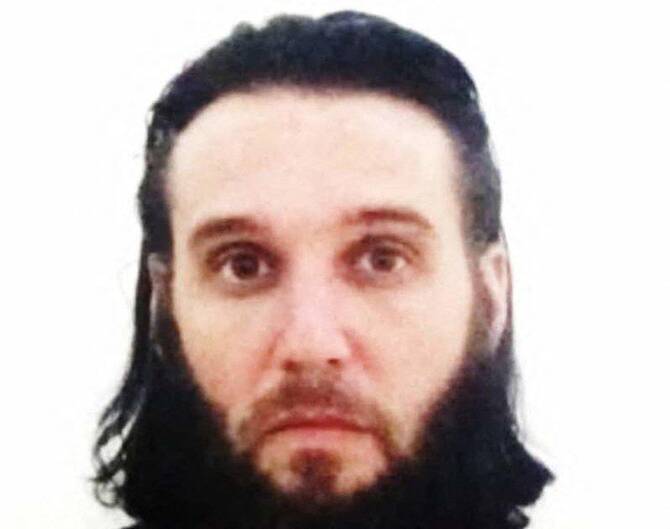
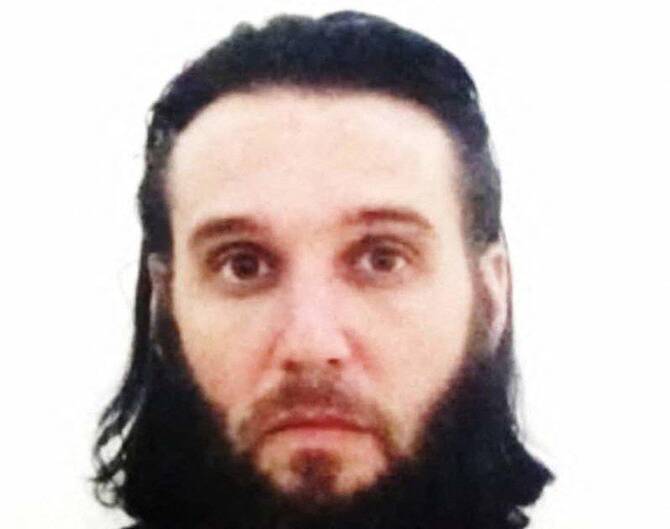
A handout image provided by the Syrian Democratic Forces (SDF) on May 24, 2018 shows a portrait of Adrien Guihal. (AFP)
Short Url
Updated 25 September 2025
Follow

French militant who claimed Nice attack to be tried in Iraq: source close to probe

  • Guihal “was brought to Iraq two months ago with another 46 French nationals that will be tried here,” the source added
  • Guihal, who joined Daesh in 2015, was detained in the Syrian city of Raqqa in May 2018

BAGHDAD: Adrien Guihal, who claimed the 2016 Nice attack for the Daesh group, will be tried in Iraq alongside 46 other French nationals recently transferred from Syria, a source close to the investigation told AFP.
“Adrien Guihal, known as Abu Osama Al-Faransi, is still under investigation,” said the source, speaking on condition of anonymity because they are not allowed to speak to the media.
Guihal “was brought to Iraq two months ago with another 46 French nationals that will be tried here,” the source added.
A veteran member of France’s militant networks, Guihal made headlines when he was recognized as the man behind the voice that claimed responsibility for the July 2016 attack which killed 86 people in the French city of Nice.
He is thought to be among the most dangerous members of the French contingent in the ranks of the Daesh group, whose self-styled “caliphate” spanned huge swathes of territory in Iraq and Syria before collapsing in 2019.
Guihal, who joined Daesh in 2015, was detained in the Syrian city of Raqqa in May 2018.
He spent years in Kurdish prisons in Syria before being brought to Iraq in July, along with 46 other French nationals who are being questioned over their alleged involvement in crimes committed by Daesh in Iraq.

- ‘Interrogations ongoing’ -

“Interrogations are ongoing with the 47 French nationals,” the Iraqi source said, alleging that “it has been proven” they are all members of Daesh.
Last week, Iraq’s National Intelligence Service said the suspects were “wanted by the Iraqi judiciary for their involvement in terrorist crimes committed in Iraq.”
Iraqi courts have handed down hundreds of death sentences and life prison terms to people convicted of terrorism offenses, including hundreds of foreign fighters — some caught in Syria and transferred across the border.
In 2019, the courts sentenced 11 French nationals to death. Their sentences were later commuted to life in prison, according to a judicial source.
Some human rights groups have denounced “terrorism” trials in Iraq as rushed.
The country still has mass graves and many personal testimonies of Daesh brutality to be investigated.
In 2024, after the mission of the UN body investigating Daesh crimes ended, Iraq created the National Center for International Judicial Cooperation (NCIJC) to gather evidence and document Daesh crimes.
The center serves as the main point of contact for foreign jurisdictions investigating alleged offenses.
In France, which has been the target of repeated militant attack over the past decade, repatriation of Daesh suspects and their family members is a deeply sensitive issue.
Since 2019, France has repatriated only 179 children and 60 women, most of whom were held in detention camps in Syria.


UN chief visits Iraq to mark end of assistance mission set up after 2003 invasion

Updated 13 December 2025
Follow

UN chief visits Iraq to mark end of assistance mission set up after 2003 invasion

  • Sudani said his country “highly values” the mission’s work in a region “that has suffered for decades from dictatorship, wars, and terrorism”
  • Guterres praised “the courage, fortitude and determination of the Iraqi people”

BAGHDAD: United National Secretary-General Antonio Guterres was in Baghdad on Saturday to mark the end of the political mission set up in 2003 following the US-led invasion of Iraq that toppled Saddam Hussein.
The UN Security Council, at Iraq’s request, voted last year to wind down the mandate of the United Nations Assistance Mission in Iraq (UNAMI), by the end of 2025. The mission was set up to coordinate post-conflict humanitarian and reconstruction efforts and help restore a representative government in the country.
Iraqi caretaker Prime Minister Mohammed Shia Al-Sudani said his country “highly values” the mission’s work in a region “that has suffered for decades from dictatorship, wars, and terrorism.” He said its conclusion showed Iraq had reached a stage of “full self-reliance.”
“Iraq emerged victorious thanks to the sacrifices and courage of its people,” he said in a joint statement with Guterres.
The ending of UNAMI’s mandate “does not signify the end of the partnership between Iraq and the UN,” Sudani said, adding that it represents the beginning of a new chapter of cooperation focused on development and inclusive economic growth.
The prime minister said a street in Baghdad would be named “United Nations Street” in honor of the UN’s work and in recognition of 22 UN staff who were killed in an Aug. 19, 2003, truck bomb attack on the Canal Hotel in Baghdad, which housed the UN headquarters.
Guterres praised “the courage, fortitude and determination of the Iraqi people” and the country’s efforts to restore security and order after years of sectarian violence and the rise of extremist groups, including the Daesh group, in the years after the 2003 invasion.
“Iraqis have worked to overcome decades of violence, oppression, war, terrorism, sectarianism and foreign interference,” the secretary-general said. “And today’s Iraq is unrecognizable from those times.”
Iraq “is now a normal country, and relations between the UN and Iraq will become normal relations with the end of UNAMI,” Guterres added. He also expressed appreciation for Iraq’s commitment to returning its citizens from the Al-Hol camp, a sprawling tent camp in northeastern Syria housing thousands of people — mostly women and children — with alleged ties to the IS.
Guterres recently recommended former Iraqi President Barham Salih to become the next head of the UN refugee agency, the first nomination from the Middle East in half a century.
Salih’s presidential term, from 2018 to 2022, came in the immediate aftermath of the Daesh group’s rampage across Iraq and the battle to take back the territory seized by the extremist group, including the key northern city of Mosul.
At least 2.2 million Iraqis were displaced as they fled the IS offensive. Many, particularly members of the Yazidi minority from the northern Sinjar district, remain in displacement camps today.