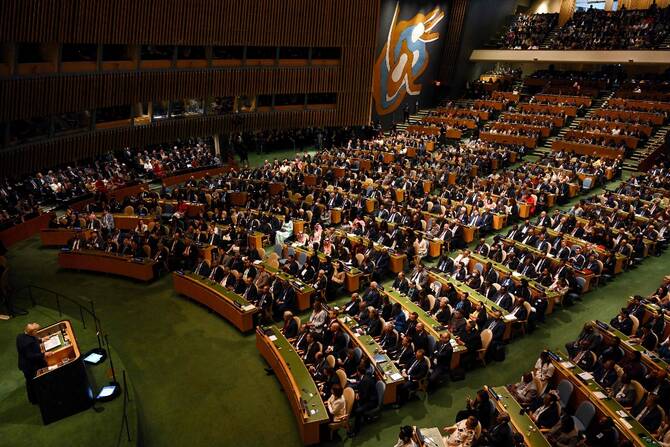
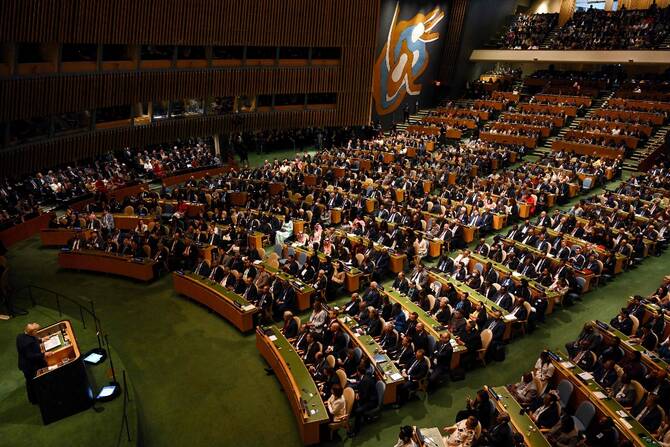
Artificial intelligence is joining the list of big and complex global challenges that world leaders and diplomats will tackle at this week’s annual high-level United Nations meetup.
Since the AI boom kicked off with ChatGPT’s debut about three years ago, the technology’s breathtaking capabilities have amazed the world. Tech companies have raced to develop better AI systems even as experts warn of its risks, including existential threats like engineered pandemics, large-scale misinformation or rogue AIs running out of control, and call for safeguards.
The UN’s adoption of a new governance architecture is the latest and biggest effort to rein in AI. Previous multilateral efforts, including three AI summits organized by Britain, South Korea and France, have resulted only in non-binding pledges.
Last month, the General Assembly adopted a resolution to set up two key bodies on AI — a global forum and an independent scientific panel of experts — in a milestone move to shepherd global governance efforts for the technology.
On Wednesday, a UN Security Council meeting will convene an open debate on the issue. Among the questions to be addressed: How can the Council help ensure the responsible application of AI to comply with international law and support peace processes and conflict prevention?
And on Thursday, as part of the body’s annual meeting, UN Secretary-General António Guterres will hold a meeting to launch the forum, called the Global Dialogue on AI Governance.
It’s a venue for governments and “stakeholders” to discuss international cooperation and share ideas and solutions. It’s scheduled to meet formally in Geneva next year and in New York in 2027.
Meanwhile, recruitment is expected to get underway to find 40 experts for the scientific panel, including two co-chairs, one from a developed country and one from a developing nation. The panel has drawn comparisons with the UN’s climate change panel and its flagship annual COP meeting.
The new bodies represent “a symbolic triumph.” They are “by far the world’s most globally inclusive approach to governing AI,” Isabella Wilkinson, a research fellow at the London-based think tank Chatham House, wrote in a blog post.
“But in practice, the new mechanisms look like they will be mostly powerless,” she added. Among the possible issues is whether the UN’s lumbering administration is able to regulate a fast-moving technology like AI.
Ahead of the meeting, a group of influential experts called for governments to agree on so-called red lines for AI to take effect by the end of next year, saying that the technology needs “minimum guardrails” designed to prevent the “most urgent and unacceptable risks.”
The group, including senior employees at ChatGPT maker OpenAI, Google’s AI research lab DeepMind and chatbot maker Anthropic, wants governments to sign an internationally binding agreement on AI. They point out that the world has previously agreed on treaties banning nuclear testing and biological weapons and protecting the high seas.
“The idea is very simple,” said one of the backers, Stuart Russell, a computer science professor and director of University of California, Berkeley’s Center for Human Compatible AI. “As we do with medicines and nuclear power stations, we can require developers to prove safety as a condition of market access.”
Russell suggested that UN governance could resemble the workings of another UN-affiliated body, the International Civil Aviation Organization, which coordinates with safety regulators across different countries and makes sure they’re all working off the same page.
And rather than laying out a set of rules that are set in stone, diplomats could draw up a “framework convention” that’s flexible enough to be updated to reflect AI’s latest advances, he said.


![]()
AI joins list of global challenges on agenda for UN meeting
Short Url
https://arab.news/c3hms
AI joins list of global challenges on agenda for UN meeting
- Since the AI boom kicked off with ChatGPT’s debut about three years ago, the technology’s breathtaking capabilities have amazed the world
- The UN’s adoption of a new governance architecture is the latest and biggest effort to rein in AI


Latest updates


Recommended


© 2026 SAUDI RESEARCH & PUBLISHING COMPANY, All Rights Reserved And subject to Terms of Use Agreement.