

French politicians bicker over Palestinian flags outside town halls

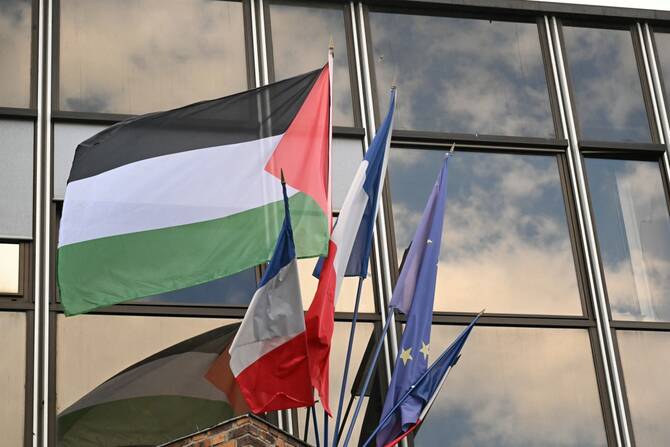
This photograph shows Palestinian, French and European flags fluttering outside the town hall of Malakoff, South of Paris. (AFP)
Short Url
Updated 22 September 2025
Follow

French politicians bicker over Palestinian flags outside town halls

  • Eiffel Tower was to be lit up with a projection of both the Israeli and Palestinian flags, alongside a dove of peace, ahead of recognitizing Palestine

PARIS: French politicians bickered on Sunday over whether it is appropriate to hoist Palestinian flags outside town halls on the eve of the country’s planned recognition of the State of Palestine.
Ahead of the landmark move, set to be finalized at the United Nations General Assembly in New York starting Monday, the government told town halls not to fly the flag and take down any Palestinian banners that they had already put up.
Hard-line Interior Minister Bruno Retailleau argued that the hoisting of Palestinian flags “seriously undermines the principle of neutrality of public services.”
His office has urged local prefects to take the matter to the administrative courts — though they cannot order the police to take the flags down.
But Socialist leader Olivier Faure — whose party’s support France’s new government will likely need to survive — urged President Emmanuel Macron to allow mayors’ offices to fly the flag if they so wished.
“It would not only be a strong gesture toward all those committed to resolving the Israeli-Palestinian conflict, but consistent with France’s position internationally,” he said.
Faure argued Retailleau was playing politics to undermine Macron’s push for recognition.
“It is not the flag he (Retailleau) is against... It is the head of state’s decision to recognize a Palestinian state,” Faure told BFMTV Sunday evening.

‘Cheap community politics’

Boris Vallaud, the Socialist Party’s top lawmaker in the National Assembly, the lower house of France’s parliament, also pushed back against what he called Retailleau’s “incorrect” interpretation of neutrality.
He pointed out that town halls had “rightfully raised the Israeli flag” after Hamas’s October, 7 2023 attack that began the war in Gaza, while “there are also Ukrainian flags” on some buildings in the wake of Russia’s invasion.
“A flag on the front of town hall has never killed anyone, while in Gaza the Israeli army kills each day,” Greens leader Marine Tondelier told a Sunday pro-Palestinian rally in Paris.
But Philippe Ballard, a lawmaker with the far-right National Rally party, accused municipalities of practicing “cheap community politics” with the hoists, while his colleague Jean-Philippe Tanguy called the initiative “illegal.”
Even town halls on the left are divided over the issue.
The Socialist mayor of Creteil, outside of Paris, said that he would refuse Faure’s call as he had a responsibility to “preserve social cohesion.”
In the capital proper, the Eiffel Tower was to be lit up with a projection of both the Israeli and Palestinian flags — alongside a dove of peace — ahead of the recognition move, the mayor of Paris said.


In rare overlap, Chinese Muslims observe Ramadan with Lunar New Year

Updated 6 sec ago
Follow

In rare overlap, Chinese Muslims observe Ramadan with Lunar New Year

  • Lunar New Year started on Feb. 17 and is celebrated for another two weeks
  • Chinese Indonesians make up about 3 percent of the Indonesian population

JAKARTA: Every year, on the first day of Lunar New Year, Febriani visits relatives and gathers for a feast with her Chinese Muslim family, part of a long-standing tradition honoring their ethnic heritage.

But this year, as Thursday marks the beginning of Ramadan, she is celebrating two important occasions within the same week, in a rare overlap that last took place in 1995.

“I’m very happy and grateful that Lunar New Year and Ramadan are celebrated so closely. I observe both every year, so it’s truly special,” she told Arab News.

Widely observed across Asia, the Lunar New Year or Chinese New Year festival is believed to date back to the 14th century B.C., to the times of the Shang Dynasty, China’s earliest ruling dynasty, when people celebrated good harvests.

In 2026, it started on Feb. 17 and is celebrated for another two weeks. For many, celebrations typically involve elaborate feasts, giving children pocket money in red envelopes, and watching dragon dance parades.

In Indonesia, Chinese-descent citizens make up an estimated 3 percent of the country’s Muslim-majority population of more than 280 million. While most are either Buddhists or Christians, a small minority professes Islam.

For 25-year-old Febriani, both Lunar New Year and Ramadan are equally meaningful.

“The two celebrations teach us to strengthen bonds, to share with one another, and to become closer to family,” she said.

“They are both important to me because they happen only once every year and they’re always an occasion to gather with the extended family. It is also a chance to self-reflect and strengthen relationships with your loved ones.”

For Naga Kunadi, whose family lives in Central Java’s Cepu district, Chinese New Year is all about embracing his ethnic identity.

Earlier in the week, his family was busy preparing for the new year’s feast, which was a fusion of Chinese and Indonesian dishes, such as claypot tofu, meatball soup and shumai, or steamed dumplings.

“To celebrate Chinese New Year, we prepared halal Chinese food at home. It’s also a way to introduce to my children the traditions from our Chinese side, but there’s a bit of a fusion because my wife is Javanese,” Kunadi told Arab News.

Kunadi, an Islamic teacher at the Lautze Mosque in Jakarta, sees both Chinese New Year and Ramadan as opportunities to teach important life values for his two children. 

Upholding Chinese New Year traditions with his family is for him a way of preserving his ethnic heritage.

“We want to preserve cultural values as long as it does not clash with our religion,” he said.

“If we leave our culture behind, we might lose our identity, so this is something I want to teach my children.”

The fasting month of Ramadan, on the other hand, gives him a chance to teach and practice honesty.

“I want to focus on the religious and moral aspects during the holy month of Ramadan, when we practice honesty on a personal level,” Kunadi said.

“There’s always an opportunity to eat or snack in secret without anybody knowing, but we train ourselves not to do that. For me, Ramadan is a time for everyone to put honesty into practice, including myself and my children.”