

Pakistan calls for alternative dispute resolution methods with 2.4 million cases pending

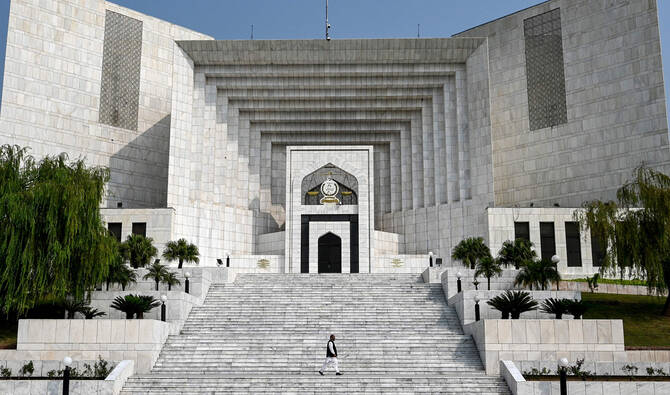
A man walks past the Pakistan’s Supreme Court building in Islamabad on October 23, 2024. (AFP/File)
Short Url
Updated 21 September 2025
Follow

Pakistan calls for alternative dispute resolution methods with 2.4 million cases pending

  • Law minister says some civil disputes often take up to 15 years to conclude, while alternative methods provide resolution in an average 75 days
  • Azam Nazeer Tarar emphasizes plans to scale up mediation centers nationwide and to strengthen Pakistan’s role as alternative dispute resolution hub

ISLAMABAD: Pakistan’s Law Minister Azam Nazeer Tarar on Sunday called for the adoption of alternative dispute resolution (ADR) methods to speed up settlement of disputes, with 2.4 million cases pending in courts across the country.

The statement came at a ceremony in Islamabad on the conclusion of a six-day internationally accredited Civil and Commercial Mediation Training Programme by the International Mediation & Arbitration Center (IMAC), established by the Pakistani law ministry.

The program, led by internationally renowned experts Mr. Rahim Shamji, Ms. Sarah Tarar, and Dr. Khalid Hamid Chowdhury, trained judges of the high courts, lawyers, government officers, academicians, and business professionals from across Pakistan.

Speaking at the ceremony, Tarar noted that there is a backlog of 2.4 million cases in Pakistan’s courts, including over 300,000 in the high courts and 1.8 million in district courts, where civil disputes often take up to 15 years to conclude.

“In contrast, ADR provides resolution in an average of just 75 days,” he was quoted as saying by Pakistan’s Press Information Department.

ADR refers to a method of resolving disputes outside of courts to help parties reach a voluntary, consensual agreement. Key ADR methods include mediation, where a mediator facilitates communication and settlement of disputes, and arbitration, where an arbitrator makes a binding or non-binding decision.

These methods offer advantages like lower costs, faster resolution and improved communication compared to traditional litigation.

Tarar emphasized plans to scale up mediation centers nationwide and strengthen Pakistan’s role as a credible ADR hub, according to the PID. The minister appreciated the IMAC team for not only creating widespread awareness but also training professionals across the country in mediation and arbitration.

Pakistan has introduced a number of judicial reforms in recent months and the country’s top judge, Yahya Afridi, this month said the Supreme Court was working to expand cooperation with judicial bodies in Muslim countries, including Saudi Arabia’s Muslim World League, to strengthen its institutional capacity.

Speaking at the ceremony in Islamabad, Justice Shahid Waheed of Pakistan’s Supreme Court underscored mediation as a vital tool to reduce case backlogs, strengthen access to justice, and foster harmony.

He outlined Pakistan’s policy direction on ADR, including the preparation of a ‘Model Law, establishment of court-annexed mediation centers and awareness campaigns

“ADR must be institutionalized, expanded nationwide, and integrated with technology to transform Pakistan’s justice landscape,” the judge said, commending the IMAC’s role in capacity building through internationally accredited training.


Pakistan, global crypto exchange discuss modernizing digital payments, creating job prospects 

Updated 05 December 2025
Follow

Pakistan, global crypto exchange discuss modernizing digital payments, creating job prospects 

  • Pakistani officials, Binance team discuss coordination between Islamabad, local banks and global exchanges
  • Pakistan has attempted to tap into growing crypto market to curb illicit transactions, improve oversight

ISLAMABAD: Pakistan’s finance officials and the team of a global cryptocurrency exchange on Friday held discussions aimed at modernizing the country’s digital payments system and building local talent pipelines to meet rising demand for blockchain and Web3 skills, the finance ministry said.

The development took place during a high-level meeting between Finance Minister Muhammad Aurangzeb, Pakistan Virtual Assets Regulatory Authority (PVARA) Chairman Bilal bin Saqib, domestic bank presidents and a Binance team led by Global CEO Richard Teng. The meeting was held to advance work on Pakistan’s National Digital Asset Framework, a regulatory setup to govern Pakistan’s digital assets.

Pakistan has been moving to regulate its fast-growing crypto and digital assets market by bringing virtual asset service providers (VASPs) under a formal licensing regime. Officials say the push is aimed at curbing illicit transactions, improving oversight, and encouraging innovation in blockchain-based financial services.

“Participants reviewed opportunities to modernize Pakistan’s digital payments landscape, noting that blockchain-based systems could significantly reduce costs from the country’s $38 billion annual remittance flows,” the finance ministry said in a statement. 

“Discussions also emphasized building local talent pipelines to meet rising global demand for blockchain and Web3 skills, creating high-value employment prospects for Pakistani youth.”

Blockchain is a type of digital database that is shared, transparent and tamper-resistant. Instead of being stored on one computer, the data is kept on a distributed network of computers, making it very hard to alter or hack.

Web3 refers to the next generation of the Internet built using blockchain, focusing on giving users more control over their data, identity and digital assets rather than big tech companies controlling it.

Participants of the meeting also discussed sovereign debt tokenization, which is the process of converting a country’s debt such as government bonds, into digital tokens on a blockchain, the ministry said. 

Aurangzeb called for close coordination between the government, domestic banks and global exchanges to modernize Pakistan’s payment landscape.

Participants of the meeting also discussed considering a “time-bound amnesty” to encourage users to move assets onto regulated platforms, stressing the need for stronger verifications and a risk-mitigation system.

Pakistan has attempted in recent months to tap into the country’s growing crypto market, crack down on money laundering and terror financing, and promote responsible innovation — a move analysts say could bring an estimated $25 billion in virtual assets into the tax net.

In September, Islamabad invited international crypto exchanges and other VASPs to apply for licenses to operate in the country, a step aimed at formalizing and regulating its fast-growing digital market.