Algeria rejects Mali ICJ complaint over drone downing

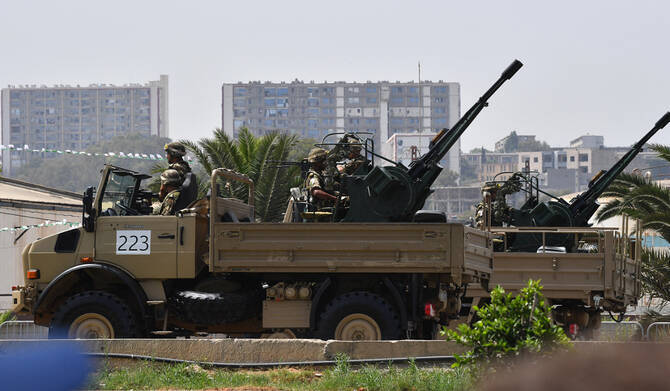
The International Court of Justice said on Friday that Mali's application for a case against neighbouring Algeria over the shooting down of a Malian military drone could only proceed if Algeria accepts the court's jurisdiction. (AFP/File)
Short Url
Updated 19 September 2025
Follow

Algeria rejects Mali ICJ complaint over drone downing

  • Algiers has said the drone was over its soil when it was hit earlier this year
  • The ICJ said the case will not proceed “unless and until Algeria consents to the Court’s jurisdiction in the case“

ALGIERS: Algeria said Friday it will oppose what it called a “shameless” complaint from Mali to the UN’s top court accusing it of downing a Malian army drone over Malian soil.
Algiers has said the drone was over its soil when it was hit earlier this year.
The foreign ministry described the complaint, which the International Court of Justice confirmed receiving on Friday, as “clearly an attempt to exploit this august judicial body of the United Nations.”
It said it will notify the court of its “refusal of this procedural ploy,” describing Mali’s move as “too crude to be credible.”
The ICJ said the case will not proceed “unless and until Algeria consents to the Court’s jurisdiction in the case.”
Mali said it had complained to the court after Algerian forces violated its airspace and downed the army drone in a “hostile act” on the night of March 31-April 1.
Algeria says its defense ministry radar data “clearly establish the violation of Algeria’s airspace” by the Malian reconnaissance drone.
The case has sparked a region-wide diplomatic spat, with Mali and allies Burkina Faso and Niger withdrawing their ambassadors from Algiers and Algeria responding in kind.
Further fallout has seen Bamako and Algiers mutually close their airspace to one another, and Mali has accused its northern neighbor of helping to foment regional “terrorism.”
In January last year, Mali’s ruling junta announced the termination of a 2015 peace accord with Tuareg rebels which had been mediated by Algiers, citing Algerian “hostility.”


Ramallah talks focus on border crossings

Palestinian Prime Minister Mohammad Mustafa speaks during a press conference in Ramallah on March 24, 2025. (AFP)
Updated 6 sec ago
Follow

Ramallah talks focus on border crossings

  • The meeting discussed ways to upgrade infrastructure and facilities at the Karama crossing, particularly arrival halls and cargo and transport areas, automate procedures and services, strengthen staff capacities, and combat smuggling

RAMALLAH: Palestinian Prime Minister Mohammed Mustafa chaired a meeting at his office in Ramallah on Saturday to review developments at border crossings, including the Karama crossing in the West Bank and the Rafah crossing in the Gaza Strip, as well as ways to develop and upgrade the crossings.
The meeting focused on improving the management and governance system for Palestinian crossings to clearly define the roles, responsibilities, and tasks of the parties involved, thereby contributing to the national economy, commercial activity, and travel services.
Mustafa reiterated that the crossings issue is a priority at all levels, as it directly affects citizens. 
He stressed the need to intensify engagement with all parties to extend operating hours for passenger and cargo movement, and to develop travel and cargo transport mechanisms.
The meeting also discussed ways to upgrade infrastructure and facilities at the Karama crossing, particularly arrival halls and cargo and transport areas, automate procedures and services, strengthen staff capacities, and combat smuggling.
These measures aim to improve services for citizens, facilitate travel procedures, and enhance readiness to address congestion and travel crises, especially during the Umrah and Hajj seasons and holidays.
Meanwhile, according to local sources, Israeli forces forced Kamal Saeed Shawaneh, a Palestinian owner of a marble factory from the town of Kafr Thulth, south of Qalqilya, to carry out the demolition of his industrial facility located east of the town, on Saturday.
The facility, built on an area of roughly 300 square meters, suffered material losses estimated at more than $26,000. Israeli authorities claimed that Shawaneh did not have a permit for the factory’s construction. 
The sources added that Israeli forces threatened Shawahneh with heavy fines if he did not carry out the demolition, noting that he had previously received a stop-work order for the factory in 2018.