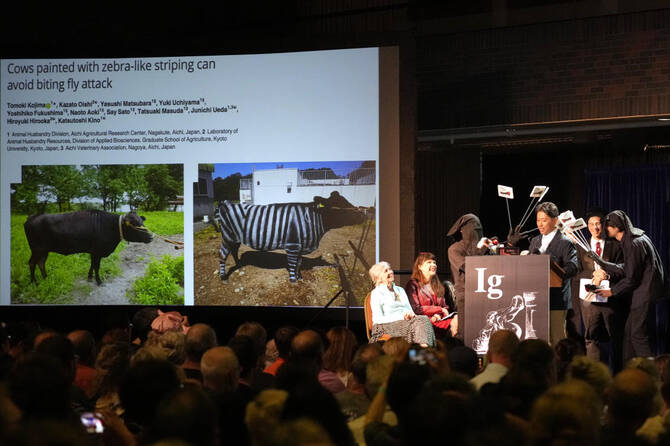
BOSTON: A team of researchers from Japan wondered if painting cows with zebra-like stripes would prevent flies from biting them. Another group from Africa and Europe pondered the types of pizza lizards preferred to eat.
Those researchers were honored Thursday in Boston with an Ig Nobel, the prize – a handmade model of a human stomach – for comical scientific achievement. In lieu of a big paycheck, each winner was also given a single hand wipe.
“When I did this experiment, I hoped that I would win the Ig Nobel. It’s my dream. Unbelievable. Just unbelievable,” said Tomoki Kojima, whose team put tape on Japanese beef cows and then spray painted them with white stripes. Kojima appeared on stage in stripes and was surrounded by his fellow researchers who harassed with cardboard flies.
As a result of the paint job, fewer flies were attracted to the cows and they seemed less bothered by the flies. Despite the findings, Kojima admitted it might be a challenge to apply this approach on a large-scale.
The year’s winners, honored in 10 categories, also include a group from Europe that found drinking alcohol sometimes improves a person’s ability to speak a foreign language and a researcher who studied fingernail growth for decades.
“Every great discovery ever, at first glance seemed screwy and laughable,” Marc Abrahams, master of ceremonies and editor of the magazine, said in an email interview ahead of the awards ceremony. “The same is true of every worthless discovery. The Ig Nobel Prizes celebrate ALL these discoveries, because at the very first glance, who really knows?”
The 35th annual Ig Nobel prize ceremony is organized by the Annals of Improbable Research, a digital magazine that highlights research that makes people laugh and then think. It’s usually held weeks before the actual Nobel Prizes are announced.
The ceremony to celebrate winners Thursday night at Boston University began with a longtime tradition: the audience pelting the stage with paper airplanes. Several of those who couldn’t attend had their speeches read by actual Nobel laureates including Esther Duflo, who won the Nobel Prize for her experimental approach to alleviating global poverty.
There was also a mini-opera about gastroenterologists and their patients, inspired by this year’s theme which is digestion. Several people sang about all the challenges of treating stomach bugs and being feted by patients who bring them pizza and chili dogs.
There was also a section called the 24-second lecture where top researchers explain their work in 24 seconds. Among them was Gus Rancatore, who spent most of his time licking an ice cream cone and repeatedly saying yum and Trisha Pasricha, who explained her work studying smartphone use on the toilet and the potential risk for hemorrhoids.
When any winner appeared to be rambling on too long, a man wearing a dress over his suit would appear at their side and repeatedly yell, “Please stop. I’m bored.”
Other winners this year included a group from India that studied whether foul-smelling shoes influenced someone’s experience using a shoe rack, and researchers from the United States and Israel who explored whether eating Teflon is a good way to increase food volume. There was also a team of international scientists that looked at whether giving alcohol to bats impaired their ability to fly.
“It’s a great honor for us,” said Francisco Sanchez, one of the researchers from Colombia who studied the drunken bats. “It’s really good. You can see that scientists are not really square and super serious and can have some fun while showing interesting science.”
Sanchez said their research found that the bats weren’t fans of rotten fruit, which often has higher concentrations of alcohol. Maybe for good reason. When they were forced to eat it, their flying and echolocation suffered, he said.
“They actually got drunk similar to what happens to us,” Sanchez said. “When you take some ethanol, you move slower and your speech is impaired.”
Among the most animated of the winners was a team of researchers from several European countries who studied the physics of pasta sauce. One of the researchers wore a cook’s outfit with a fake mustache to accept the award while another dressed as a big ball of mozzarella cheese got pummeled by several people holding wooden cookware. They ended by handing out bowls of pasta to the Nobel laureates.


![]()

Does painting cows with stripes prevent fly bites? Researchers who studied this win Ig Nobel prize
Short Url
https://arab.news/ntbpv
Does painting cows with stripes prevent fly bites? Researchers who studied this win Ig Nobel prize
- As a result of the paint job, fewer flies were attracted to the cows and they seemed less bothered by the flies
- Another group from Africa and Europe pondered the types of pizza lizards preferred to eat


Latest updates


© 2026 SAUDI RESEARCH & PUBLISHING COMPANY, All Rights Reserved And subject to Terms of Use Agreement.