

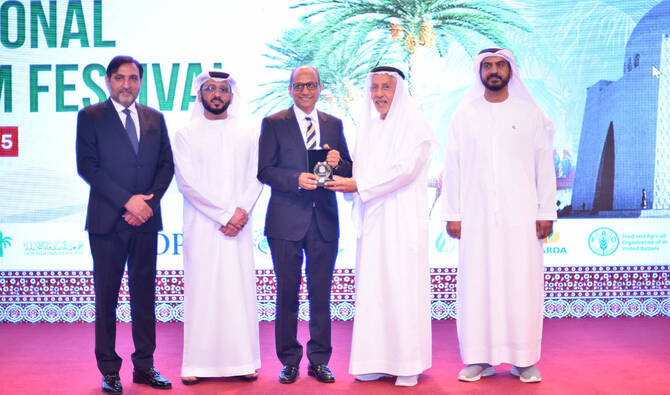

KARACHI: Hundreds of Pakistani growers, exporters and international experts gathered in Karachi on Tuesday for the second Pakistan International Date Palm Festival to exchange ideas, showcase innovations and forge new trade links as the Pakistan’s date farming industry looks to modernize and expand its global reach.
The festival was organized in the port city of Karachi by the Trade Development Authority of Pakistan (TDAP) under the patronage of the United Arab Emirates’ Khalifa International Award for Date Palm & Agricultural Innovation.
The three-day event, running till Thursday, is featuring stalls from several countries, including the UAE, Egypt and Jordan, which offered different varieties of dates, farming techniques and packaging solutions to Pakistani growers.
With Pakistan ranked as the world’s fifth-largest date producer, yielding around 535,000 tons annually, the event aimed to help local growers meet the stringent requirements of international markets.
“The purpose of coming here is to connect our linkages with other countries, especially Saudi Arabia and Dubai, so that we can improve our business and go toward import and export,” Ameer Sultan Zehri, a grower from Kharan in Pakistan’s Balochistan, told Arab News.
While Pakistan boasts diverse and high-quality date varieties, many farmers face logistical and technological barriers.
“I saw a lot of growers of date palms in Pakistan, [saw] different varieties,” said Engineer Mohamed Hasan Al-Shamsi Al-Awadhi, a board member of the UAE’s Date Palm Friends Society.
“We are very happy to be with them and to discuss what cooperation we can make with them for import and for export.”
Al-Awadhi stressed the importance of “proper packaging and quality control.”
“When you want to export internationally, you need good packing, good variety, good size,” he said, noting that European markets particularly demand strict specifications.
Growers like Ghulam Qasim Jiskani from Khairpur in Pakistan’s southern Sindh province had the same concerns.
“We don’t have factories to process dates,” he said. “If we have the same facilities, cold storage, marketing, and packaging, we can compete with the world.”
Jiskani, patron of the Pakistani Date Palm Growers Association, said he had personally imported and cultivated 15 varieties of date palms from the Gulf countries, which yielded “excellent results,” but it was hard to make a leap in export without necessary processing infrastructure in Pakistan.
To help address these gaps, international firms at the festival introduced new solutions, aimed at boosting farmer profitability and reducing waste.
Nur Al-Muhammad Berdibekov, manager of the UAE-based Best Bags Packing and Packaging Materials Trading LLC, displayed new mesh bags that protect dates from environmental damage and bird attacks.
“For the Pakistani market, it’s not new, but for the dates [industry], mesh bag, it’s new, new technology for them,” he said, adding the bags will help farmers save dates, reduce waste and increase profit.
On the sustainability front, Egypt’s Valorizen Research and Innovation Center firm showcased technology that transforms date palm waste, often burned or dumped in Pakistan, into thermal insulation and other eco-friendly products.
“[What] we provide is a solution of how to convert this biomass into an added-value product, maybe to substitute few imported products, maybe to substitute other types of, let’s say, material that are produced from petroleum-based ingredients,” Said Awad, an official at the Egyptian firm, told Arab News.
“If commercialized, this can be replicated in Pakistan and provide environmental and economic benefits.”
The festival also drew interest from exporters looking to tap into the growing Pakistani date market.
Amjad M. Tadros of Jordan’s Nadine Dates was seeking to capitalize on growing demand in Pakistan for his company’s unique ‘Madjoul’ dates.
“We would like to offer them the knowledge about the dates,” he said, “the different kinds of dates and why Madjoul dates are better and how to best market them.”


