

UN expert Albanese: Israel seeks to make Gaza City unlivable

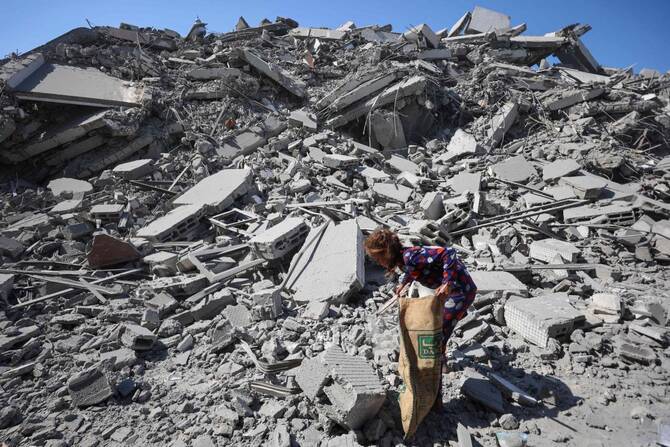
A Palestinian girl searches the rubble of Al-Ghafari tower after its destruction by Israeli airstrikes in Gaza City on Monday. (AFP)
Short Url
Updated 15 September 2025
Follow

UN expert Albanese: Israel seeks to make Gaza City unlivable

  • Francesca Albanese accuses Israeli military of using unconventional weapons in Gaza

GENEVA: Israel is trying to make Gaza City unliveable in its assault on the enclave’s largest urban area and is endangering the lives of Israeli hostages, the top UN expert on Palestinian rights Francesca Albanese said on Monday.

“Israel is bombing using unconventional weapons ... it is trying to forcibly evacuate Palestinians. Why? This is the last piece of Gaza that needs to be rendered unlivable before advancing the ethnic cleansing of that piece of land,” Albanese told reporters in Geneva.
The Israeli mission in Geneva was not immediately available for comment.
Israel says the offensive to take control of Gaza City is part of a plan to defeat Palestinian militant group Hamas for good and that it has warned civilians to head south to a designated humanitarian zone.
However, the UN and numerous countries say its tactics amount to forced mass displacement and that conditions in the humanitarian zone are dire, with food in short supply.


UN Special Rapporteur on the occupied Palestinian territories Francesca Albanese at a press conference in Geneva on Monday on the human rights situation in Gaza. (AFP)

Italian lawyer Albanese serves as a special rapporteur on human rights in the occupied Palestinian territories, one of dozens of experts appointed by the 47-member UN Human Rights Council to report on specific global issues.
“The ongoing assault to take the last remnant of Gaza will not only devastate the Palestinians but endanger also the remaining Israeli hostages,” Albanese said.
She accused Israel of genocide and said the international community was complicit.
The nearly two-year campaign in the Palestinian enclave has killed more than 64,000 people, according to local authorities. Some rights groups like Amnesty International have also accused Israel of committing genocide, but not the United Nations itself. UN officials have in the past said it is up to international courts to determine genocide.
Israel rejects the accusation, citing its right to self-defense following the October 7, 2023, attack by Hamas militants that killed 1,200 people and resulted in the capture of 251 hostages, according to Israeli figures.
In July, the US Secretary of State Marco Rubio announced that Albanese would be added to the US sanctions list for her actions, which he described as prompting illegitimate prosecutions of Israelis at the International Criminal Court.
Albanese said her attempts to travel to New York for the UN General Assembly in September to deliver a report do not look promising.


Can AI really discover anything?

Updated 7 sec ago
Follow

Can AI really discover anything?

  • Nobel Laureates discuss true impact on science at World Laureate Summit in Dubai

DUBAI: Since its rise, artificial intelligence has brought with it a promise of human and scientific progression beyond most people’s imaginations.

However, the spread of AI slop, fakes and proliferation of seemingly nefarious and useless applications have caused many to wonder whether the technology can really live up to its promise.

Scientists and academics gathered in Dubai on Sunday for the opening of the World Laureates Summit argued that the technology does, in fact, help them work faster, spot patterns and test ideas that would otherwise take years or decades.

“Can AI help us in speeding up discovery? Yes. Can it simplify the tasks and eliminate a lot of the trial and error that we chemists use to crystallize things. Yes. Will it get better? Yes,” Palestinian-Saudi Prof. Omar M. Yaghi, 2025 winner of the Nobel prize in chemistry, told the conference.

“I think we are in the middle of a revolution, transforming chemistry by blending it with AI.”

Yaghi said AI was already reducing the time it took chemists to crystallize molecules — a process that lines up atoms or molecules in a neat, repeating pattern rather than a jumble — from several years down to just two weeks. This, in turn, speeds up the process of scientific discovery and application.

His views were echoed by Prof. Tony Fan-cheong Chan, president of the King Abdullah University of Science and Technology, who said AI had already contributed to Nobel Prize-winning discoveries.

However, he questioned the limits of AI saying that despite its ability to improve and accelerate science, humans still led the big, world-changing ideas.

“Here’s my thought experiment for all of you to consider: If someone besides Einstein had the best AI model pre-1905, would that person be able to discover the general theory of relativity?” Feng asked the crowd gathered in Dubai’s Madinat Jumeirah.

Robert Endre Tarjan, a prolific American computer scientist and mathematician, warned against AI — specifically for its inclination to “hallucinate.” He said he believed that regardless of how useful a tool it was, it could never replace human creativity and ingenuity in science.

“AI systems as we know them hallucinate; asking the right question is more important than finding the answer,” he said.

Russian mathematician Yurii Nesterov said AI was ultimately limited by the data made available to it. While he believes AI does have creative capacity, it depends how well it is programmed by humans.

“I believe that artificial intelligence has indeed a considerable creative power, it can discover new links, structures, and properties of the investigated objects,” he said.

“Artificial intelligence is already alive, and the main goal of the scientific community is to ensure the developments in the right directions.”

The World Laureates Summit, held in partnership with the World Governments Summit in Dubai, brings together some of the world’s most distinguished scientists, including Nobel Prize winners, Turing Award recipients, Fields Medalists and other award-winning researchers.