

Pakistan’s monsoon deaths climb to 985 as floodwaters move downstream toward Sindh

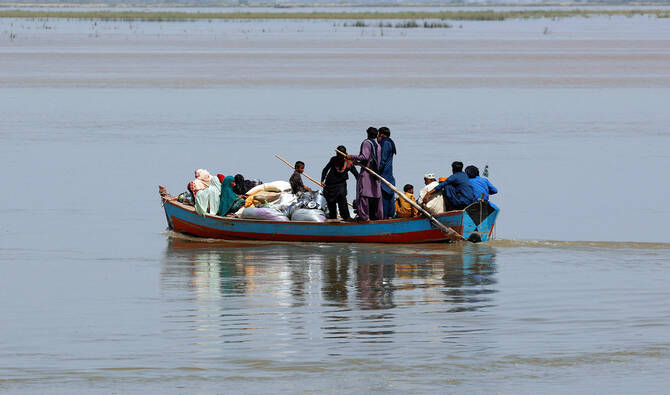
People with their supplies travel in a boat as they head to their village along the Indus River, in Sukkur district of Sindh province, Pakistan, on September 14, 2025. (REUTERS)
Short Url
Updated 15 September 2025
Follow

Pakistan’s monsoon deaths climb to 985 as floodwaters move downstream toward Sindh

  • Over 4,700 villages affected and 2.5 million people evacuated across Punjab, disaster agency says
  • Indus flood wave building at Guddu Barrage, expected to reach Kotri Barrage later this in September

ISLAMABAD: The overall death toll from monsoon rains in Pakistan since late June has risen to 985, officials said on Monday, as floodwaters receded in Punjab and continued their march downstream toward the southern Sindh province.

The flooding in Punajb, triggered by heavy monsoon rains and excess water released from Indian dams, has inundated thousands of villages, displaced millions, and is now consolidating into a flood wave moving down the Indus River system. Authorities say the pressure has shifted from Punjab, the country’s agricultural heartland and most populous province, toward Sindh, where the Guddu and Sukkur barrages — two of the main control points on the Indus — are bracing for high inflows in the coming days.

According to official figures, nationwide 985 deaths have occurred from flash floods, house collapses, landslides and other rain-related incidents since June 26 when this year’s monsoon season began. The northwestern Khyber Pakhtunkhwa (KP) province recorded the highest toll with 504 fatalities, followed by Punjab with 287, Sindh 80, Gilgit-Baltistan 41, Azad Kashmir 38, Balochistan 26 and Islamabad, the federal capital, nine.

The Provincial Disaster Management Authority said Punjab alone has reported 104 deaths since late August as swollen rivers inundated thousands of villages.

“Due to severe flooding in the Ravi, Sutlej, and Chenab rivers, more than 4,700 villages have been affected,” Punjab Relief Commissioner Nabil Javed was quoted as saying in a Provincial Disaster Management Authority (PDMA) report.

According to the PDMA, flooding in the Chenab affected 2,484 villages, in the Sutlej 719 villages, and in the Ravi 1,458 villages. Javed said around 4.72 million people had been affected in total, with 2.56 million evacuated to safer locations.

Authorities have set up 372 relief camps, 454 medical camps and 385 veterinary camps across affected districts, while nearly 2.07 million livestock have also been moved to safety.

The PDMA said water levels have “receded considerably” in Punjab’s Ravi, Sutlej and Chenab rivers, with most stations now in the normal to medium range. At Chenab’s Trimmu Headworks and at upstream points such as Marala, Khanki and Qadirabad, flows have returned to normal levels.

Panjnad, however, remains in a very high flood at 369,085 cusecs, though receding compared with its peak on September 11–12. Panjnad is the southern Punjab confluence where all five major rivers, Jhelum, Chenab, Ravi, Beas and Sutlej, merge before joining the Indus River.

At Sindh’s Guddu Barrage, inflows were reported at 635,759 cusecs and outflows at 606,489 cusecs, with levels expected to rise to 650,000–700,000 cusecs by late September 15.

“The flood will remain across Sindh through September before sinking into the Arabian Sea by month’s end,” the PDMA said.

It warned that “current stress has shifted to Kandhkot, Ubaro, Kashmore, Ghotki, while proximity near Jamshoro, Qambar Shahdadkot and later Hyderabad–Thatta corridor will successively bear the downstream stress.”

The PDMA added that Sukkur Barrage was likely to receive 600,000 cusecs by September 17–18, with Kotri Barrage expected to see peak discharges of 400,000–450,000 cusecs by September 24–26. Sukkur is the largest irrigation barrage in Pakistan, while Kotri is the final control point before the Indus empties into the Arabian Sea.

Heavy rains and flooding have also caused power disruptions across Punjab. 

The Ministry of Water and Power reported 51 grid stations and 543 feeders affected, with 309 feeders fully restored and 226 partially restored.

Pakistan’s recent flooding has revived memories of the 2022 deluge, which killed more than 1,700 people, displaced millions and caused damages of over $30 billion.

Despite contributing less than 1 percent of global greenhouse gas emissions, the South Asian country consistently ranks among the nations most vulnerable to climate change.


Pakistan opposition to continue protest over ex-PM Khan’s health amid conflicting reports

Updated 16 February 2026
Follow

Pakistan opposition to continue protest over ex-PM Khan’s health amid conflicting reports

  • Pakistan’s government insists that the ex-premier’s eye condition has improved
  • Khan’s personal doctor says briefed on his condition but cannot confirm veracity

ISLAMABAD: Pakistan’s opposition alliance on Monday vowed to continue their protest sit-in at parliament and demanded “clarity” over the health of jailed former prime minister Imran Khan, following conflicting medical reports about his eye condition.

The 73-year-old former cricket star-turned-politician has been held at the high-security Adiala prison in Rawalpindi since 2023. Concerns arose about his health last week when a court-appointed lawyer, Barrister Salman Safdar, was asked to visit Khan at the jail to assess his living conditions. Safdar reported that Khan had suffered “severe vision loss” in his right eye due to central retinal vein occlusion (CRVO), leaving him with just 15 percent sight in the affected eye.

On Sunday, a team of doctors from various hospitals visited the prison to examine Khan’s eye condition, according to the Adiala jail superintendent, who later submitted his report in the court. On Monday, a Supreme Court bench led by Chief Justice Yahya Afridi observed that based on reports from the prison authorities and the amicus curiae, Khan’s “living conditions in jail do not presently exhibit any perverse aspects.” It noted that Khan had “generally expressed satisfaction with the prevailing conditions of his confinement” and had not sought facilities beyond the existing level of care.

Having carefully perused both reports in detail, the bench observed that their general contents and the overall picture emerging therefrom are largely consistent. The opposition alliance, which continued to stage its sit-in for a fourth consecutive day on Monday, held a meeting at the parliament building on Monday evening to deliberate on the emerging situation and discuss their future course of action.

“The sit-in will continue till there is clarity on the matter of [Khan's] health,”  Sher Ali Arbab, a lawmaker from Khan's Pakistan Tehreek-e-Insaf (PTI) party who has been participating in the sit-in, told Arab News, adding that PTI Chairman Gohar Ali Khan and Opposition Leader in Senate Raja Nasir Abbas had briefed them about their meeting with doctors who had visited Khan on Sunday.

Speaking to reporters outside parliament, Gohar said the doctors had informed them that Khan’s condition had improved.

“They said, 'There has been a significant and satisfactory improvement.' With that satisfactory improvement, we also felt satisfied,” he said, noting that the macular thickness in Khan’s eye had reportedly dropped from 550 to 300 microns, a sign of subsiding swelling.

Gohar said the party did not want to politicize Khan’s health.

“We are not doctors, nor is this our field,” he said, noting that Khan’s personal physician in Lahore, Dr. Aasim Yusuf, and his eye specialist Dr. Khurram Mirza had also sought input from the Islamabad-based medical team.

“Our doctors also expressed satisfaction over the report.”

CONFLICTING ACCOUNTS

Despite Gohar’s cautious optimism, Khan’s personal physician, Dr. Yusuf, issued a video message on Monday, saying he could neither “confirm nor deny the veracity” of the government’s claims.

“Because I have not seen him myself and have not been able to participate in his care... I’m unable to confirm what we have been told,” Yusuf said.

He appealed to authorities to grant him or fellow physician, Dr. Faisal Sultan, immediate access to Khan, arguing that the ex-premier should be moved to Shifa International Hospital in Islamabad for specialist care.

Speaking to Arab News, PTI’s central information secretary Sheikh Waqas Akram said Khan’s sister and their cousin, Dr. Nausherwan Burki, will speak to media on Tuesday to express their views about the situation.

The government insists that Khan’s condition has improved.

“His eye [condition] has improved and is better than before,” State Minister Talal Chaudhry told the media in a brief interaction on Monday.

“The Supreme Court of Pakistan is involved, and doctors are involved. What medicine he receives, whether he needs to be hospitalized or sent home, these decisions are made by doctors. Neither lawyers nor any political party will decide this.”