

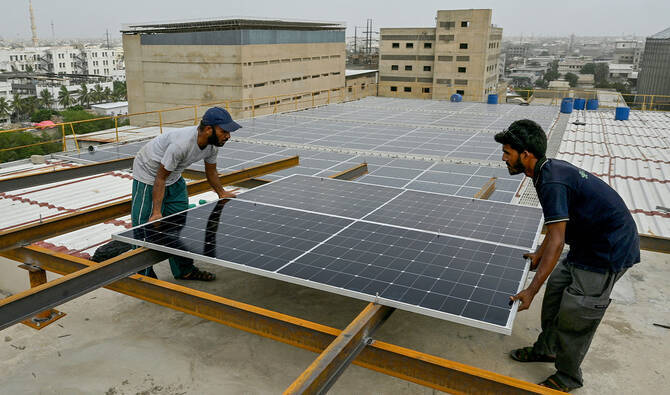

ISLAMABAD: A Pakistani regulator has decided to abolish preferential buyback rates for electricity sold to the national grid by existing rooftop solar users, according to a draft of the notification seen by Arab News on Monday.
The development comes days after Pakistan introduced new regulations that sharply reduced the rate at which households and businesses were being paid for excess electricity generated from rooftop solar systems, in a move that was likely to ease financial pressure on state-run power utilities.
The changes, which were widely criticized in Pakistan, replaced the net-metering regime, under which solar users offset power bills at the same rate they pay for grid power, with a net-billing framework that separates buying and selling prices, which meant consumers would pay full tariffs for power drawn from the grid while receiving a lower, market-linked rate for excess power they exported.
However, the National Electric Power Regulatory Authority (NEPRA) is now amending the regulations notified on Feb. 9 to allow existing solar users to continue to sell excess power to the national grid at the same rates they purchase from it.
"The National Electric Power Regulatory Authority hereby notifies following amendment(s) in the National Electric Power Regulatory Authority (Prosumer) Regulations," it said in the draft notification.
"Notwithstanding the repeal effected by these regulations, nothing shall affect approvals granted, licenses or concurrences issued and agreements executed under the repealed regulations before the commencement of these regulations and any distributed generator having a valid agreement executed under the repealed regulations shall be billed in accordance with rate and mechanism provided in the repealed regulations till the expiry of the term of the agreement executed under the repealed regulations," it said.
"Provided that this sub-regulation shall be deemed to have taken effect on 9th February 2026 and shall always be deemed to have had effect accordingly."
NEPRA has sought public comments on draft amendment within 30 days of the publication to finalize the amendment.
Pakistan has seen an unprecedented boom in rooftop solar systems over the past three years as households and businesses turned to private generation to escape record electricity prices, frequent outages and inflation-driven energy costs.
Solar power grew from 4 percent of the energy mix in 2021 to over 14–25 percent in 2024-2025, official figures show. Driven by skyrocketing grid tariffs, Pakistan became one of the world’s top new solar adopters, importing roughly 22 gigawatts (GW) of solar panels in 2024 alone. Industry data shows tens of thousands of new solar connections have been added annually, significantly reducing demand from the grid during daylight hours.
Power distribution companies had warned that the net-metering regime was eroding revenues, worsening losses and shifting costs onto non-solar consumers, a growing concern in a sector already weighed down by billions of dollars in circular debt.
The revised framework, notified on Feb. 9, sought to rebalance incentives while still allowing consumers to generate their own electricity, officials said.
The revised regulations apply to distributed generation systems using solar, wind or biogas technology with installed capacity of up to one megawatt. Installed capacity may not exceed a consumer’s sanctioned load, and utilities may restrict new connections if injections exceed 80 percent of a local transformer’s rated capacity.
Projects above 250 kilowatts will require technical studies before approval. All new agreements will be signed for five years and renewed under the updated rules, according to the regulations notified on Feb. 9. Existing net-metered consumers will remain on their current contracts until expiry, after which they will transition to the new billing system.
NEPRA said at the time the policy aimed to balance renewable energy adoption with grid stability and financial sustainability as Pakistan tries to reform a power sector marked by chronic losses, rising subsidies and persistent fiscal pressure.


