

Pakistan, OIC call for pan-Islamic response to Israeli military actions in Middle East — FO

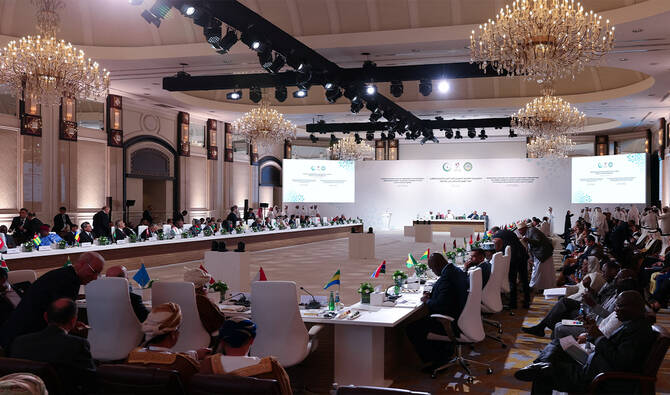
Delegations attend the preparatory ministerial meeting for the emergency Arab-Islamic summit in Doha, Qatar, on September 14, 2025. (Qatar Ministry of Foreign Affairs)
Short Url
Updated 15 September 2025
Follow

Pakistan, OIC call for pan-Islamic response to Israeli military actions in Middle East — FO

  • Leaders from Arab and Islamic nations are meeting in Doha to forge a united front about Israeli attack against Hamas leaders in Doha
  • Pakistani deputy PM, OIC chief reaffirm unwavering support for the Palestinian cause, stress need to advance regional peace and stability

ISLAMABAD: Pakistan and the Organization of Islamic Cooperation (OIC) on Sunday called for a pan-Islamic response to Israeli military actions in the Middle East, the Pakistani foreign ministry said, as foreign ministers of Arab and Islamic nations gathered in Doha to forge a united front about an Israeli strike against Hamas leaders in Qatar’s capital.

The statement came after a meeting between Pakistani Deputy Prime Minister and Foreign Minister, Ishaq Dar, and OIC Secretary-General Hissein Brahim Taha on the sidelines of a preparatory ministerial meeting of the emergency Arab-Islamic Summit in Doha in the aftermath of Israeli airstrike.

Leaders from Arab and Islamic nations are meeting in Doha to forge a united front about the Israeli attack, which appears to have ended attempts to secure an Israel-Hamas ceasefire and the release of hostages ahead of the upcoming United Nations (UN) General

Assembly session focused on Israel’s war on Gaza.

During their meeting, The Pakistani deputy PM and the OIC secretary-general condemned Israeli attacks on Qatar and other regional states as clear violations of their sovereignty and international law, according to the Pakistani foreign ministry.

“The DPM & the SG underscored the urgency for coordinating a unified pan-Islamic response to Israeli aggression in these challenging times,” the Pakistani ministry said in a statement.

Dar thanked Secretary-General Taha for steering the OIC’s constructive role in forging unity and solidarity within the Muslim world.

“They also reaffirmed their unwavering support for the Palestinian cause and stressed the need to advance regional peace and stability,” the foreign ministry added.

Pakistan has repeatedly condemned Israel’s offensive in Gaza, which has killed nearly 65,000 people, mostly women and children, since October 2023, and called for an immediate ceasefire and war-crimes accountability.

The South Asian country does not have diplomatic relations with Israel and calls for a two-state solution to resolve the Middle East crisis. Islamabad supports an independent Palestinian state as per the aspirations of the Palestinian people, with Al-Quds Al-Sharif as its capital and according to the pre-1967 borders.

In his address with Sunday’s preparatory ministerial meeting, the OIC secretary-general stressed that the blatant Israeli aggression against the sovereignty of Qatar, an active Member of the Organization of Islamic Cooperation and the League of Arab States, constitutes a continuation of Israel’s “expansion of the circle of war, a destabilization of regional security and stability, and a persistent violation of international charters, laws, and resolutions,” according to an OIC statement.

“He further reiterated the necessity of redoubling efforts to hold Israel accountable for its violation of the sovereignty of the State of Qatar, and for committing crimes of genocide, settlement, and organized terrorism against the Palestinian people, and to support efforts aimed at implementing the resolutions of the Security Council and the General Assembly on ending Israeli aggression, occupation, and settlement, and on implementing the two-State solution,” the statement read.

Qatari Prime Minister Sheikh Mohammed bin Abdulrahman Al-Thani urged the international community to “stop using double standards” and punish Israel for what he described as its “crimes.”

“The time has come for the international community to stop using double standards and to punish Israel for all the crimes it has committed, and Israel needs to know that the ongoing war of extermination that our brotherly Palestinian people is being subjected to, and whose aim is to expel them from their land, will not work,” he said on the eve of the Arab-Islamic Summit.

The Israeli attack was widely condemned across the Arab and Islamic world as a violation of the international law and sovereignty of Qatar, which has been facilitating mediation efforts, including for a ceasefire in Gaza, together with Egypt and the United States.

The Arab-Islamic Summit is to discuss a draft statement regarding the Israeli attack on Qatar on Sept. 9, which targeted the residences of several Hamas officials in Doha, according to the Qatar News Agency.


IMF warns against policy slippage amid weak recovery as it clears $1.2 billion for Pakistan

Updated 11 December 2025
Follow

IMF warns against policy slippage amid weak recovery as it clears $1.2 billion for Pakistan

  • Pakistan rebuilt reserves, cut its deficit and slowed inflation sharply over the past one year
  • Fund says climate shocks, energy debt, stalled reforms threaten stability despite recent gains

ISLAMABAD: Pakistan’s economic recovery remains fragile despite a year of painful stabilization measures that helped pull the country back from the brink of default, the International Monetary Fund (IMF) warned on Thursday, after it approved a fresh $1.2 billion disbursement under its ongoing loan program.

The approval covers the second review of Pakistan’s Extended Fund Facility (EFF) and the first review of its climate-focused Resilience and Sustainability Facility (RSF), bringing total disbursements since last year to about $3.3 billion.

Pakistan entered the IMF program in September 2024 after years of weak revenues, soaring fiscal deficits, import controls, currency depletion and repeated climate shocks left the economy close to external default. A smaller stopgap arrangement earlier that year helped avert immediate default, but the current 37-month program was designed to restore macroeconomic stability through strict monetary tightening, currency adjustments, subsidy rationalization and aggressive revenue measures.

The IMF’s new review shows that Pakistan has delivered significant gains since then. Growth recovered to 3 percent last year after shrinking the year before. Inflation fell from over 23 percent to low single digits before rising again after this year’s floods. The current account posted its first surplus in 14 years, helped by stronger remittances and a sharp reduction in imports. And the government delivered a primary budget surplus of 1.3 percent of GDP, a key program requirement. Foreign exchange reserves, which had dropped dangerously low in 2023, rose from US$9.4 billion to US$14.5 billion by June.

“Pakistan’s reform implementation under the EFF arrangement has helped preserve macroeconomic stability in the face of several recent shocks,” IMF Deputy Managing Director Nigel Clarke said in a statement after the Board meeting.

But he warned that Islamabad must “maintain prudent policies” and accelerate reforms needed for private-sector-led and sustainable growth.

The Fund noted that the 2025 monsoon floods, affecting nearly seven million people, damaging housing, livestock and key crops, and displacing more than four million, have set back the recovery. The IMF now expects GDP growth in FY26 to be slightly lower and forecasts inflation to rise to 8–10 percent in the coming months as food prices adjust.

The review warns Pakistan against relaxing monetary or fiscal discipline prematurely. It urges the State Bank to keep policy “appropriately tight,” allow exchange-rate flexibility and improve communication. Islamabad must also continue raising revenues, broadening the tax base and protecting social spending, the Fund said.

Despite the progress, Pakistan’s structural weaknesses remain severe.

Power-sector circular debt stands at about $5.7 billion, and gas-sector arrears have climbed to $11.3 billion despite tariff adjustments. Reform of state-owned enterprises has slowed, including delays in privatizing loss-making electricity distributors and Pakistan International Airlines. Key governance and anti-corruption reforms have also been pushed back.

The IMF welcomed Pakistan’s expansion of its flagship Benazir Income Support Program, which raises cash transfers for low-income families and expands coverage, saying social protection is essential as climate shocks intensify. But it warned that high public debt, about 72 percent of GDP, thin external buffers and climate exposure leave the country vulnerable if reform momentum weakens.

The Fund said Pakistan’s challenge now is to convert short-term stabilization into sustained recovery after years of economic volatility, with its ability to maintain discipline, rather than the size of external financing alone, determining the durability of its gains.