

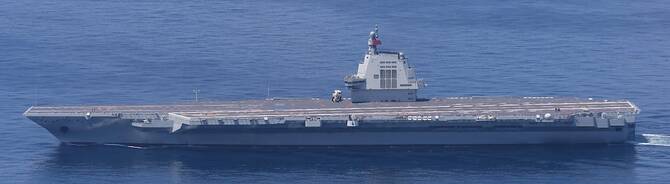
China’s newest aircraft carrier, the Fujian, sails through Taiwan Strait

Above, China’s third and newest aircraft carrier, the Fujian, sails in the East China Sea in this handout photo taken by Japan’s Ministry of Defense on Sept. 11, 2025. (Japan’s Ministry of Defense via Jiji Press/AFP)
Short Url
Updated 12 September 2025
Follow

China’s newest aircraft carrier, the Fujian, sails through Taiwan Strait

  • Beijing has ploughed billions of dollars into modernizing its military in recent years
  • This trend that has unnerved some governments in East Asia

BEIING: China said on Friday that its third and newest aircraft carrier, the Fujian, recently sailed through the sensitive Taiwan Strait to carry out “scientific research trials and training missions” in the South China Sea.

Beijing has ploughed billions of dollars into modernizing its military in recent years, a trend that has unnerved some governments in East Asia despite China insisting its aims are peaceful.

China has two carriers in operation – the Liaoning and Shandong – with the Fujian currently undergoing sea trials.

China’s navy said on Friday that undertaking cross-regional trials “is a normal part of the aircraft carrier’s construction process”.

It is “not directed at any specific target”, a spokesman for the Chinese navy, Leng Guowei, said in a statement.

However, its transit through the sensitive Taiwan Strait was intended to signal “China’s rise as a strong military power, and beyond that, a maritime great power”, said Collin Koh, a senior fellow at the S. Rajaratnam School of International Studies in Singapore.

“It’s to flex China’s newfound military strength and send a veritable signal to potential adversaries,” he said.

Taiwan’s Ministry of National Defense said Friday it had used “joint intelligence, surveillance and reconnaissance means to fully grasp the situation and responded accordingly”.

Japan’s defense ministry said that on Thursday afternoon it had identified three Chinese naval ships advancing southwest in waters approximately 200 kilometers (124 miles) northwest of one of the disputed Senkaku Islands, known in Chinese as the Diaoyu Islands.

“Among these, the Fujian aircraft carrier was confirmed by the Japan Maritime Self-Defense Force for the first time,” it said in a statement.

Japan said in July that China’s intensifying military activities could “seriously impact” its security, citing the first confirmed incursion by a Chinese military aircraft into its airspace last August in an annual threat assessment.

China said that a coastguard fleet had “patrolled within the territorial waters of the Diaoyu Islands” on Friday.

Last year, Chinese vessels sailed near the Japanese-administered islands a record 355 times, according to Tokyo.

Expanding its reach

Compared to the other seas, the South China Sea “presents a more challenging environment with harsher conditions, making the trials more rigorous” for the Fujian, said Song Zhongping, a Chinese military commentator.

After undergoing sea trials and completing further adaptive training, the Fujian will likely be commissioned into active service, Song said.

The Soviet-built Liaoning is China’s oldest aircraft carrier, commissioned in 2012, while the Shandong entered service in 2019.

Analysts at Washington-based think tank CSIS have said the Fujian is expected to feature more advanced take-off systems, allowing the Chinese air force to deploy jets carrying larger payloads and more fuel.

China has stepped up a massive expansion of its naval forces in recent years as it seeks to grow its reach in the Pacific and challenge a US-led alliance.

The US Department of Defense said in a December report that China numerically has the largest navy in the world, with a battle force of more than 370 ships and submarines.

Beijing said in June that its Liaoning and Shandong carrier formations conducted combat drills in the western Pacific Ocean, unsettling regional neighbors including Japan.

A Taiwanese security official also said that month Beijing had deployed its two aircraft carrier groups around the island in May.

The Chinese Communist Party has refused to rule out using force to seize control of Taiwan, a democratic, self-ruled island that China insists is part of its territory.


Tug of war: how US presidents battle Congress for military powers

Updated 01 March 2026
Follow

Tug of war: how US presidents battle Congress for military powers

  • The last official declaration of war by Congress was as far back as World War II

WASHINGTON, United States: Donald Trump’s unleashing of operation “Epic Fury” against Iran has once more underscored the long and bitter struggle between US presidents and Congress over who has the power to decide on foreign military action.
In his video address announcing “major combat” with the Islamic republic, Trump didn’t once mention any authorization or consultation with the US House of Representatives or Senate.
In doing so he sidelined not only Democrats, who called for an urgent war powers vote, but also his own Republican party as he asserts his dominance over a largely cowed legislature.
A US official said Secretary of State Marco Rubio had called top congressional leaders known as the “Gang of Eight” to give them a heads up on the Iran attack — adding that one was unreachable.
Rubio also “laid out the situation” and consulted with the same leaders on Tuesday in an hour-long briefing, the US official said.
According to the US Constitution, only Congress can declare war.
But at the same time the founding document of the United States first signed in 1787 says that the president is the “commander in chief” of the military, a definition that US leaders have in recent years taken very broadly.
The last official declaration of war by Congress was as far back as World War II.
There was no such proclamation during the unpopular Vietnam War, and it was then that Congress sought to reassert its powers.
In 1973 it adopted the War Powers Resolution, passed over Richard Nixon’s veto, to become the only lasting limit on unilateral presidential military action abroad.
The act allows the president to carry out a limited military intervention to respond to an urgent situation created by an attack against the United States.
In his video address on Saturday, Trump evoked an “imminent” threat to justify strikes against Iran.

- Sixty days -

Yet under this law, the president must still inform Congress within 48 hours.
It also says that if the president deploys US troops for a military action for more than 60 days, the head of state must then obtain the authorization of Congress for continued action.
That falls short of an official declaration of war.
The US Congress notably authorized the use of force in such a way after the September 11, 2011 attacks on the United States by Al-Qaeda. Presidents have used it over the past two decades for not only the 2001 invasion of Afghanistan but a series of operations in several countries linked to the “War on Terror.”
Trump is far from the first US president to launch military operations without going through Congress.
Democrat Bill Clinton launched US air strikes against Kosovo in 1999 as part of a NATO campaign, despite the lack of a green light from skeptical lawmakers.
Barack Obama did the same for airstrikes in Libya in 2011.
Trump followed their example in his first term in 2018 when he launched airstrikes in Syria along with Britain and France.
But since his return to power the 79-year-old has sought to push presidential power to its limits, and that includes in the military sphere.
Trump has ordered strikes on alleged drug trafficking boats in Latin America without consulting Congress, and in June 2025 struck Iran’s nuclear facilities.
Perhaps the most controversial act was when he ordered the capture of Venezuelan president Nicolas Maduro in a lightning military raid on January 3.
Republicans however managed to knock down moves by Democrats for a rare war powers resolution that would have curbed his authority over Venezuela operations.
Trump has meanwhile sought to extend his powers over the home front. Democrats have slammed the Republican for deploying the National Guard in several US cities in what he calls a crackdown on crime and immigration.