

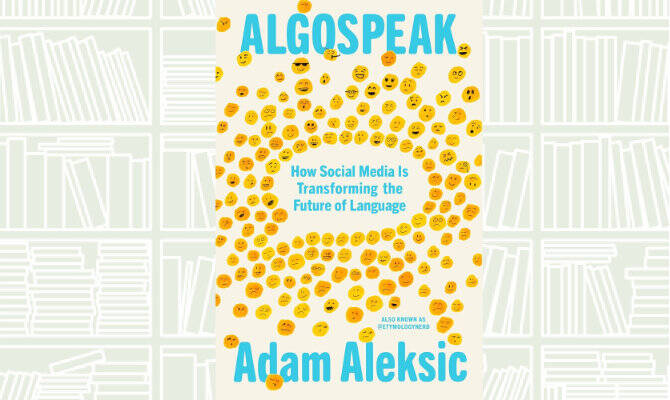
Book Review: ‘Algospeak: How Social Media is Transforming the Future of Language’

Short Url
Updated 03 December 2025
Follow

Book Review: ‘Algospeak: How Social Media is Transforming the Future of Language’

  • Adam Aleksic examines substitutions and coded phrases used online to bypass censorship, from PG-rated or silly alternatives to fruit emojis and dollar signs replacing letters

In “Algospeak: How Social Media is Transforming the Future of Language,” author Adam Aleksic explores how algorithms are reshaping the words we use and the ways in which we communicate.

Known online as “Etymology Nerd,” the Harvard-educated content creator, who co-founded and led the Harvard Undergraduate Linguistics Society, has been digging into word origins since 2016. He has built a wide audience with his bite-sized educational TikTok videos which explain where trending words come from and how they spread.

The term “algospeak” blends “algorithm” with a concept popularized by tech journalist and fellow book author Taylor Lorenz, describing how creators adapt language to avoid platform restrictions.

“Social media platforms want to promote the most compelling content possible so it makes sense that the words will reach us through maximally compelling mediums, like memes rather than something more serious. ‘Unalive’ is far more likely to spread today than boring traditional alternatives, such as ‘passed away’,” Aleksic writes.

The word “unalive” illustrates how online language quickly filters into offline spaces, from middle school classrooms to playgrounds, often boosted by memes. Aleksic notes: “Language and memes and metadata are one and the same, all of it shaping our vocabulary and identities.”

Fleeting words used by teens may sound like gibberish to adult ears, but they are still worthy of note even if they are merely trendy for a short amount of time, he argues. It helps us figure out who we are, what we are talking about and how we see ourselves — even if by the time you read this review, new words have come and gone.

Aleksic examines substitutions and coded phrases used online to bypass censorship, from PG-rated or silly alternatives to fruit emojis and dollar signs replacing letters.

This isn’t new. Teenagers have long softened words and code-switched in front of authority figures in everyday speech, but now these shifts are documented, amplified and collectively adopted online.

This chronically online generation uses the language to playfully and strategically avoid shadow banning or content removal — including in high-stakes contexts such as posts about the conflict in Gaza. It works.

This is not the death of language, Aleksic insists, but its evolution. Memes, emojis and subtle code words show how communities collectively and creatively innovate, creating words and phrases in real time while navigating the constraints of platforms. “Algospeak” reveals language as a living, evolving system, shaped by algorithms, culture and the people who use it.


XP Music Futures unites industry experts to drive music, creativity

Updated 05 December 2025
Follow

XP Music Futures unites industry experts to drive music, creativity

RIYADH: The annual XP Music Futures conference has started in Riyadh, celebrating creative voices and focusing firmly on the Kingdom’s music and entertainment culture.

Hosted in JAX District, the festival brings together artists, managers and fans in a bid to drive the region’s music scene forward. It is hosted by the MDLBEAST Foundation and includes a series of panel talks and workshops.

During the Saudi Music Managers Forum on Thursday, industry pioneers spoke about their experiences.

Saudi Music Managers Forum at XP Riyadh. (AN Photo / Huda Bashatah)

During on on-stage discussion between Gigi Arabia, CEO of heavy metal promotion company Heavy Arabia, and Rayan Al-Rasheed, director of operations and artist booking at MDLBEAST, the pair emphasized the importance of investing in Saudi artists.

Al-Rasheed explained that supporting the ecosystem surrounding Saudi artists from production to creative direction was a necessary component of greater success.

“What we lack in the MENA (Middle East and North Africa) market is the investment in artists. When I bring foreign artists they have their own visual artists, sound engineers and more … That’s what we need to invest in, that’s what will help sell shows in the end. The more you invest, the more the product succeeds,” he said.

Zeyne Speaks on her experience as an Arab Artist. (AN Photo / Huda Bashatah)

Zeyne, a Palestinian Jordanian artist, spoke about the importance of Arab artistic representation.

On delicately incorporating Arab culture into art, she said: “We approached everything with a lot of intention and research, and I think that’s really important when you want to represent culture.”

Rawan AlTurki Poses in Front of Her Work at XP Riyadh. (AN Photo / Huda Bashatah)

The mission of empowering the region’s voices through art at the festival goes beyond music, with a diverse array of creatives attending.

Rawan Al-Turki and Abir Ahmed, photographers from Jeddah, spoke to Arab News about being part of Riyadh’s ambitious creative sector. Al-Turki said: “The development that’s happening in Riyadh, it’s really beautiful … you see so much innovation from all these artists … we’re so proud of the transformation.”