

Qatar to host emergency Arab-Islamic summit following Israeli attack

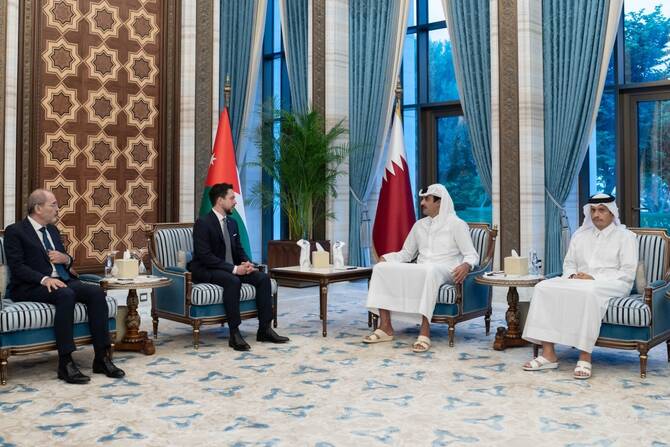
This handout picture released by Qatar's Amiri Diwan shows Qatar's Emir Sheikh Tamim bin Hamad al-Thani (C-R) and Prime Minister and Foreign Minister Mohammed bin Abdulrahman al-Thani (R) meeting with Jordan's Crown Prince Hussein (C-L) and Jordan's Foreign Minister Ayman Safadi (L) in Doha on September 10, 2025. (File/AFP)
Short Url
Updated 11 September 2025
Follow

Qatar to host emergency Arab-Islamic summit following Israeli attack

  • Egypt and the UAE expressing full solidarity and warning that such actions threaten Gulf security and regional stability

LONDON: Qatar will host an emergency Arab-Islamic summit next Sunday and Monday to discuss the recent Israeli attack on Doha targeting senior Hamas leaders, according to the Qatari news agency.

Meanwhile, Egyptian Foreign Minister Badr Abdelatty arrived in Doha on Thursday to express Egypt’s full solidarity with Qatar. Abdelatty was received by Qatar’s Emir, Sheikh Tamim bin Hamad Al-Thani, during the visit.

The United Arab Emirates also strongly condemned Israeli Prime Minister Benjamin Netanyahu’s aggressive statements against Qatar.

In a statement, the UAE Ministry of Foreign Affairs said that Qatar’s security and stability are integral to the security of all Gulf Cooperation Council states, adding that any attack on a Gulf nation constitutes an attack on the collective Gulf security system.

The Ministry emphasized its full rejection of statements containing future threats to Qatar, warning that such provocative rhetoric undermines regional stability and could push the Gulf toward dangerous paths.

Anwar Gargash, Diplomatic Advisor to the UAE President, also said Israel’s attacks on Qatar highlight the volatile regional environment. He noted that the UAE President is embarking on a Gulf tour to strengthen coordination, enhance cooperation, and reinforce the concept of a “shared destiny” among Gulf nations.


Lebanon PM publishes long-awaited banking law draft

Updated 4 sec ago
Follow

Lebanon PM publishes long-awaited banking law draft

  • The law stipulates that each of the state, the central bank, commercial banks and depositors will share the losses accrued as a result of the financial crisis.
  • Depositors with a limit of $100,000, over the course of four years

BEIRUT: Lebanese Prime Minister Nawaf Salam published on Friday a long-awaited banking draft bill, which distributes losses from the 2019 economic crisis between banks and the state.
The draft law is a key demand from the international community, which has conditioned economic aid to Lebanon on financial reforms.
In a televised speech, Salam said “this draft law constitutes a roadmap to getting out of the crisis” that still grips Lebanon.
The draft will be discussed by the Lebanese cabinet on Monday before being sent to parliament, where it could be blocked.
The law stipulates that each of the state, the central bank, commercial banks and depositors will share the losses accrued as a result of the financial crisis.
Depositors, who lost access to their funds after the crisis, will be able to retrieve their money, with a limit of $100,000, over the course of four years.
Salam said that 85 percent of depositors had less than $100,000 in their accounts.
The wealthiest depositors will see the remainder of their money compensated by asset-backed securities.
“I know that many of you are listening today with hearts full of anger, anger at a state that abandoned you,” Salam said.
“This bill may not be perfect... but it is a realistic and fair step toward restoring rights, halting the collapse.”

- ‘Banks are angry’ -

The International Monetary Fund, which closely monitored the drafting of the bill, had previously insisted on the need to “restore the viability of the banking sector consistent with international standards” and protect small depositors.
The Associations of Banks in Lebanon criticized the draft law on Monday, saying in a statement that it contains “serious shortcomings” and harms commercial banks.
“Banks are angry because the law opens the door to them sharing any part of the losses,” said Sami Zougheib, researcher at The Policy Initiative, a Beirut-based think tank.
He told AFP that banks would have preferred that the state bear full responsibility.
The text provides for the recapitalization of failing banks, while the government’s debt to the Central Bank will be converted into bonds.
Salam said that the bill aims to “revive the banking sector” which had collapsed, giving free rein to a parallel economy based on cash transactions, which facilitate money laundering and illicit trade.
According to government estimates, the losses resulting from the financial crisis amounted to about $70 billion, a figure that is expected to have increased over the six years that the crisis was left unaddressed.
Since assuming power, Salam and President Joseph Aoun have pledged to implement the necessary reforms and legislation.
In April, Lebanon’s parliament adopted a bank restructuring law, as the previous legislation was believed to have allowed a flight of capital at the outbreak of the 2019 crisis.
The new bill stipulates that politically exposed persons and major shareholders who transferred significant capital outside the country from 2019 onwards — while ordinary depositors were deprived of their savings — must return them within three months or face fines.
The draft law could still be blocked by parliament even if the cabinet approves it.
“Many lawmakers are directly exposed as large depositors or bank shareholders, politically allied with bank owners, and unwilling to pass a law that either angers banks or angers depositors,” Zougheib said.
Politicians and banking officials have repeatedly obstructed the reforms required by the international community for Lebanon to receive financial support.