

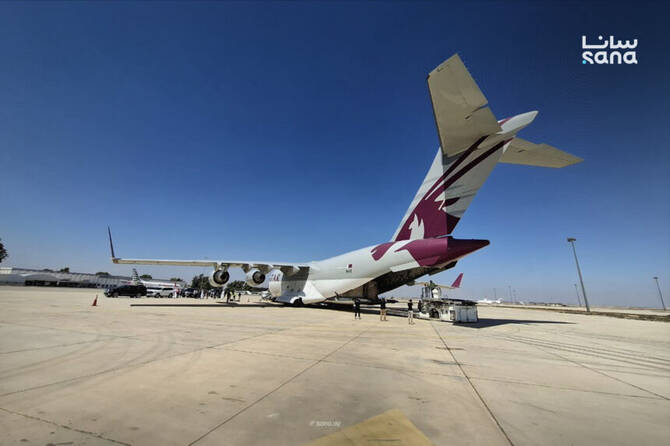
Qatar sends vital medical supplies to support Syrian hospitals

Sidra Medicine and other Qatari organizations delivered the aid shipment as part of Doha’s Syria Abshiri humanitarian initiative. (SANA)
Short Url
Updated 08 September 2025
Follow

Qatar sends vital medical supplies to support Syrian hospitals

  • Health director in Damascus said aid from Qatar represents ‘a new hope’ for both patients and medical staff
  • Qatar has sent 90 tons of aid so far, which will be distributed to approximately 50 Syrian hospitals, the health minister said

LONDON: Qatar sent 12 tons of advanced medical equipment this week aboard an air force plane to support hospitals in the Syrian Arab Republic as Damascus recovers from over a decade of civil war.

Sidra Medicine and other Qatari organizations delivered the aid shipment as part of Doha’s Syria Abshiri humanitarian initiative, which aims to enhance the capacity of Syrian hospitals.

The shipment included ventilators, portable incubators for newborns, dialysis machines, anesthesia and imaging equipment, cardiac and oxygen monitoring systems, as well as advanced radiology and laboratory analysis devices.

Syrian Health Minister Musab Al-Ali announced that the latest aid is part of an agreement with Doha to deliver medical equipment through land and air routes. He added that 90 tons of Qatari aid have arrived so far and will be distributed to approximately 50 hospitals, the SANA news agency reported.

Yousef bin Ali Al-Khater, head of the Qatari Red Crescent, said that the Syria Abshiri initiative highlights the strong ties between the two peoples and is part of a broader effort to rehabilitate Syria’s healthcare sector.

President of the Syrian Arab Red Crescent Dr. Hazem Baqleh announced that this shipment signifies the start of ongoing support efforts from Qatar, while Dr. Wael Daghmash, the director of health in Damascus, said it represents “a new hope” for both patients and medical staff, SANA added.


Sudan paramilitary seizes key oil field: engineer

Updated 3 sec ago
Follow

Sudan paramilitary seizes key oil field: engineer

  • Sudan’s energy and petroleum ministry did not immediately respond to a request for comment on the reported capture of the Heglig field
  • The Heglig field is the country’s largest, and is also the main processing facility for South Sudan’s oil exports
PORT SUDAN, Sudan: An engineer at Sudan’s largest oil field said Monday that the paramilitary Rapid Support Forces had seized the facility along the country’s southern border, forcing the evacuation of its staff.
Sudan’s energy and petroleum ministry did not immediately respond to a request for comment on the reported capture of the Heglig field, located in the resource-rich Kordofan region.
“This morning the RSF took control of the field. Our technical teams shut it down and halted production, and the workers were evacuated to South Sudan,” the engineer said by phone from across the border.
Since April of 2023, the RSF has been waging a war with the regular army that has killed tens of thousands of people, displaced 12 million more and decimated the country’s already fragile infrastructure.
The Heglig field is the country’s largest, and is also the main processing facility for South Sudan’s oil exports, which make up nearly all of Juba’s government revenue.
“The processing plant near the field through which South Sudanese oil passes was also shut down,” the engineer said on condition of anonymity because he was not authorized to speak to the media.
The army has repeatedly accused the RSF of launching drone strikes on Heglig, prompting authorities to temporarily suspend operations there in August.
Heglig lies in the far south of Sudan’s Kordofan region, which has seen fierce fighting in recent weeks as the two sides wrestle for territory.
A drone attack in South Kordofan state blamed on the RSF hit a kindergarten and a hospital last week, killing dozens of civilians, including children, according to a local official and army-aligned foreign ministry.
In October, the RSF pushed army troops out of their last position in the western Darfur region, putting the military on the defensive as it tries to halt the paramilitary advance through Kordofan and back toward the capital Khartoum.
Sudan is now effectively split in two, with the army holding the north, east and center, and the RSF in control of the west and, with the help of its allies, swathes of the south.