BBC says will fight Trump's $10 bn defamation lawsuit

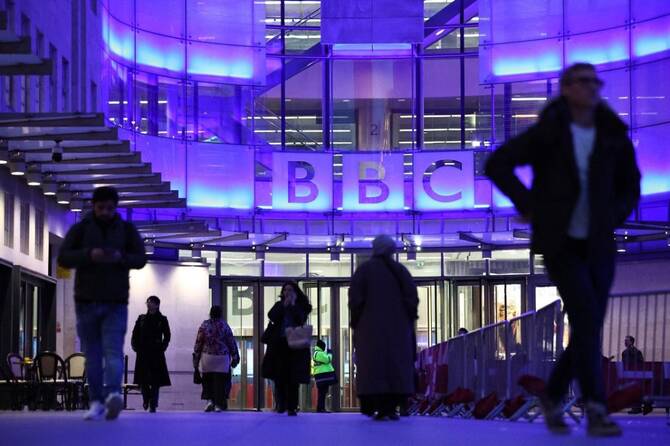
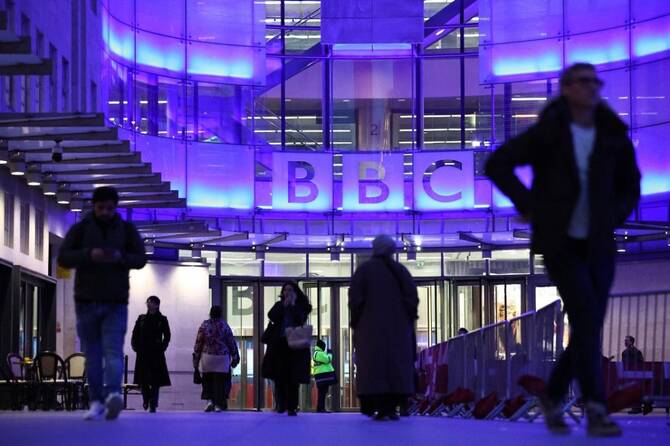
People use the entrance to the offices of British broadcaster BBC in London in the late afternoon on November 11, 2025. (AFP)
Short Url
Updated 16 December 2025
Follow

BBC says will fight Trump's $10 bn defamation lawsuit

LONDON: The BBC said Tuesday it would fight a $10-billion lawsuit brought by US President Donald Trump against the British broadcaster over a documentary that edited his 2021 speech ahead of the US Capitol riot.
“As we have made clear previously, we will be defending this case,” a BBC spokesperson said in a statement sent to AFP, adding the company would not be making “further comment on ongoing legal proceedings.”
The lawsuit, filed in federal court in Miami, seeks “damages in an amount not less than $5,000,000,000” for each of two counts against the British broadcaster, for alleged defamation and violation of the Florida Deceptive and Unfair Trade Practices Act.
The video that triggered the lawsuit spliced together two separate sections of Trump’s speech on January 6, 2021 in a way that made it appear he explicitly urged supporters to attack the Capitol, where lawmakers were certifying Joe Biden’s 2020 election win.
The lawsuit comes as the UK government on Tuesday launched the politically sensitive review of the BBC’s Royal Charter, which outlines the corporation’s funding and governance and needs to be renewed in 2027.
As part of the review, it launched a public consultation on issues including the role of “accuracy” in the BBC’s mission and contentious reforms to the corporation’s funding model, which currently relies on a mandatory fee for anyone in the country who watches television.
Minister Stephen Kinnock stressed after the lawsuit was filed that the UK government “is a massive supporter of the BBC.”
The BBC has “been very clear that there is no case to answer in terms of Mr.Trump’s accusation on the broader point of libel or defamation. I think it’s right the BBC stands firm on that point,” Kinnock told Sky News on Tuesday.
Trump, 79, had said the lawsuit was imminent, claiming the BBC had “put words in my mouth,” even positing that “they used AI or something.”
The documentary at issue aired last year before the 2024 election, on the BBC’s “Panorama” flagship current affairs program.

Apology letter 

“The formerly respected and now disgraced BBC defamed President Trump by intentionally, maliciously, and deceptively doctoring his speech in a brazen attempt to interfere in the 2024 Presidential Election,” a spokesperson for Trump’s legal team said in a statement to AFP.
“The BBC has a long pattern of deceiving its audience in coverage of President Trump, all in service of its own leftist political agenda,” the statement added.
The British Broadcasting Corporation, whose audience extends well beyond the United Kingdom, faced a period of turmoil last month after a media report brought renewed attention to the edited clip.
The scandal led the BBC director general, Tim Davie, and the organization’s top news executive, Deborah Turness, to resign.
Trump’s lawsuit says the edited speech in the documentary was “fabricated and aired by the Defendants one week before the 2024 Presidential Election in a brazen attempt to interfere in and influence the Election’s outcome to President Trump’s detriment.”
The BBC has denied Trump’s claims of legal defamation, though BBC chairman Samir Shah has sent Trump a letter of apology.
Shah also told a UK parliamentary committee last month the broadcaster should have acted sooner to acknowledge its mistake after the error was disclosed in a memo, which was leaked to The Daily Telegraph newspaper.
The BBC lawsuit is the latest in a string of legal actions Trump has taken against media companies in recent years, several of which have led to multi-million-dollar settlements.


Disinformation the new enemy in disaster zones, says Red Cross

Updated 05 March 2026
Follow

Disinformation the new enemy in disaster zones, says Red Cross

  • “Harmful information and dehumanizing narratives” undermines humanitarian aid and putting lives of aid workers at risk
  • Between 2020 and 2024, disasters affected nearly 700 million people, displaced over 105 million, and killed more than 270,000 — doubling the number in need of humanitarian aid

GENEVA: The rise of disinformation is undermining humanitarian aid and putting lives at risk, while disasters are affecting ever more people, the Red Cross warned Thursday.
“Between 2020 and 2024, disasters affected nearly 700 million people, caused more than 105 million displacements, and claimed over 270,000 lives,” the International Federation of Red Cross and Red Crescent Societies said.
The number of people needing humanitarian assistance more than doubled in the same timeframe, the IFRC said in its World Disasters Report 2026.
But the world’s largest humanitarian network said that “harmful information and dehumanizing narratives” were increasingly undermining trust, putting the lives of aid workers at risk.
“In polarized and politically-charged contexts, humanitarian principles such as neutrality and impartiality are increasingly misunderstood, misrepresented or deliberately attacked online,” it said.
The IFRC has more than 17 million volunteers across more than 191 countries.
“In every crisis I have witnessed, information is as essential as food, water and shelter,” said the Geneva-based federation’s secretary general Jagan Chapagain.
“But when information is false, misleading or deliberately manipulated, it can deepen fear, obstruct humanitarian access and cost lives.”
He said harmful information was not a new phenomenon, but it was now moving “with unprecedented speed and reach.”
Chapagain said digital platforms were proving “fertile ground for lies.”
The IFRC report said the challenge nowadays was no longer about the availability of information but its reliability, noting that the production and spread of disinformation was easily amplified by artificial intelligence.

- ‘Life and death’ -

The report cited numerous recent examples of harmful information hampering crisis response.
During the 2024 floods in Valencia, false narratives online accused the Spanish Red Cross of diverting aid to migrants, which in turn fueled “xenophobic attacks on volunteers,” the IFRC said.
In South Sudan, rumors that humanitarian agencies were distributing poisoned food “caused people to avoid life-saving aid” and led to threats against Red Cross staff.
In Lebanon, false claims that volunteers were spreading Covid-19, favoring certain groups with aid and providing unsafe cholera vaccines eroded trust and endangered vulnerable communities, the IFRC said.
And in Bangladesh, during political unrest, volunteers faced “widespread accusations of inaction and political alignment,” leading to harassment and reputational damage, it added.
Similar events were registered by the IFRC in Sudan, Myanmar, Peru, the United States, New Zealand, Canada, Kenya and Bulgaria.
The report underlined that around 94 percent of disasters were handled by national authorities and local communities, without international interventions.
“However, while volunteers, local leaders and community media are often the most trusted messengers, they operate in increasingly hostile and polarized information environments,” the IFRC said.
The federation called on governments, tech firms, humanitarian agencies and local actors to recognize that reliable information “is a matter of life and death.”
“Without trust, people are less likely to prepare, seek help or follow life-saving guidance; with it, communities act together, absorb shocks and recover more effectively,” said Chapagain.
The organization urged technology platforms to prioritize authoritative information from trusted sources in crisis contexts, and transparently moderate harmful content.
And it said humanitarian agencies needed to make preparing to deal with disinformation “a core function” of their operations, with trained teams and analytics.