

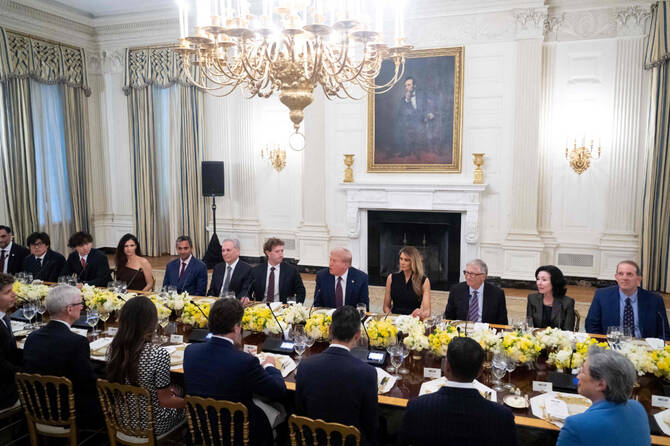

WASHINGTON: President Donald Trump hosted a high-powered group of tech executives at the White House on Thursday as he showcased research on artificial intelligence and boasted of investments that companies are making around the United States.
“This is taking our country to a new level,” he said at the center of a long table surrounded by what he described as “high IQ people.”
It was the latest example of a delicate two-way courtship between Trump and tech leaders, several of whom attended his inauguration. Trump has exulted in the attention from some of the world’s most successful businesspeople, while the companies are eager to remain on the good side of the mercurial president.
While the executives praised Trump and talked about their hopes for technological advancement, the Republican president was focused on dollar signs. He went around the table and asked executives how much they were investing in the country.
Meta’s Mark Zuckerberg, who sat to Trump’s right, said $600 billion. Apple’s Tim Cook said the same. Google’s Sundar Pichai said $250 billion.

President Donald Trump speaks as Facebook CEO Mark Zuckerberg listens during a dinner in the State Dining Room of the White House on Sept. 4, 2025, in Washington. (AP)
“What about Microsoft?” Trump said. “That’s a big number.”
CEO Satya Nadella said it was up to $80 billion per year.
“Good,” Trump responded. “Very good.”
Notably absent from the guest list was Elon Musk, once a close ally of Trump who was tasked with running the Department of Government Efficiency. Musk had a public breakup with Trump earlier this year.
At the table instead was one of Musk’s rivals in artificial intelligence, Sam Altman of OpenAI.
In another reflection of shifting loyalties in Trump’s world, the dinner included Jared Isaacman, who founded the payment processing company Shift4.
Isaacman was a Musk ally chosen by Trump to lead NASA, only to have his nomination withdrawn because he was, in Trump’s words, “totally a Democrat.”
The dinner was expected to be held in the Rose Garden, where Trump recently paved over the grassy lawn and set up tables, chairs and umbrellas that look strikingly similar to the outdoor setup at his Mar-a-Lago club in Palm Beach, Florida.
But because of inclement weather, officials decided to move the event to the White House State Dining Room.
The event followed an afternoon meeting of the White House’s new Artificial Intelligence Education task force, which first lady Melania Trump chaired and some tech leaders participated.
“The robots are here. Our future is no longer science fiction,” she said,

Sundar Pichai (L), CEO of Google, attends a dinner hosted by US President Donald Trump and First Lady Melania Trump for tech leaders at the White House in Washington, DC, on Sept. 4, 2025. (AFP)
Pichai, IBM chairman and CEO Arvind Krishna and Code.org President Cameron Wilson were among those participating in the task force.
The White House confirmed that the guest list for the dinner also included: Microsoft cofounder Bill Gates; Google founder Sergey Brin; OpenAI founder Greg Brockman; Oracle CEO Safra Catz; Blue Origin CEO David Limp; Micron CEO Sanjay Mehrotra; TIBCO Software chairman Vivek Ranadive; Palantir executive Shyam Sankar; Scale AI founder Alexandr Wang; and Shift4 Payments CEO Jared Isaacman.
Trump’s outreach to top tech executives has occasionally been divisive within the Republican Party.
One of Trump’s closest allies in Congress, Sen. Josh Hawley, delivered a sharp criticism of the tech industry during a speech at a conservative conference in Washington on Thursday morning. He criticized the lack of regulation around artificial intelligence and singled out Meta and ChatGPT.
“The government should inspect all of these frontier AI systems so we can better understand what the tech titans plan to build and destroy,” the Missouri senator said.
Trump has embraced AI-created imagery and frequently shares it online, despite his complaints earlier in the week about the technology being used to create misleading videos.
Late Wednesday night, he posted a string of AI-generated memes and videos, such as one depicting him interacting with the man pictured in the Cracker Barrel logo, one showing California Democratic Sen. Adam Schiff with an extremely elongated neck, and one with Trump’s face superimposed on a pole vaulter as it appears to leap over a Cracker Barrel banner.
On Tuesday, Trump said a video showing items being thrown out of an upstairs window of the White House must have been created by AI, despite his team seeming to have confirmed the video’s veracity hours earlier.
Trump then said, “If something happens that’s really bad, maybe I’ll have to just blame AI.”
The first lady, at her event Thursday, likewise highlighted both the potential and peril of AI.
“As leaders and parents, we must manage AI’s growth responsibly,” she said, calling for both action and caution. “During this primitive stage, it is our duty to treat AI as we would our own children — empowering, but with watchful guidance.”
Last month, the first lady launched a nationwide contest for students in grades K-12 to use AI to complete a project or address a community challenge. The project was aimed at showing the benefits of AI, but the first lady has also highlighted its drawbacks.
Melania Trump lobbied Congress this year to pass legislation that imposes penalties for online sexual exploitation using imagery that is real or an AI-generated deepfake.
The president signed the “Take It Down Act” in May.


