

Pakistan floods: Sindh on high alert as Punjab threat persists

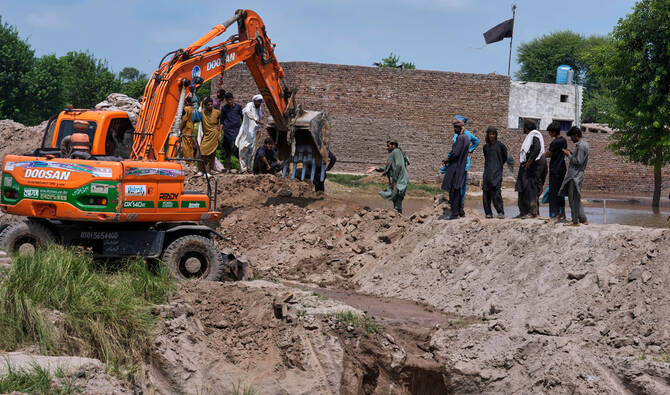
Residents use an excavator to build embankment following floodwater approaching their village in Garh Maharaja, in Jhang district, Pakistan on September 2, 2025. (AP)
Short Url
Updated 04 September 2025
Follow

Pakistan floods: Sindh on high alert as Punjab threat persists

  • NDMA issues high alert for Sindh districts as monsoon spell intensifies. nearly 4 million already affected in Punjab
  • Nationwide, more than 883 people have died in rains, floods and landslides since monsoon season began on June 26

ISLAMABAD: Pakistan’s disaster agency on Thursday issued a high alert for Sindh as heavy monsoon rains and swollen rivers threatened to inundate large parts of the southern province, even as Punjab, the country’s most populous region, remained under severe pressure from surging Chenab River flows.

Nationwide, more than 883 people have died in rains, floods and landslides since the monsoon season began on June 26, according to the NDMA, reviving memories of Pakistan’s catastrophic 2022 deluges when a third of the country was submerged, 30 million displaced and economic losses exceeded $35 billion.

On Thursday evening, the National Disaster Management Authority (NDMA) said Sindh’s southern districts including Thatta, Sujawal, Badin, Tharparkar, Umerkot, Sanghar, Karachi, Hyderabad and Jamshoro could see heavy downpours in the coming days, while the northern districts of Sukkur, Ghotki, Larkana, Khairpur, Dadu and Jacobabad were also at risk.

With flood peaks still moving downstream from Punjab, the alert warned of “high to very high” flooding along the eastern rivers, urging residents of riverine areas to evacuate without delay.

“Your lives are precious, and no unnecessary risk should be taken in the face of natural calamities,” First Lady Bibi Aseefa Bhutto Zardari told communities during a preparedness visit to embankments near Nawabshah.

She inspected protective structures and relief camps, praising local authorities for round-the-clock monitoring and rescue readiness.

“Effective coordination between departments, close monitoring, and advanced planning are essential if we are to manage this challenge successfully,” Bhutto Zardari added.

PUNJAB CRISIS

In Punjab, home to half of Pakistan’s 240 million people and often described as the country’s breadbasket, officials said nearly 3.9 million people had been affected, 1.8 million displaced, and 46 killed in floods since late August. Thousands of villages have been submerged.

Punjab Disaster Management Authority chief Irfan Ali Kathia said the next 24 hours were “extremely critical” for Multan, a city of 2.6 million and the main economic hub of southern Punjab. Multan.

“The main surge of the Chenab has already reached Head Muhammad Wala at its peak and is now moving downstream,” he told reporters.

Kathia added that the Sher Shah Bridge flood gauge near Multan had reached 393.4 feet, against a danger mark of 393.5 feet, leaving only a few inches of space.

If authorities were forced to open a breaching section to relieve pressure, he said, 27 settlements including Shershah, Akbarpur and Mirzapur, home to around 35,000 people, could be inundated.

RIVER FLOWS

Fresh PDMA data from Thursday morning showed the Chenab easing at some upstream points but worsening downstream. Flows at Marala dropped sharply to around 117,000 cusecs from 192,000 recorded the previous evening, and at Khanki fell from 253,600 to 248,800 cusecs. Qadirabad also declined, from 489,000 to 385,000 cusecs.

But the danger has shifted further downstream: at Chiniot bridge levels climbed to nearly 555,000 cusecs, up from 540,000 only hours earlier, while gauges at Riwaz Bridge and Head Muhammad Wala edged higher and Sher Shah Bridge held just inches below its maximum capacity.

On the Ravi, flows steadied or fell slightly at most points, with Jassar down to 80,000 cusecs from 84,000, though Balloki remained elevated at nearly 139,000. On the Sutlej, Ganda Singh Wala dipped modestly to 319,000 cusecs from 327,000, while Panjnad surged to 224,000 from 200,500, suggesting pressure building in the south.

NORTHERN AREAS

Separately, the NDMA warned of landslides in Gilgit-Baltistan and Azad Jammu & Kashmir from Sept. 4–8, citing high risk in Muzaffarabad, Neelum Valley, Haveli, Bagh, Poonch and Sudhnuti.

Heavy rains could block the Karakoram Highway and other routes in Torghar, Batagram, Shangla, Lower Kohistan, Gilgit, Hunza, Rondhu, Skardu and Chitral.



Walnut tree remains ‘under arrest’ for over a century, living symbol of colonial power in Pakistan

Updated 4 sec ago
Follow

Walnut tree remains ‘under arrest’ for over a century, living symbol of colonial power in Pakistan

  • British officer is said to have ordered chaining of the tree in 1898, a reminder of the absolute authority and psychological control enforced under colonial rule in Khyber Pass region
  • Locals and historians say the shackled tree survives as a physical memory of the Frontier Crimes Regulation era, when even nature could be punished to discipline subjects and display power

LANDI KOTAL, KHYBER: In the military cantonment of Landi Kotal, close to Pakistan’s Torkham border crossing with Afghanistan and the mouth of the historic Khyber Pass, a single walnut tree stands bound in heavy iron chains.

It has been this way for more than a century, a surreal, almost absurd monument to the power structures and punitive imagination of the British Empire’s rule in the tribal frontier.

Black shackles still brace parts of its branches, giving it the appearance of a theatrical installation. To locals, it is a wound that never fully healed, a reminder that even nature could be punished when authority wished to show dominance.

Local oral histories trace the origin of this bizarre imprisonment to 1898, when a British officer named James Squid, allegedly intoxicated, believed the tree was moving toward him and instantly ordered it arrested. Soldiers carried out the instruction and the walnut tree has never been freed since.

Muhammad Sardar, the caretaker who oversees the site today, recounted the story as it has been passed down for generations.

“This British military official at that time was drunk and thought this walnut tree was moving toward him to attack him,” he told Arab News. “The officer ordered to arrest this tree, hence the soldiers had to obey the order and arrest this tree.”

Whether the event unfolded exactly as described is impossible to verify, but historians and residents agree on what the continued chaining represented: the unquestionable authority of colonial power.

A LAW THAT COULD BIND PEOPLE — AND TREES

Landi Kotal was one of the most militarized points of the British-controlled frontier, a strategic chokepoint along the Khyber Pass, a route armies, traders and empires have used for thousands of years. To control the region, the British introduced the Frontier Crimes Regulation (FCR), a law that denied locals the right to appeal, hire lawyers or challenge government decisions. Entire tribes could be punished for the suspected action of one member.

The chained walnut tree is often interpreted as a physical embodiment of that era: a warning made visible.

Dr. Syed Waqar Ali Shah, Assistant Professor of History at the University of Peshawar, said the symbolism was deliberate.

“It was an assertion of their [British] authority, it was a symbol of their power. Right. It’s a funny thing as well, because it’s something which was under the influence of some intoxication,” he explained.

“The officer behaved or gave orders for the imprisonment of that particular tree under the influence of some intoxicants.”

Dr. Shah continued:

“It was something which was a symbol of colonial authority, assertion of their authority, of bureaucratic diplomacy, a symbol of their bureaucratic strength and power, and maybe some cultural encounter as well.”

He added that such displays endured because “it was a cultural link between the locals and the colonial power. So it was a reflection of that. But later on, they continued with it in the presence of FCR (Frontier Crimes Regulation) and regulations like this.”

Even once the officer sobered, the chains remained.

Dr. Shah believes that was intentional: psychological messaging meant to instill conformity and fear in people living under colonial law.

“Their objective and purpose was to make it a symbol of discipline for the masses. It was an exhibition of power, a sheer exhibition of power, a symbol that if we can do this to something which was inhuman … if they can deal with a tree like this, so the general public, they should be aware that discipline is very important.”

Landi Kotal’s older residents say their fathers and grandfathers retold the story long before Pakistan existed and long before independence movements dismantled the Raj.

Usman Khan Shinwari, a 26-year-old shopkeeper, said the story continues to live in households like a family inheritance.

“My grandfather would often narrate this story of the arrested tree,” he recalled. “My grandfather would say that it shows how the then rulers were treating the locals and what our ancestors had endured.”

Over a century later, long after the end of British rule and the formal abolition of the Frontier Crimes Regulation in 2018, the walnut tree remains exactly where it was chained, part spectacle, part scar.

Tourists sometimes come to photograph it. Others stand silently before it.

But for many in Khyber, it is neither attraction nor curiosity.

It is proof that power once flowed one way only. A tree could be punished, so people learned not to resist.