

Gaza docu-drama on Hind Rajab gets record 23-minute ovation at Venice premiere

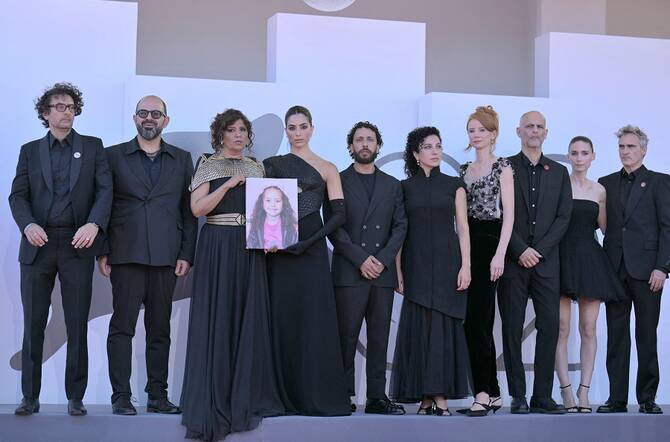
Franco-Tunisian director Kaouther Ben Hania and her cast, all dressed in black, are pictured ahead of the premiere. (AFP)
Short Url
Updated 04 September 2025
Follow

Gaza docu-drama on Hind Rajab gets record 23-minute ovation at Venice premiere

VENICE: A gut-wrenching new film about a five-year-old girl killed by Israeli forces in Gaza last year was given a record breaking 23-minute standing ovation after its premiere at the star-studded Venice Film Festival on Wednesday.

“The Voice of Hind Rajab”, a docu-drama about real events from January 2024, left much of the audience and many journalists sobbing as it screened for the first time.

Franco-Tunisian director Kaouther Ben Hania and her cast, all dressed in black, were also in tears as they soaked in applause, cheers and shouts of “Free Palestine! at the 1,032-seat main festival cinema.

“We see that the narrative all around world is that those dying in Gaza are collateral damage, in the media,” Ben Hania told journalists ahead of the premiere.

“And I think this is so dehumanising, and that's why cinema, art and every kind of expression is very important to give those people a voice and face.”

Her film tells the story of Hind Rajab Hamada who was fleeing the Israeli military in Gaza City with six relatives last year when their car came under fire.

The sole survivor, her desperate calls with the Red Crescent rescue service -- which were recorded and released -- brief caused international outrage.

“The Voice of Hind Rajab” has plenty of famous names attached as executive producers -- from actors Joaquin Phoenix, who attended the premiere, and Brad Pitt to Oscar-winning directors Jonathan Glazer (“The Zone of Interest”) and Mexico's Alfonso Cuaron (“Roma”).

“I'm very happy, and I never in my life thought that can be possible,” Ben Hania said of her A-list backers.

Its premiere came on the same day as a senior Israeli military official said one million Palestinians could be displaced by a new offensive around Gaza City.


Lebanese filmmaker turns archival footage into a love letter to Beirut

Updated 28 February 2026
Follow

Lebanese filmmaker turns archival footage into a love letter to Beirut

LONDON: Lebanese filmmaker Lana Daher’s debut feature “Do You Love Me” is a love letter of sorts to Beirut, composed entirely of archival material spanning seven decades across film, television, home videos and photography.

The film premiered at the 82nd Venice International Film Festival in September and has since traveled to several regional and international festivals.

Pink Smoke (2020) by Ben Hubbard. (Supplied)

With minimal dialogue, the film relies heavily on image and sound to reconstruct Lebanon’s fragmented history.

“By resisting voiceover and autobiography, I feel like I had to trust the image and the shared emotional landscape of these archives to carry the meaning,” Daher said.

A Suspended Life (Ghazal el-Banat) (1985) by Jocelyne Saab. (Supplied)

She explained that in a city like Beirut “where trauma is rarely private,” the socio-political context becomes the atmosphere of the film, with personal memory expanding into a collective experience — “a shared terrain of emotional history.”

Daher said: “By using the accumulated visual representations of Beirut, I was, in a way, rewriting my own representation of home through images that already existed."

Whispers (1980) by Maroun Bagdadi. (Supplied)

Daher, with editor Qutaiba Barhamji, steered clear of long sequences, preferring individual shots that allowed them to “reassemble meaning” while maintaining the integrity of their own work and respecting the original material, she explained.

The film does not feature a voice-over, an intentional decision that influenced the use of sound, music, and silence.

The Boombox (1995) by Fouad Elkoury. (Supplied)

“By resisting the urge to fill every space with dialogue or score, we created room for discomfort,” Daher said, adding that silence allows the audience to sit with the image and enter its emotional space rather than being guided too explicitly.

 The film was a labor of love, challenging Daher personally and professionally.

“When you draw from personal memory, you’re not just directing scenes, you’re revisiting parts of yourself and your childhood,” she said. “There’s vulnerability in that.”