

Suicide bombing at political rally kills 15 in Pakistan’s southwestern Balochistan province

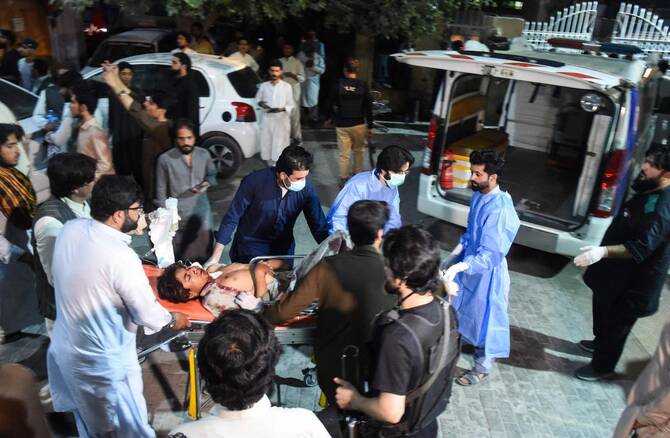
Medical personnel and volunteers push a stretcher with a victim injured by a suicide bombing at a hospital in Quetta on September 2, 2025. At least 22 people were killed in three attacks in Pakistan on September 2, 2025, officials said, including 11 who died after a suicide bomber targeted a political rally in the southwestern province of Balochistan. (Photo by Banaras KHAN / AFP)
Short Url
Updated 03 September 2025
Follow

Suicide bombing at political rally kills 15 in Pakistan’s southwestern Balochistan province

  • Blast targeted Balochistan National Party rally in Quetta, no group claims responsibility
  • BNP-M chief Akhtar Mengal announces three days of mourning after deadly attack

QUETTA, Pakistan: A suicide bombing ripped through a political rally in Pakistan’s restive southwestern province of Balochistan on Tuesday night, killing at least 15 people and injuring 32, a senior administration official said on Wednesday, in one of the deadliest attacks in recent months.

No group immediately claimed responsibility for the bombing, but Balochistan, Pakistan’s largest yet most impoverished province, has been grappling for decades with a separatist insurgency that has escalated in recent years. Militants frequently target security forces, officials and non-local residents they accuse of exploiting the province’s resources. The province is also of strategic importance for Beijing’s Belt and Road Initiative, with China investing heavily in ports, roads and energy projects.

Police said the blast was caused by a suicide bomber who detonated about 10 kilograms of explosives as supporters and senior leaders of the Balochistan National Party-Mengal (BNP-M) left a stadium after a rally to mark the fourth death anniversary of party founder Attaullah Mengal.

“The suicide attack occurred at 9:40 p.m. outside the Shahwani Stadium when people were coming out,” Hamza Shafqaat, Additional Chief Secretary Home, said during a news conference wherein he confirmed the latest toll.

“A total of 112 policemen were deployed to protect the venue of Balochistan National Party Mengal’s rally,” he continued. “The body of the suicide bomber was recovered from the crime scene. His age was less than 30, but his ethnicity is yet to be confirmed as investigations continue.”

Shafqaat added the provincial government had already imposed Section 144 in the province following the high-level threat alert until September 15.

“Despite the threat alert, the government allowed BNP-Mengal to hold a public rally and issued a no-objection certificate with 17 to 18 clauses, including maintaining time restrictions,” he continued.

Shafqaat said law enforcement agencies had shared 22 threat alerts with the Balochistan administration related to processions marking the birth anniversary of Prophet Muhammad (PBUH), which will be observed on Saturday.

“We are on high alert,” he added.

BNP-M, an ethnic Baloch nationalist party that campaigns for greater provincial autonomy and control over natural resources, is headed by former parliamentarian Sardar Akhtar Mengal and remains a key political force in Balochistan’s majority-Baloch districts.

Mengal said the explosion struck shortly after he escorted political allies out of the rally.

“After the rally, I was escorting our guests, including the opposition leader, Mehmood Khan Achakzai. As we left and moved a little ahead, the blast occurred,” Mengal told Arab News.

Mengal declared a three-day mourning period and a “black day” across Balochistan.

“The government didn’t inform us of any threat alert before the rally,” he said. “Further actions will be announced after discussions with our aligned political parties.”

Eyewitnesses described scenes of chaos.

“We looked back and saw flames rising up … several people were injured and some had already been martyred. We immediately picked up people and left for Civil Hospital,” Bilal Ahmed told Arab News.

Party member Agha Hassan Baloch said he and other leaders were just steps away when the bomber struck.

“We were approximately 15 to 20 feet away from the site of the explosion … it happened next to our party’s central leader Nawab Niyaz Zehri’s car, which was a suicide blast,” he said.

Provincial health officials said eight of the injured were in critical condition and had been shifted to the Combined Military Hospital.

“Teams are working around the clock to treat the wounded,” Dr. Waseem Baig, spokesperson for the provincial health department, said.


China foreign minister blasts Middle East war, urges US to manage ties

Updated 57 min 3 sec ago
Follow

China foreign minister blasts Middle East war, urges US to manage ties

  • Wang Yi: ‘A strong fist does not mean strong reason. The world cannot return to the law of the jungle’

BEIJING: China’s top diplomat condemned on Sunday the war in the Middle East and urged the United States to iron out its differences with Beijing.
Foreign Minister Wang Yi told a press conference in the Chinese capital that the war, which was sparked by US and Israeli strikes on Iran, “should never have happened.”
“A strong fist does not mean strong reason. The world cannot return to the law of the jungle,” he told reporters.
He was speaking during China’s annual political gathering, which began this week, known as the “Two Sessions.”
The parallel meetings of China’s parliament and political consultative body are closely watched for clues as to the priorities of top leaders, in the face of a precarious geopolitical landscape
Wang addressed a range of issues, including a trade war with the United States, regional tensions in the South China Sea, as well as wars in the Middle East and Ukraine.
“This year is indeed a big year for Sino-US relations,” Wang said.
‘Manage differences’
Ties between China and the United States have been strained since US President Donald Trump returned to the White House last year, followed by a trade war that saw the two countries impose tit-for-tat tariffs on each other’s products.
“We observe certain country erecting tariff barriers and pursuing decoupling and supply chain disruption,” Wang said on Sunday.
“These actions are akin to trying to extinguish a fire with fuel. Ultimately, they will backfire and harm itself.”
While China and the United States “cannot change each other,” he said, “we can change the way we interact with each other.”
Wang urged both sides to “create a suitable environment, manage existing differences, and eliminate unnecessary interference.”
But a wide range of disagreements remain.
Beijing has blasted US and Israeli military strikes on Iran, with which it has diplomatic and trade ties.
It has in particular condemned the killing of the country’s supreme leader Ayatollah Ali Khamenei.
Wang also maintained that China’s relations with Moscow, which have been criticized by Western countries for sustaining the war in Ukraine, remained “steadfast and unshakeable.”
China ‘gym’
China has sought to profit off Trump’s volatile foreign policies, positioning itself as a reliable alternative to once traditional US allies.
Leaders from France, Canada, Finland and the United Kingdom, among others, have flocked to Beijing, recoiling from Trump’s bid to seize Greenland and tariff threats against fellow NATO members.
Wang welcomed the visits on Sunday, saying “we have noticed that more and more insightful Europeans agree that China is not a competitor, but a global partner.”
“We welcome our European friends to step out of the ‘small attic’ of protectionism and come to the ‘gym’ of the Chinese market, where they can strengthen their muscles and enhance their competitiveness,” he said.
In the spirit of warming relations, China has doled out visa-free travel agreements to around 50 countries including France, Germany, and the United Kingdom.
Beijing has also agreed to reduced tariffs with Ottawa and London in their exports to China.
Wang also addressed relations between China and Japan, which have been locked in a spat after comments by Prime Minister Sanae Takaichi in November that Tokyo could intervene militarily in any attack on self-ruled Taiwan.
Takaichi’s comments enraged Beijing, which views Taiwan as its territory and has not ruled out taking by force.
Wang emphasized on Sunday that Beijing “will never allow anyone or any force to separate Taiwan … from China once again.”
He warned Japan against “repeating the same disastrous mistakes,” adding that China “will never allow anyone to stand up for colonialism,” in an apparent reference to Tokyo’s actions during World War II.
The issue of Taiwan, he insisted, is “at the heart of China’s core interests” and “a red line that must not be crossed or trampled on.”