

Rising Chenab levels, India dam releases deepen Pakistan’s flood emergency

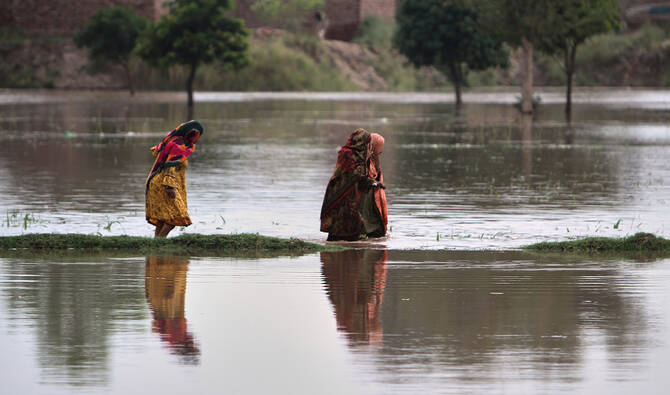
Rescue workers evacuate villagers from a flooded area in Muza Islam Wala in Jhang district of Pakista, on Sept. 2, 2025. (AP)
Short Url
Updated 03 September 2025
Follow

Rising Chenab levels, India dam releases deepen Pakistan’s flood emergency

  • Over 2.4 million people already affected in Punjab, 41 dead in rains, floods in last ten days
  • Tens of thousands remain without electricity as power utilities struggle to restore supply

ISLAMABAD: Pakistan warned on Wednesday of fresh flooding risks in Punjab after India conveyed a “high flood” alert for the Sutlej and Tawi rivers, even as rising waters on the Chenab threatened downstream districts where millions are already reeling from monsoon devastation.

Punjab, Pakistan’s most populous province and its agricultural heartland, has been under a flood emergency for more than a week, with at least 41 people killed and more than 2.4 million affected in the last 10 days, according to the Provincial Disaster Management Authority (PDMA). 

Nationwide, rains, floods and landslides have killed 881 people since June 26, reviving memories of the catastrophic 2022 deluges when a third of the country was submerged, more than 1,700 people died, 30 million were displaced and economic losses topped $35 billion.

With fresh inflows working through Punjab’s waterways, authorities have warned riverside settlements in districts of Kasur, Okara, Vehari, Bahawalnagar, Gujrat, Sialkot and Jhang to prepare for possible evacuations in the coming days.

“The High Commission of India to Pakistan has conveyed the following information … Flood Data: High Flood, Sutlej (Harike below, Ferozepur below) and Tawi, Jammu, at 0800 hrs on 3rd September 2025,” Pakistan’s Office of the Commissioner for Indus Waters said in a statement.

The PDMA said the Indian intimation meant “Sutlej, Harike and Ferozepur below, and Tawi, Jammu is at high flood level … which will affect the water levels in downstream respective districts.”

Much of the flooding crisis in Pakistan is driven by unusually heavy monsoon rains, but water levels also surge when India releases excess flows from its upstream dams and barrages once reservoirs fill to capacity. 

Under the 1960 Indus Waters Treaty, India retains control of the eastern rivers — Ravi, Beas and Sutlej — but is obliged to notify Pakistan of releases that could cause flooding downstream, a process meant to prevent sudden inundations.

RISING RIVER FLOWS

According to the PDMA’s latest update, water levels were continuing to rise along the Chenab River, with flows at Marala Headworks crossing 468,000 cusecs, Khanki at 367,000 and Qadirabad at 253,000. 

Levels on the Ravi were also climbing at Jassar, Ravi Siphon and Shahdara, while the Sutlej was steady but carrying more than 269,000 cusecs at G.S. Wala.

PDMA chief Irfan Ali Kathia said the civil administration, army and line departments had been placed on alert, pledging that citizens’ lives and property would be protected.

Authorities have directed district administrations to strengthen embankments, pre-place heavy machinery at choke points, and stockpile food, medicines and drinking water in flood-prone areas. Evacuation teams and Rescue 1122 units have been pre-deployed.

POWER DISRUPTIONS

Floodwaters have also battered electricity distribution networks across multiple regions. A federal Power Division report said tens of thousands of households in districts such as Jhang and Toba Tek Singh remained without power as of Wednesday, while Chiniot and Faisalabad had restored service to more than 90 percent of affected consumers.

In Jhang, only about 5 percent of over 81,000 impacted customers had electricity back, while in Chiniot nearly 95 percent of 72,000 affected consumers had been reconnected. The ministry said most repairs were targeted for completion between Sept. 4 and 5, subject to floodwaters receding.

“Restoration of electricity in affected areas is the top priority,” the Power Division said.

Monsoon rains, which provide 70–80 percent of South Asia’s annual precipitation between June and September, are crucial for farming but increasingly unpredictable due to climate change.


Pakistan opposition rallies in Khyber Pakhtunkhwa to demand release of Imran Khan

Updated 07 December 2025
Follow

Pakistan opposition rallies in Khyber Pakhtunkhwa to demand release of Imran Khan

  • PTI-led gathering calls the former PM a national hero and demands the release of all political prisoners
  • Government says the opposition failed to draw a large crowd and accuses PTI of damaging its own politics

ISLAMABAD: Pakistan’s opposition led by the Pakistan Tehreek-e-Insaf (PTI) party demanded the release of jailed former prime minister Imran Khan at a rally in the northwestern Khyber Pakhtunkhwa province on Sunday, describing him as a national hero who continues to command public support.

The gathering came days after a rare and strongly worded briefing by the military’s media chief, Lt. Gen. Ahmed Sharif Chaudhry, who dismissed Khan as “narcissistic” and “mentally ill” on Friday while responding to the former premier’s allegations that Pakistan’s chief of defense forces was responsible for undermining the constitution and rule of law.

He said that Khan was promoting an anti-state narrative which had become a national security threat.

The participants of the rally called for “civilian supremacy” and said elected representatives should be treated with respect.

“We, the people of Pakistan, regard Imran Khan as a national hero and the country’s genuinely elected prime minister, chosen by the public in the February 8, 2024 vote,” said a resolution presented at the rally in Peshawar. “We categorically reject and strongly condemn the notion that he or his colleagues pose any kind of threat to national security.”

“We demand immediate justice for Imran Khan, Bushra Bibi and all political prisoners, and call for their prompt release,” it added, referring to Khan’s wife who is also in prison. “No restrictions should be placed on Imran Khan’s meetings with his family, lawyers or political associates.”

Addressing the gathering, Sohail Afridi, the chief minister of Khyber Pakhtunkhwa, denied his administration was not serious about security issues amid increased militant activity. However, he maintained the people of his province had endured the worst of Pakistan’s conflict with militancy and urged a rethinking of long-running security policies.

The resolution asked the federal government to restore bilateral trade and diplomatic channels with Afghanistan, saying improved cross-border ties were essential for the economic stability of the region.

The trade between the two neighbors has suffered as Pakistan accuses the Taliban administration in Kabul of sheltering and facilitating armed groups that it says launch cross-border attacks to target its civilians and security forces. Afghan officials deny the claim.

The two countries have also had deadly border clashes in recent months that have killed dozens of people on both sides.

Some participants of the rally emphasized the restoration of democratic freedoms, judicial independence and space for political reconciliation, calling them necessary to stabilize the country after years of political confrontation.

Reacting to the opposition rally, Information Minister Attaullah Tarrar said the PTI and its allies could not gather enough people.

“In trying to build an anti-army narrative, they have ruined their own politics,” he said, adding that the rally’s reaction to the military’s media chief’s statement reflected “how deeply it had stung.”

“There was neither any argument nor any real response,” he added, referring to what was said by the participants of the rally.