

India warns Pakistan of more cross-border flooding as monsoon death toll tops 880

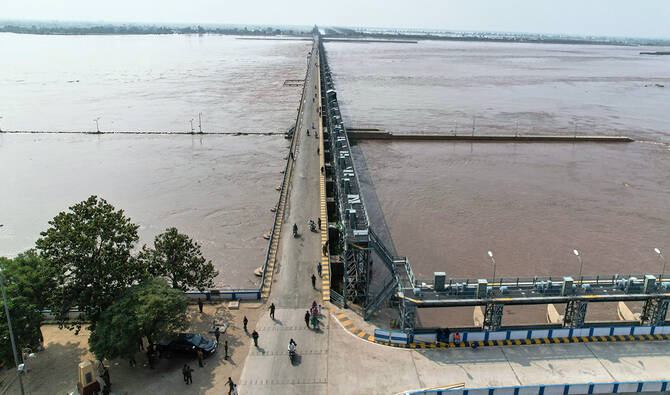
Motorcyclists drive through Trimmu Barrage on the River Chenab, which overflowed after torrential rains and water releases from Indian dams, in Jhang district, Pakistan, on September 1, 2025. (AP)
Short Url
Updated 02 September 2025
Follow

India warns Pakistan of more cross-border flooding as monsoon death toll tops 880

  • Pakistan is facing a flood emergency, with more than 2.4 million affected in Punjab province in the last 10 days
  • The latest warning concerns a surge in the Sutlej River, with floodwaters expected to enter Pakistan on Wednesday

ISLAMABAD: India has warned Pakistan about possible cross-border flooding for the second time in as many weeks, Pakistani disaster management authorities announced on Tuesday, as the nationwide monsoon death toll surged past 880.

Pakistan has been facing a flood emergency, with at least 41 people killed and more than 2.4 million affected in its breadbasket province of Punjab over the last 10 days, according to the Provincial Disaster Management Authority (PDMA).

Nationwide, rains, floods, landslides and similar incidents have killed 881 people since June 26, reviving memories of the catastrophic 2022 deluges when a third of Pakistan was submerged, more than 1,700 people were killed, 30 million displaced and damages topped $35 billion.

An Indian government official told AP news agency that New Delhi shared the warning with Pakistan on ‘humanitarian grounds’ through its high commission in Islamabad as Pakistan’s national disaster management authority (NDMA) warned of further rains in flood-hit Punjab.

“These rains may increase problems in flood-affected areas in Punjab,” the NDMA said on Tuesday evening. “Stay away from rivers, streams and drains. Residents of low-lying areas should take precautionary measures. Follow the instructions of the administration.”

Widespread heavy rains are expected in Punjab, including Sialkot, Narowal, Lahore, Sheikhupura, Gujrat, Gujranwala, Hafizabad, Chiniot, Faisalabad, Sargodha and adjoining areas in the next 12 to 24 hours, according to the authority.

Intermittent rain is also likely in Islamabad, Rawalpindi, Jhelum, Chakwal, Attock and Multan, Khanewal, Bahawalnagar, Bahawalpur, Rahim Yar Khan, DG Khan, Rajanpur and adjoining areas during the same period.

Punjab’s Disaster Management Authority said the Indian high commission conveyed the warning to Pakistan through the Ministry of Water Resources rather than the water-sharing Indus Waters Treaty, which India has said remains suspended, according to the AP report.

The latest warning concerns a surge in the Sutlej River, with floodwaters expected to enter Pakistan on Wednesday. Raging torrents already have devastated border communities in Kasur, Okara, Vehari and Bahawalnagar.

Monsoon season brings South Asia 70 to 80 percent of its annual rainfall, arriving in early June in India and late June in Pakistan, and lasting through until September. The annual rains are vital for agriculture and food security, and the livelihoods of millions of farmers. But increasingly erratic and extreme weather patterns are turning the rains into a destructive force.

The NDMA said on Tuesday evening that the flow of 885,000 cusecs in Chenab has been reduced to 550,000 cusecs after authorities breached the river bank at two locations.

“Since there is a capacity of only 650,000 cusecs to pass through the Panjnad headworks, there will be no need to breach the dyke at any other place,” it said.

“This stream from Panjnad is likely to reach Guddu Barrage by the afternoon of September 6, where the total flow is expected to be 450,000 to 500,000 cusecs.”

Punjab PDMA Director General Irfan Ali Kathia earlier said a flood wave from the Chenab would reach Multan in southern Punjab via the Trimmu headworks by Tuesday night.

“The situation in Multan could become critical,” Kathia said in a statement. “The total number of villages affected so far [in Punjab] is 3,243 and approximately, 2.4 million population have been affected in some form or the other.”

Over one million people had been rescued with both government and private agencies participating in operations, Kathia added. 


Pakistan, global crypto exchange discuss modernizing digital payments, creating job prospects 

Updated 05 December 2025
Follow

Pakistan, global crypto exchange discuss modernizing digital payments, creating job prospects 

  • Pakistani officials, Binance team discuss coordination between Islamabad, local banks and global exchanges
  • Pakistan has attempted to tap into growing crypto market to curb illicit transactions, improve oversight

ISLAMABAD: Pakistan’s finance officials and the team of a global cryptocurrency exchange on Friday held discussions aimed at modernizing the country’s digital payments system and building local talent pipelines to meet rising demand for blockchain and Web3 skills, the finance ministry said.

The development took place during a high-level meeting between Finance Minister Muhammad Aurangzeb, Pakistan Virtual Assets Regulatory Authority (PVARA) Chairman Bilal bin Saqib, domestic bank presidents and a Binance team led by Global CEO Richard Teng. The meeting was held to advance work on Pakistan’s National Digital Asset Framework, a regulatory setup to govern Pakistan’s digital assets.

Pakistan has been moving to regulate its fast-growing crypto and digital assets market by bringing virtual asset service providers (VASPs) under a formal licensing regime. Officials say the push is aimed at curbing illicit transactions, improving oversight, and encouraging innovation in blockchain-based financial services.

“Participants reviewed opportunities to modernize Pakistan’s digital payments landscape, noting that blockchain-based systems could significantly reduce costs from the country’s $38 billion annual remittance flows,” the finance ministry said in a statement. 

“Discussions also emphasized building local talent pipelines to meet rising global demand for blockchain and Web3 skills, creating high-value employment prospects for Pakistani youth.”

Blockchain is a type of digital database that is shared, transparent and tamper-resistant. Instead of being stored on one computer, the data is kept on a distributed network of computers, making it very hard to alter or hack.

Web3 refers to the next generation of the Internet built using blockchain, focusing on giving users more control over their data, identity and digital assets rather than big tech companies controlling it.

Participants of the meeting also discussed sovereign debt tokenization, which is the process of converting a country’s debt such as government bonds, into digital tokens on a blockchain, the ministry said. 

Aurangzeb called for close coordination between the government, domestic banks and global exchanges to modernize Pakistan’s payment landscape.

Participants of the meeting also discussed considering a “time-bound amnesty” to encourage users to move assets onto regulated platforms, stressing the need for stronger verifications and a risk-mitigation system.

Pakistan has attempted in recent months to tap into the country’s growing crypto market, crack down on money laundering and terror financing, and promote responsible innovation — a move analysts say could bring an estimated $25 billion in virtual assets into the tax net.

In September, Islamabad invited international crypto exchanges and other VASPs to apply for licenses to operate in the country, a step aimed at formalizing and regulating its fast-growing digital market.