

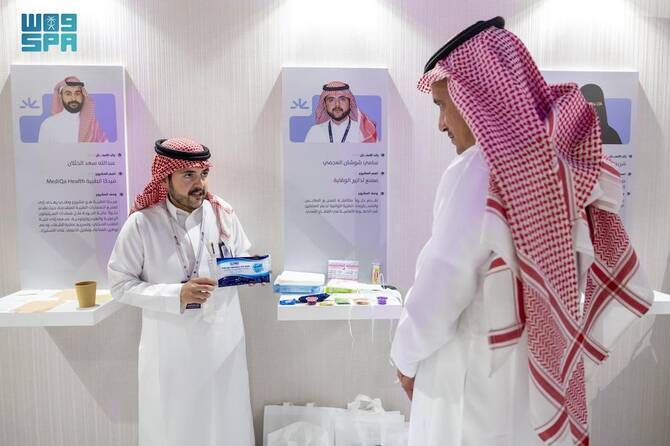
Program launched to boost entrepreneurial growth in Kingdom

The launch took place during the closing ceremony of the third edition, attended by entrepreneurs, representatives of supporting entities, and participants’ families. (SPA)
Short Url
Updated 31 August 2025
Follow

Program launched to boost entrepreneurial growth in Kingdom

  • With financial awards, industrial land, consulting support for previous winners, the program equips projects to scale, compete

RIYADH: Minister of Industry and Mineral Resources Bandar Alkhorayef launched the fourth 1K Mile Program in Riyadh, the Saudi Press Agency reported on Sunday.

The launch took place during the closing ceremony of the third edition, attended by entrepreneurs, representatives of supporting entities, and participants’ families.

Minister of Transport and Logistic Services Saleh Al-Jasser, Minister of Communications and Information Technology Abdullah Al-Swaha and Minister of Education Yousef Al-Benyan also attended.

Alkhorayef, who is also chairman of the National Industrial Development and Logistics Program, said the 1K Mile Program has evolved from an initiative supporting entrepreneurs into a key pillar of the Kingdom’s industrial and entrepreneurial transformation.

He said that the fourth edition reflects the successes of previous editions and the inspiring stories they produced, the SPA added.

Alkhorayef said the program empowers entrepreneurs by helping them develop realistic, sustainable business plans while providing support throughout their projects, ensuring growth, expansion, and readiness to compete.

He emphasized that the program has redefined industrial investment, showing that industry is no longer limited to large enterprises but open to ambitious, innovative young people.

He also highlighted its role in promoting advanced manufacturing and encouraging investment in modern technologies, according to the SPA.

There were 8,001 entrepreneurs registered for the third edition, with 147 projects nominated for aligning with Vision 2030 goals.

The Saudi Investment Bank, the ceremony’s official sponsor, presented financial awards to 20 pioneering projects in the industrial, mining, and logistics sectors.

First-place winners received SR500,000 ($133,000), while second-place winners in each sector received SR250,000.

Program winners also receive an official document offering unique benefits, including financing, industrial land, ready-made factories, and consulting services, designed to support the sustainability and growth of their projects.


Najran farmers find sugarcane cultivation viable, promising lucrative economic returns

Updated 07 December 2025
Follow

Najran farmers find sugarcane cultivation viable, promising lucrative economic returns

  • Najran's mountainous parts are blessed with temperate climate and abundant water resources, suitable for sugarcane production

NAJRAN: Farmers in Saudi Arabia's southwestern region of Najran have found that sugarcane production is a viable enterprise, the Saudi Press Agency (SPA) has reported.

One farmer, Ibrahim Shakwan, confirmed to SPA the success of his 7.3-hectare sugarcane farm and noted "growing regional interest due to its high productivity and lucrative economic returns."

Najran was chosen as a trial area for sugarcane production owing to the temperate climate, diverse soils, and abundant water resources in its mountainous parts. The experiment is in line with Saudi Vision 2030, which calls for enhancing food security and self-sufficiency.

Others regions in the Kingdom's southwest, such as Jazan, Asir and Baha, have similar features as Najran. 

Sugarcane is easily propagated via cuttings that yield a high number of plantable pieces. (SPA)

Sugarcane is easily propagated via cuttings that yield a high number of plantable pieces. Planting occurs primarily in the summer, although seedlings can be planted year-round. 

Effective cultivation methods include selecting disease-resistant varieties, proper soil preparation, and balanced irrigation and fertilization, according to the report.

The crop is harvested approximately eight months after planting, with fertilization ending three months before and irrigation ceasing 20 days prior to harvest to boost sugar concentration and improve juice quality, which is rich in natural sugars, vitamins, and minerals.

Several countries in the Middle East have long been growing sugarcane, with Egypt and Iran as key producers. 

Botanists believe sugarcane was first cultivated 10,000 years ago in what is now New Guinea in the southwest Pacific Ocean, where the environment is humid, according to an article titled Sugar Please, published in the Aramcoworld magazine in 2012.