

Film AlUla hosts reception for ‘Hijra’ cast at Venice Film Festival

Short Url
Updated 31 August 2025
Follow

Film AlUla hosts reception for ‘Hijra’ cast at Venice Film Festival

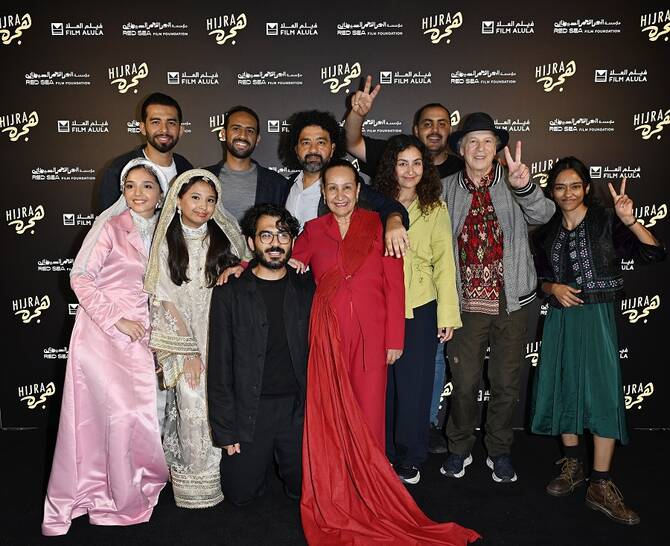
DUBAI: The cast and crew of the Saudi film “Hijra” have attended a reception hosted by Film AlUla at the Venice Film Festival.

The reception took place after the premiere screening of “Hijra,” with guests invited to the St. Regis Venice after the credits rolled.

Saudi director Shahad Ameen was on hand at the event, alongside stars Khairia Nazmi and Lamar Faden.

The film follows a grandmother (Nazmi) and her granddaughter (Faden) as they journey across northern Saudi Arabia to find a missing teenage girl.

Shot over about 55 days in eight Saudi cities — Taif, Jeddah, Madinah, Wadi Al-Faraa, AlUla, Tabuk, Neom, and Duba — the story unfolds against the backdrop of Hajj.

Saudi Arabia’s Red Sea Film Foundation has returned to the 82nd edition of the world’s longest running film festival to present a strong lineup of films and industry initiatives to reinforce its commitment to nurturing emerging talent from Saudi Arabia, the Arab world, Africa and Asia.

“Hijra” is among the highlights, while Lebanese filmmaker Cyril Aris’ “A Sad and Beautiful World” — a drama developed with the support of the Red Sea Labs, Red Sea Fund and Red Sea Souk — is also being featured.

Algerian director Yanis Koussim’s “Roqia” and Sudanese filmmaker Suzannah Mirghani’s “Cotton Queen” are both being screened in the Venice Critics’ Week section, offering urgent narratives that reflect the complexity of contemporary Arab identity. Completing the lineup is Damien Hauser’s “Memory of Princess Mumbi.”


Lebanese filmmaker turns archival footage into a love letter to Beirut

Updated 28 February 2026
Follow

Lebanese filmmaker turns archival footage into a love letter to Beirut

LONDON: Lebanese filmmaker Lana Daher’s debut feature “Do You Love Me” is a love letter of sorts to Beirut, composed entirely of archival material spanning seven decades across film, television, home videos and photography.

The film premiered at the 82nd Venice International Film Festival in September and has since traveled to several regional and international festivals.

Pink Smoke (2020) by Ben Hubbard. (Supplied)

With minimal dialogue, the film relies heavily on image and sound to reconstruct Lebanon’s fragmented history.

“By resisting voiceover and autobiography, I feel like I had to trust the image and the shared emotional landscape of these archives to carry the meaning,” Daher said.

A Suspended Life (Ghazal el-Banat) (1985) by Jocelyne Saab. (Supplied)

She explained that in a city like Beirut “where trauma is rarely private,” the socio-political context becomes the atmosphere of the film, with personal memory expanding into a collective experience — “a shared terrain of emotional history.”

Daher said: “By using the accumulated visual representations of Beirut, I was, in a way, rewriting my own representation of home through images that already existed."

Whispers (1980) by Maroun Bagdadi. (Supplied)

Daher, with editor Qutaiba Barhamji, steered clear of long sequences, preferring individual shots that allowed them to “reassemble meaning” while maintaining the integrity of their own work and respecting the original material, she explained.

The film does not feature a voice-over, an intentional decision that influenced the use of sound, music, and silence.

The Boombox (1995) by Fouad Elkoury. (Supplied)

“By resisting the urge to fill every space with dialogue or score, we created room for discomfort,” Daher said, adding that silence allows the audience to sit with the image and enter its emotional space rather than being guided too explicitly.

 The film was a labor of love, challenging Daher personally and professionally.

“When you draw from personal memory, you’re not just directing scenes, you’re revisiting parts of yourself and your childhood,” she said. “There’s vulnerability in that.”