

UN Security Council renews Lebanon peacekeeping mission ‘for a final time’

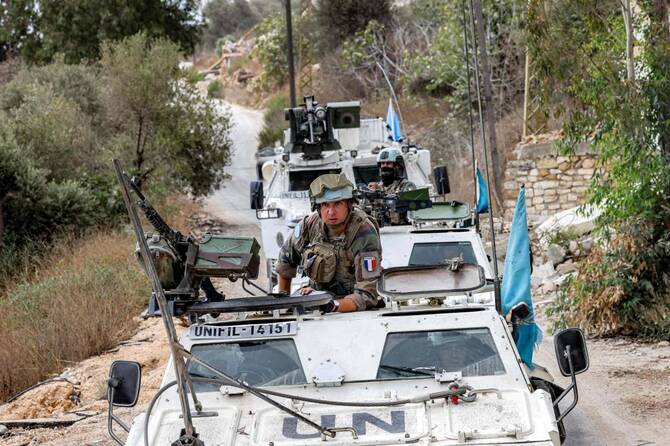
UNIFIL armored vehicles at a position formerly held by Hezbollah in the Khraibeh Valley in southern Lebanon. (AFP)
Short Url
Updated 29 August 2025
Follow

UN Security Council renews Lebanon peacekeeping mission ‘for a final time’

  • Peacekeeping operation in Lebanon extended until the end of 2026, and will then begin a year-long ‘orderly and safe drawdown and withdrawal’
  • The 15-member council unanimously adopted a French-drafted resolution after a compromise was reached with the US, a veto-wielding council member

UNITED NATIONS: The United Nations Security Council on Thursday unanimously extended “for a final time” a long-running peacekeeping mission in Lebanon until the end of 2026, when the operation will then begin a year-long “orderly and safe drawdown and withdrawal.”

The UN Interim Force in Lebanon (UNIFIL), established in 1978, patrols Lebanon’s southern border with Israel.

The 15-member council unanimously adopted a French-drafted resolution after a compromise was reached with the United States, a veto-wielding council member. The Security Council decided “to extend for a final time the mandate of UNIFIL.”

The resolution “requests UNIFIL to cease its operations on 31 December 2026 and to start from this date and within one year its orderly and safe drawdown and withdrawal of its personnel, in close consultation with the Government of Lebanon with the aim of making Lebanon Government the sole provider of security in southern Lebanon.” This will be the last time the United States will support an extension of UNIFIL, said acting US Ambassador to the UN Dorothy Shea.

“The security environment in Lebanon is radically different than just one year ago, creating the space for Lebanon to assume greater responsibility,” she told the council. UNIFIL’s mandate was expanded in 2006, following a month-long war between Israel and Hezbollah, to allow peacekeepers to help the Lebanese army keep parts of the south free of weapons or armed personnel other than those of the Lebanese state.

That has sparked friction with Hezbollah, which effectively controls southern Lebanon despite the presence of the Lebanese army. Hezbollah is a heavily armed party that is Lebanon’s most powerful political force.

“Decades since UNIFIL’s mandate was extended, it is time to dispel the illusion. UNIFIL has failed in its mission and allowed Hezbollah to become a dangerous regional threat,” Israel’s UN Ambassador Danny Danon said after the vote. The United States brokered a truce in November between Lebanon and Israel following more than a year of conflict sparked by the war in Gaza.

The US is now seeking to promote a plan for Hezbollah’s disarmament. Washington is linking the plan to a phased Israeli withdrawal from southern Lebanon, while also promoting a US- and Gulf-backed economic development zone in Lebanon’s south aimed at reducing Hezbollah’s reliance on Iranian funding.

Lebanon’s Prime Minister Nawaf Salam welcomed the extension, noting that it “reiterates the call for Israel to withdraw its forces from the five sites it continues to occupy, and affirms the necessity of extending state authority over all its territory.”


Iraq election result ratified by Supreme Federal Court

Updated 11 sec ago
Follow

Iraq election result ratified by Supreme Federal Court

  • The Independent High Electoral Commission submitted the final results of the legislative elections to the Supreme Federal Court on Monday for official certification after resolving 853 complaints submitted regarding the election results

BAGHDAD: The result of last month’s parliamentary elections in Iraq was ratified by the Supreme Federal Court on Sunday, confirming that the party of caretaker Prime Minister Mohammed Shia Al-Sudani won the largest number of seats — but not enough to assure him a second term.
The court confirmed that the voting process met all constitutional and legal requirements and contained no irregularities that would affect its validity.
The Independent High Electoral Commission submitted the final results of the legislative elections to the Supreme Federal Court on Monday for official certification after resolving 853 complaints submitted regarding the election results.

FASTFACT

Prime Minister Mohammed Shia Al-Sudani’s Reconstruction and Development Coalition won 46 seats in the 329-seat parliament.

Al-Sudani’s Reconstruction and Development Coalition won 46 seats in the 329-seat parliament. 
However, in past elections in Iraq, the bloc that won the most seats has often been unable to impose its preferred candidate.
The coalition led by former Prime Minister Nouri Al-Maliki won 29 seats, the Sadiqoun Bloc, which is led by the leader of the Asaib Ahl Al-Haq militia, Qais Al-Khazali, won 28 seats, and the Kurdistan Democratic Party, led by Masoud Barzani, one of the two main Kurdish parties in the country, won 27 seats.
The Taqaddum (Progress) party of ousted former Parliament Speaker Mohammed Al-Halbousi also won 27 seats, setting the stage for a contest over the speaker’s role.
Overall, Shiite alliances and lists secured 187 seats, Sunni groups 77 seats, Kurdish groups 56 seats, and nine seats reserved for minority groups.
Al-Sudani came to power in 2022 with the backing of the Coordination Framework, a coalition of Iran-backed Shiite parties, but it is unclear whether the alliance will support him again.
With no single bloc able to form a government alone, political leaders have launched negotiations to build a ruling coalition.